
Description
KLOW Peptide Blend at a glance
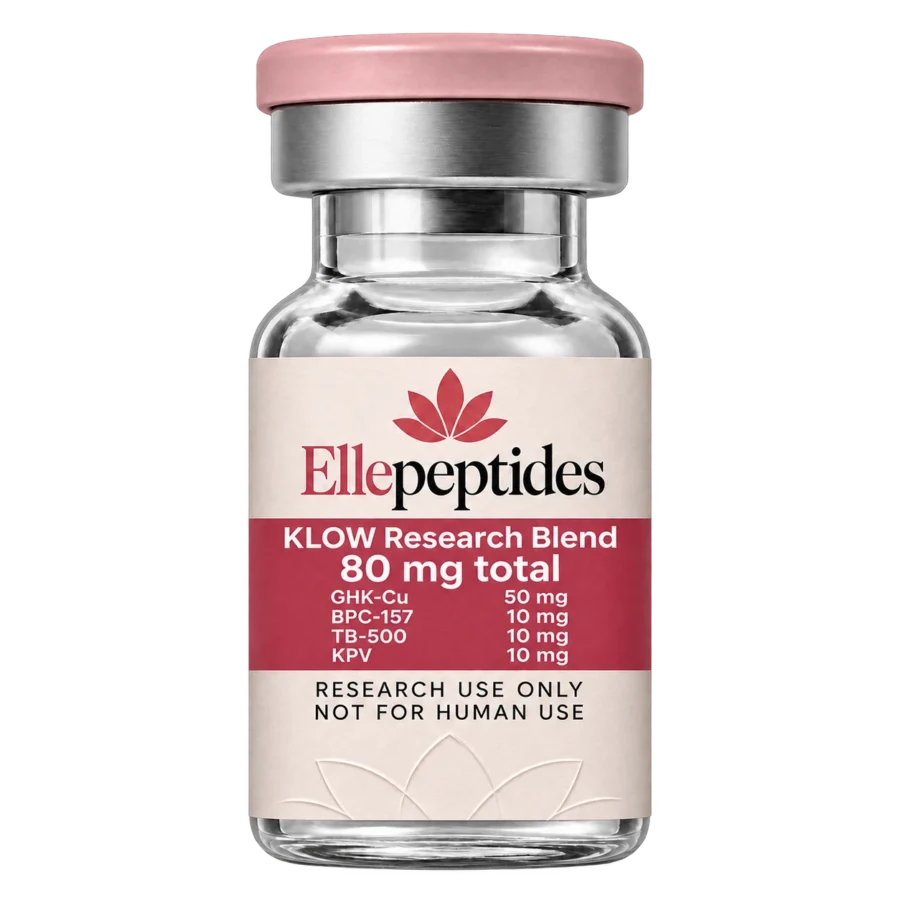
KLOW is a four-component research blend: one freeze-dried vial lists 50 mg GHK-Cu, 10 mg BPC-157, 10 mg TB-500 and 10 mg KPV, for 80 mg in total. Each ingredient has its own cell, animal or small human literature, but no published trial has tested the KLOW mixture itself.
- Type of material: fixed blend of a copper–peptide complex and three peptides
- Vial size: 80 mg combined (50 + 10 + 10 + 10 mg)
- Listed price: from $174.38 USD
- Form: lyophilized (freeze-dried) powder
- Shipping: within the US; free shipping over $200
- Scope: for laboratory research only
KLOW vial sizes and price per mg
| Vial size | Listed price (USD) | Price per mg |
|---|---|---|
| 80 mg (GHK-Cu 50 mg + BPC-157 10 mg + TB-500 10 mg + KPV 10 mg) | $174.38 | $2.18 |
Prices are listed in USD at the time of writing and the size selector shows the current price; bulk or combination savings via cart or coupon are not promised. For reference, GLOW lists 70 mg at $150.00 ($2.14 per mg) and KPV alone is $60.00 for 10 mg.
KLOW compound profile
| Catalog name | KLOW Research Blend (80 mg) |
|---|---|
| Nominal amount per vial | 80 mg combined |
| Declared components | GHK-Cu 50 mg + BPC-157 10 mg + TB-500 10 mg + KPV 10 mg |
| Share of vial mass | GHK-Cu 62.5%; BPC-157, TB-500 and KPV 12.5% each |
| GHK-Cu reference | Copper(II) complex of Gly-His-Lys (PubChem CID 71587328) |
| BPC-157 reference | 15 residues, GEPPPGKPADDAGLV (PubChem CID 9941957) |
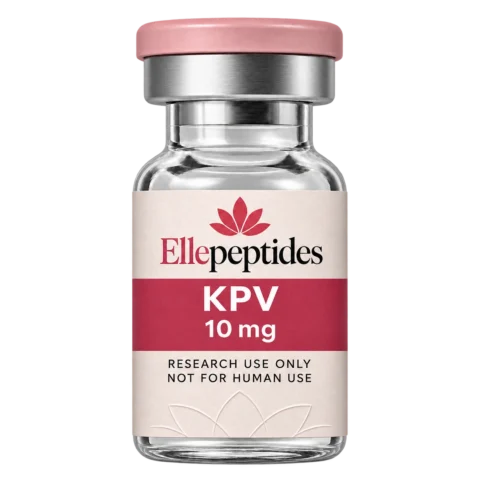
| KPV reference | Lys-Pro-Val, C-terminal tripeptide of alpha-MSH (PubChem CID 125672) |
| TB-500 reference | Name tied to thymosin beta-4 research; exact form must be verified |
| Mixture identity | No single sequence, CAS number, formula or molar mass applies |
| Intended scope | Laboratory research |
The table gives the declared composition and each name’s reference molecule, not the measured content of any vial. Note the TB-500 row: one analysis found a short fragment, not the full protein, in a product sold under that name (Esposito et al., 2012).
How KLOW works in research
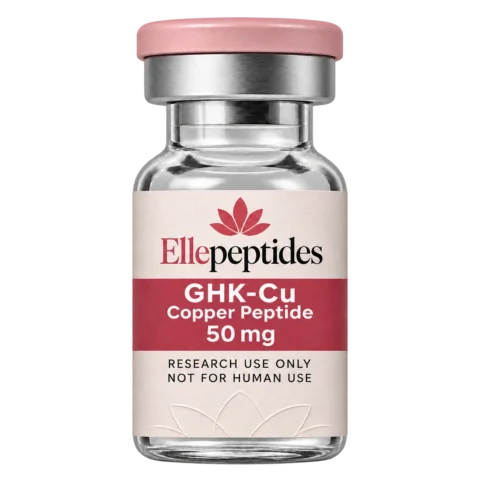
No study has examined KLOW’s mechanism as a mixture, so this goes component by component. GHK-Cu is the copper(II) complex of the tripeptide glycine–histidine–lysine. In fibroblast cultures it increased collagen synthesis (Maquart et al., 1988), and later work linked it to the matrix enzyme MMP-2 and its inhibitors TIMP-1 and TIMP-2 (Simeon et al., 2000).
BPC-157 is a 15-residue peptide. In rat tendon cells it increased cell migration and survival under oxidative stress, with FAK–paxillin signaling implicated, while proliferation did not rise directly (Chang et al., 2011). Full-length thymosin beta-4, the protein behind the TB-500 name, sped re-epithelialization and collagen deposition in rat skin wounds (Malinda et al., 1999).
KPV is what separates KLOW from GLOW. The PepT1 transporter carries this tripeptide into intestinal epithelial and immune cells, where it reduced NF-κB and MAPK inflammatory signaling; mouse colitis models showed lower inflammation indices (Dalmasso et al., 2008). Whether the four interact, add up or interfere in one vial is untested.
Key KLOW component studies
| Year | Study & model | What was measured | Main finding | Source |
|---|---|---|---|---|
| 2008 | Dalmasso et al. — gut and immune cells; mouse colitis (KPV) | PepT1 uptake, inflammatory signaling | PepT1 carried KPV; inflammation markers fell | PubMed |
| 2011 | Chang et al. — rat tendon cells (BPC-157) | Migration, survival | More migration and survival; FAK–paxillin activated | PubMed |
| 2012 | Esposito et al. — product sold as TB-500 | Molecular identity | A seven-residue thymosin beta-4 fragment | PubMed |
| 2016 | Badenhorst et al. — 40 women, split-face, 8 weeks (GHK-Cu serum) | Wrinkle volume, depth | Volume fell 55.8% more than vehicle | Open-access PDF |
| 2025 | Vasireddi et al. — review of 36 BPC-157 studies | Evidence base | 35 preclinical, 1 clinical; human safety unknown | PMC |
| 2026 | Biçer et al. — 32 male rats, repaired Achilles (BPC-157, TB-500, both) | Load to failure, histology | TB-500 alone significant; no added benefit from the pair | Journal abstract |
No study tested KLOW. We found no published animal or human study of the four-component mixture; every row concerns one ingredient, another formulation or a two-peptide pair.
In the closest combination test, Biçer et al., TB-500 alone significantly improved tendon load to failure over four weeks, while BPC-157 + TB-500 did not outperform either peptide; the authors called this an absence of additive effects. The only controlled human data belong to GHK-Cu, in a formulated serum rather than a powder.
KLOW research involving women
No KLOW study in women has been published; two components have women-specific data, each in another form:
- GHK-Cu: 40 women aged 40–65 (39 analyzed) in a randomized, double-blind, split-face trial of a nano-carrier GHK-Cu serum. Wrinkle volume fell 55.8% more than with vehicle and 31.6% more than with a Matrixyl 3000 product; one participant had minor, resolving skin reactions (Badenhorst et al., 2016).
- BPC-157: 12 women aged 39–76 with interstitial cystitis in an uncontrolled single-clinic report; ten self-reported complete symptom resolution and two 80% improvement (Lee, Walker and Ayadi, 2024).
- TB-500 and KPV: no women-specific outcomes identified.
Our women focus is brand identity, not evidence that KLOW does anything in women; a serum trial and a chart review cannot add up to a result for this powder. See also peptides for women.
KLOW vs GLOW and related blends
| Material | Components per vial | Total | Main research focus (components) | Sizes on Ellepeptides |
|---|---|---|---|---|
| KLOW (this page) | GHK-Cu 50 mg, BPC-157 10 mg, TB-500 10 mg, KPV 10 mg | 80 mg | GLOW’s areas plus PepT1 and inflammatory signaling | 80 mg vial |
| GLOW | GHK-Cu 50 mg, BPC-157 10 mg, TB-500 10 mg | 70 mg | Matrix remodelling, tendon-cell migration, wound models | 70 mg vial |
| BPC-157 + TB-500 Blend | BPC-157 5 mg, TB-500 5 mg | 10 mg | Tendon and wound models | 10 mg vial |
| KPV | KPV 10 mg | 10 mg | PepT1 transport, intestinal inflammation models | 10 mg vial |
KLOW and GLOW differ only by the 10 mg of KPV, which adds $24.38 at listed prices. A fixed blend cannot vary one component, so studies isolating an ingredient use single materials such as GHK-Cu, BPC-157 or TB-500.
Handling, storage and reconstitution math
Lyophilized peptides are generally kept sealed, dry and away from light and heat, but the storage conditions on the label are the ones to follow. Letting a vial reach room temperature before opening limits condensation.
Concentration is vial mass ÷ solvent volume, applied to each component of a blend. Adding 4.0 mL to an 80 mg KLOW vial gives 20 mg/mL combined: 12.5 mg/mL GHK-Cu and 2.5 mg/mL each of BPC-157, TB-500 and KPV. The peptide calculator handles other volumes; solvent choice belongs to your protocol, and bacteriostatic water is listed with our lab supplies.
Ordering KLOW in the US
KLOW ships within the United States. Shipping is free when the merchandise subtotal exceeds $200 after coupon discounts (before taxes and shipping); otherwise standard shipping is $15.99 per order. Delivery options and the available payment methods are shown at checkout; see the shipping policy.
KLOW Peptide FAQ
What is the KLOW peptide?
KLOW is a fixed research blend, not a single peptide: one freeze-dried vial combines GHK-Cu, BPC-157, TB-500 and KPV, 80 mg in total. The name is a catalog label with no sequence, CAS number or clinical record of its own; each component is studied separately.
What is in the KLOW peptide blend?
GHK-Cu 50 mg, BPC-157 10 mg, TB-500 10 mg and KPV 10 mg, for 80 mg combined. By mass, GHK-Cu is 62.5% of the vial and each other component 12.5%. Confirm the form supplied as TB-500 from your documentation, since the name has covered a fragment.
What is the difference between KLOW and GLOW?
KLOW is GLOW plus 10 mg of KPV. Both list GHK-Cu 50 mg, BPC-157 10 mg and TB-500 10 mg, which is why the totals read 80 mg and 70 mg. Those figures are combined mass, not strength. No study has compared the two blends.
What KLOW peptide benefits have been studied?
None for the blend, because no KLOW trial exists. Component studies measured collagen synthesis with GHK-Cu, tendon-cell migration with BPC-157, wound closure with thymosin beta-4 in rats and inflammatory signaling with KPV. These are ingredient observations, not demonstrated benefits of KLOW.
What side effects have been reported for KLOW?
None, because the blend has not been studied. In the GHK-Cu serum trial, one of 40 women had minor skin reactions that resolved. The 2025 BPC-157 review found no study that assessed human safety. Missing safety data are a limitation, not reassurance.
How much does KLOW peptide cost in the US?
The 80 mg vial is listed at $174.38 USD at the time of writing, about $2.18 per mg of combined material; the selector always shows the current price. Taxes and any shipping are calculated at checkout, and shipping is free over $200 after coupons.
Where can I buy KLOW peptide in the US?
On this page, as an 80 mg research vial shipped within the US, with the available payment methods shown at checkout. Related mixtures sit in the peptide blends category. With any supplier, ask what documentation covers the TB-500 component, because published analysis shows that name is used loosely.
What is the half-life of KLOW?
No half-life has been measured for KLOW; half-life belongs to single compounds, and each component would behave differently. For BPC-157 alone, animal data summarised in the 2025 review put it below 30 minutes, which describes falling concentrations in animals rather than how long an effect lasts.
Is KLOW available as capsules, a nasal spray or a cream?
Not from Ellepeptides: KLOW is sold only as a freeze-dried powder in a research vial. Other formats would be different formulations with no published data for this blend. Finished skincare, such as the Copper Peptide Renewal Serum, is a separate line with its own label.
Has KLOW been studied in women?
No. The only women-specific data concern components in other forms: a split-face GHK-Cu serum trial in 40 women aged 40–65 and an uncontrolled BPC-157 report in 12 women with interstitial cystitis. Neither tested KLOW or shows the blend does anything in women.
KLOW references
- Maquart et al. (1988). GHK-Cu and fibroblast collagen synthesis. PubMed 3169264
- Simeon et al. (2000). GHK-Cu, MMP-2 and TIMPs in fibroblasts. PubMed 11045606
- Malinda et al. (1999). Thymosin beta-4 accelerates wound healing. PubMed 10469335
- Dalmasso et al. (2008). KPV, PepT1 and intestinal inflammation. PubMed 18061177
- Chang et al. (2011). BPC-157 and tendon fibroblast migration. PubMed 21030672
- Esposito et al. (2012). Identity of a product sold as TB-500. PubMed 22962027
- Badenhorst T et al. (2016). GHK-Cu serum and facial wrinkles. J Aging Sci. Open-access PDF
- Lee E, Walker C, Ayadi B (2024). BPC-157 in interstitial cystitis: pilot study. PubMed 39325560
- Vasireddi N et al. (2025). BPC-157 systematic review. HSS J. PMC12313605
- Biçer O et al. (2026). BPC-157 and TB-500 in rat Achilles healing. Journal abstract
- NCBI PubChem records for GHK-Cu, BPC-157 and KPV.
Related research materials: Peptide Blends, GLOW Research Blend (70 mg), KPV, GHK-Cu Copper Peptide, BPC-157 + TB-500 Blend and our research overview. For laboratory research only. Not for human or veterinary use.

Reviews
There are no reviews yet.