
Description
BPC-157 at a glance
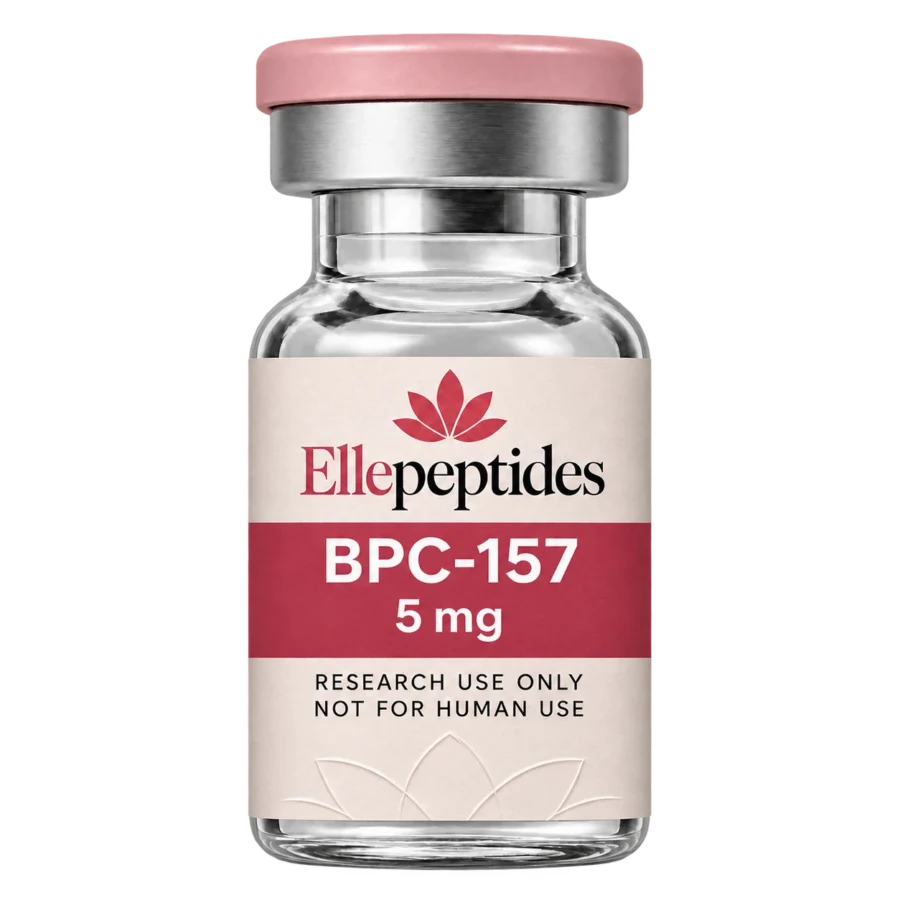
BPC-157 is a synthetic 15-amino-acid peptide whose sequence comes from a larger “body protection compound” first described in human gastric juice (Chang et al., 2014). It is studied mostly in rat tendon-cell and blood-vessel models. Ellepeptides lists it as freeze-dried research material in 5 mg and 10 mg vials, though a 2025 systematic review found only one small clinical report among 36 studies (Vasireddi et al., 2025).
- Molecule type: synthetic pentadecapeptide (15 amino acids)
- Vial sizes: 5 mg or 10 mg of nominal peptide per vial
- Listed price: from $60.00 USD
- Form: freeze-dried (lyophilized) powder
- Shipping: within the United States, with free shipping when your subtotal exceeds $200 (see the shipping policy)
- Intended use: for laboratory research only
BPC-157 vial sizes and price per mg
| Vial size | Listed price (USD) | Price per mg |
|---|---|---|
| BPC-157 5 mg | $60.00 | $12.00 |
| BPC-157 10 mg | $80.00 | $8.00 |
Prices are listed in U.S. dollars at the time of writing, and the size selector above always shows the current price. The 10 mg vial is about 33% cheaper per milligram; bulk or combination savings depend on cart and coupon rules at checkout and are not promised.
BPC-157 compound profile
| Research name and aliases | BPC-157; BPC157; BPC 157; Bepecin |
|---|---|
| Peptide length | 15 amino acids |
| Sequence | GEPPPGKPADDAGLV |
| Molecular formula | C62H98N16O22 |
| Molar mass | 1419.5 g/mol |
| CAS number | 137525-51-0 |
| PubChem identifier | CID 9941957 |
| Supplied form | Freeze-dried powder in a sealed vial |
The table describes the reference molecule as recorded in PubChem’s BPC-157 entry, with the sequence also reported by Chang et al. (2014). It identifies the standard structure; it is not a statement about the lot, salt form or composition of any vial.
How BPC-157 works in research
Nearly all mechanistic BPC-157 data come from cultured cells, rat tissue and chick-embryo assays, so the pathways below describe laboratory models, not effects in people.
Cell movement and survival. In rat Achilles-tendon explants and tendon fibroblasts, BPC-157 accelerated outgrowth, increased migration and spreading, and improved cell survival under oxidative stress. Phosphorylation of FAK and paxillin, two proteins that help cells attach and crawl, rose with treatment, while a proliferation assay showed no direct change in cell division (Chang et al., 2011).
Growth-hormone receptor signaling. A follow-up microarray study in male-rat tendon fibroblasts found the growth-hormone receptor among the most up-regulated genes. When growth hormone was added, pretreated cells proliferated more and JAK2 signaling was activated. That points to greater cellular responsiveness, not higher hormone levels (Chang et al., 2014).
Blood-vessel formation. In chick chorioallantoic membranes, human endothelial-cell tube assays and a rat hind-limb ischemia model, BPC-157 increased vessel density and sped blood-flow recovery. VEGFR2 expression, internalization and the downstream Akt–eNOS pathway increased, while VEGF-A itself did not change (Hsieh et al., 2017).
Key BPC-157 studies
| Year | Study & model | What was measured | Main finding | Source |
|---|---|---|---|---|
| 2011 | Chang et al. — rat tendon explants and fibroblasts | Outgrowth, migration, survival under oxidative stress | More migration and survival; FAK–paxillin activation; no direct proliferation change | PubMed |
| 2014 | Chang et al. — male-rat tendon fibroblasts | Growth-hormone receptor expression and signaling | Receptor mRNA and protein increased; JAK2 activated after growth hormone was added | PMC |
| 2017 | Hsieh et al. — chick embryo, endothelial cells, rat ischemic limb | Vessel density, blood-flow recovery, VEGFR2 pathway | More vessels and faster flow recovery; VEGFR2–Akt–eNOS activation | PubMed |
| 2021 | Lee and Padgett — retrospective review, 16 knee-pain patients reached | Patient-reported pain by telephone | 11 of 12 BPC-157-only patients reported improvement; no control group | PubMed |
| 2022 | He et al. — rats and beagle dogs | Pharmacokinetics and metabolism | Elimination half-life under 30 minutes for the intact peptide; breakdown into smaller fragments | PMC |
| 2024 | Lee, Walker and Ayadi — 12 women with interstitial cystitis | Symptom-response questionnaire (chart review) | 10 of 12 reported full resolution, 2 reported 80% improvement; uncontrolled | Journal |
| 2025 | Lee and Burgess — 2 adults, safety pilot | Short-term safety observations | No side effects reported; far too small to establish safety | Journal |
| 2025 | Vasireddi et al. — systematic review, 36 studies | Evidence base in musculoskeletal research | 35 preclinical and 1 clinical study; no clinical safety data found | PubMed |
The animal pharmacokinetics. He and colleagues tracked BPC-157 in rats and beagle dogs and reported an elimination half-life of under 30 minutes for the intact peptide, which broke down into smaller fragments. Half-life is how quickly a measured concentration falls by half; it is not the duration of an effect, and animal values cannot be carried over to people or to vial storage (He et al., 2022).
The knee-pain chart review. Lee and Padgett reached 16 patients by telephone; 12 had received BPC-157 alone and 11 of them described substantial improvement, while four had received a combination with thymosin beta-4. Without a control group, blinding or standardized functional testing, it cannot separate any effect from natural recovery, expectation or other care (Lee and Padgett, 2021).
Where the evidence stands. The 2025 HSS Journal review kept 36 of 544 screened records; 35 were preclinical. The authors found no clinical safety data and cautioned that unregulated manufacturing and contamination add uncertainty (Vasireddi et al., 2025). A phase 1 safety and pharmacokinetics study in healthy volunteers was registered in 2015 with an estimated 42 participants, but its status is listed as unknown and no results have been posted (ClinicalTrials.gov NCT02637284).
BPC-157 research involving women
The only publication we found that focuses on women is a 2024 pilot describing 12 women with interstitial cystitis, also called bladder pain syndrome. It was a retrospective chart review using a symptom-response questionnaire, with no placebo group. Ten women reported complete symptom resolution and two reported 80% improvement; the authors themselves flagged the small sample and limited ethnic diversity (Lee, Walker and Ayadi, 2024).
Otherwise women appear only incidentally: the 2025 safety pilot followed two adults, one a woman (Lee and Burgess, 2025), and the cell work used male-rat tissue. No randomized study, menopause data or sex-stratified results were identified in the sources reviewed, so rodent or small mixed-group findings cannot be assumed to apply to women. Our peptides for women hub groups compounds with female study populations.
BPC-157 vs TB-500, the Wolverine blend and KPV
| Compound | Type | Main research focus | Sizes on Ellepeptides |
|---|---|---|---|
| BPC-157 (this page) | 15-amino-acid synthetic peptide | Tendon-cell migration, vessel formation | 5 mg, 10 mg |
| TB-500 | Name tied to thymosin beta-4 or a 7-residue fragment | Actin binding, wound and cardiac models | 5 mg, 10 mg |
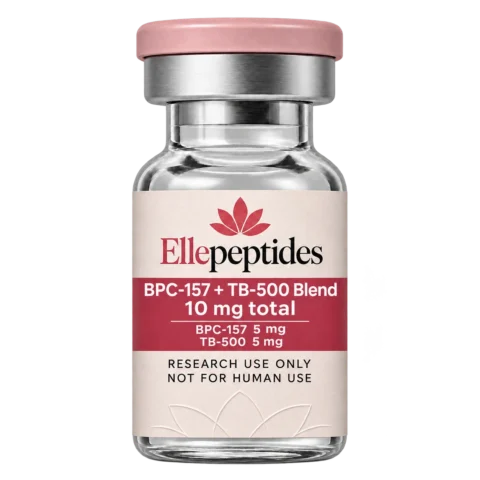
| BPC-157 + TB-500 Blend | Two-peptide mixture in one vial | Combination designs; one 2026 rat tendon comparison | 5 mg + 5 mg |
| KPV | Tripeptide (Lys–Pro–Val) from alpha-MSH | Intestinal inflammation signaling | 10 mg |
BPC-157 and TB-500 are often grouped together, but they are unrelated molecules, and an analytical paper found that material sold as TB-500 can be a short acetylated fragment rather than full thymosin beta-4 (Esposito et al., 2012). In a 32-rat tendon-repair comparison, the combination did not outperform either peptide alone (Biçer et al., 2026). KPV is a separate tripeptide whose research centers on PepT1 transport and inflammatory signaling in gut cells (Dalmasso et al., 2008). Multi-component vials such as KLOW and GLOW also contain BPC-157 at 10 mg alongside other peptides.
BPC-157 handling, storage and reconstitution math
Freeze-dried peptide can look like a thin film rather than visible powder. Keep the vial sealed until needed, store it as its label directs, and log the lot number and opening date. After a solvent is added, your laboratory’s own procedures for sterile technique and labeling apply.
Concentration is simple division: vial mass ÷ solvent volume. For example, 10 mg brought up in 5 mL gives 2 mg per mL. The Ellepeptides peptide calculator handles that arithmetic and the unit conversions; it does not recommend amounts for any use. If your method specifies a preserved diluent, bacteriostatic water (30 mL) is listed in our lab supplies.
Ordering BPC-157 in the US
Orders ship to addresses within the United States. Shipping is free when your merchandise subtotal exceeds $200 after coupon discounts (before taxes and shipping). Otherwise, standard shipping is $15.99 per order. The available payment methods and delivery options are shown at checkout—see the shipping policy for current details.
BPC-157 FAQ
How much does BPC-157 cost?
BPC-157 is listed from $60.00 USD for a 5 mg vial, and the 10 mg vial is $80.00, which works out to $12.00 and $8.00 per mg respectively. The size selector above always shows the current price, and shipping is free once your merchandise subtotal passes $200 after coupons.
Where can I buy BPC-157 in the US?
You can order BPC-157 research vials directly from this page; Ellepeptides ships to addresses across the United States. It is sold as freeze-dried powder for laboratory research, not as a supplement. Related materials sit in the healing and recovery category.
What is BPC-157?
BPC-157 is a synthetic pentadecapeptide, meaning a chain of 15 amino acids with the sequence GEPPPGKPADDAGLV. Researchers describe it as a partial sequence of a protective protein isolated from human gastric juice (Chang et al., 2014), and study it mainly in cell and rodent models.
What are the benefits of BPC-157 in studies?
In laboratory models, BPC-157 has been linked to faster tendon-cell migration, better cell survival under oxidative stress and new blood-vessel formation in ischemic rat muscle (Hsieh et al., 2017). A 2025 systematic review counted 35 preclinical studies and one small clinical report, so benefits in people have not been demonstrated.
What side effects of BPC-157 have been reported in studies?
Very little human safety data exists. A 2025 systematic review found no clinical safety data in the 36 studies it included, and noted that animal studies of up to six weeks reported no acute organ toxicity (Vasireddi et al., 2025). A two-person pilot reported no side effects (Lee and Burgess, 2025), but a sample that small cannot establish safety.
What is the half-life of BPC-157?
In rats and beagle dogs, intact BPC-157 had an elimination half-life of under 30 minutes and was broken down into smaller fragments (He et al., 2022). No peer-reviewed human half-life has been published, and a registered phase 1 study in healthy volunteers has no posted results.
What is the difference between BPC-157 and TB-500?
They are different molecules. BPC-157 is a 15-amino-acid peptide studied in tendon and blood-vessel models; TB-500 is a catalog name tied to thymosin beta-4, an actin-binding protein, or to a short fragment of it. See the TB-500 page for its identity question and study list.
Should BPC-157 and TB-500 be studied together?
It depends on the research question: testing a combination needs each peptide alone, the mixture and a control. The one controlled animal comparison found that the combination did not outperform the single peptides after tendon repair in rats (Biçer et al., 2026). The BPC-157 + TB-500 Blend offers both in one vial.
Is BPC-157 available as capsules, a cream or a nasal spray?
Not from Ellepeptides. This listing is freeze-dried BPC-157 powder in a vial for laboratory work; it is not a capsule, cream, spray or skincare formula. Finished cosmetic products are a separate range in our skincare category, and a listing that sells BPC-157 in those finished forms is a different product type from this research material.
Is BPC-157 sold on Walmart or Amazon the same as a research vial?
Not necessarily. General marketplaces host many third-party sellers, and listings can describe very different products, such as capsules, liquids or multi-ingredient formulas with unclear amounts. A research vial states one compound and a nominal mass in milligrams, so compare the form and stated amount before relying on any listing.
How should BPC-157 vials be stored?
Follow the storage conditions printed on the vial label, keep it sealed until use, and record the lot number and date opened. Requirements for a solution depend on the solvent and your laboratory’s procedures; animal half-life data say nothing about shelf stability.
How long does BPC-157 shipping take?
Delivery options are shown at checkout, and the shipping policy has current details on rates and the free-shipping threshold.
Is there BPC-157 research in women?
The main example is a 2024 uncontrolled chart review of 12 women with interstitial cystitis, in which 10 reported complete symptom resolution (Lee, Walker and Ayadi, 2024). No randomized trial or sex-specific data were found. Browse the peptides for women hub for related research materials.
BPC-157 references
- Chang et al. (2011). BPC 157, tendon outgrowth, cell survival and migration. J Appl Physiol.
- Chang et al. (2014). BPC 157 and growth hormone receptor expression in tendon fibroblasts. Molecules.
- Hsieh et al. (2017). Pro-angiogenic BPC 157 and VEGFR2 activation. J Mol Med.
- Lee and Padgett (2021). BPC 157 and knee pain: retrospective patient review. Altern Ther Health Med.
- He et al. (2022). BPC-157 pharmacokinetics in rats and dogs.
- Lee, Walker and Ayadi (2024). BPC 157 in interstitial cystitis: pilot study.
- Lee and Burgess (2025). BPC 157 safety pilot in two adults.
- Vasireddi et al. (2025). BPC-157 in orthopaedic sports medicine: systematic review. HSS J.
- ClinicalTrials.gov (2015). NCT02637284, PCO-02 phase 1 study.
- Biçer et al. (2026). BPC-157, thymosin beta-4 and combination in rat tendon repair. Jt Dis Relat Surg.
- Esposito et al. (2012). Thymosin beta-4 fragment identified in TB-500. Drug Test Anal.
- Dalmasso et al. (2008). PepT1-mediated KPV uptake, cell and mouse study.
- NCBI PubChem. Compound summary CID 9941957 (BPC-157).
Related research materials: Healing & Recovery peptides, all research peptides, TB-500, BPC-157 + TB-500 Blend, GHK-Cu, KPV and our research library. For laboratory research only. Not for human or veterinary use.

Reviews
There are no reviews yet.