
Description
5-Amino-1MQ at a glance
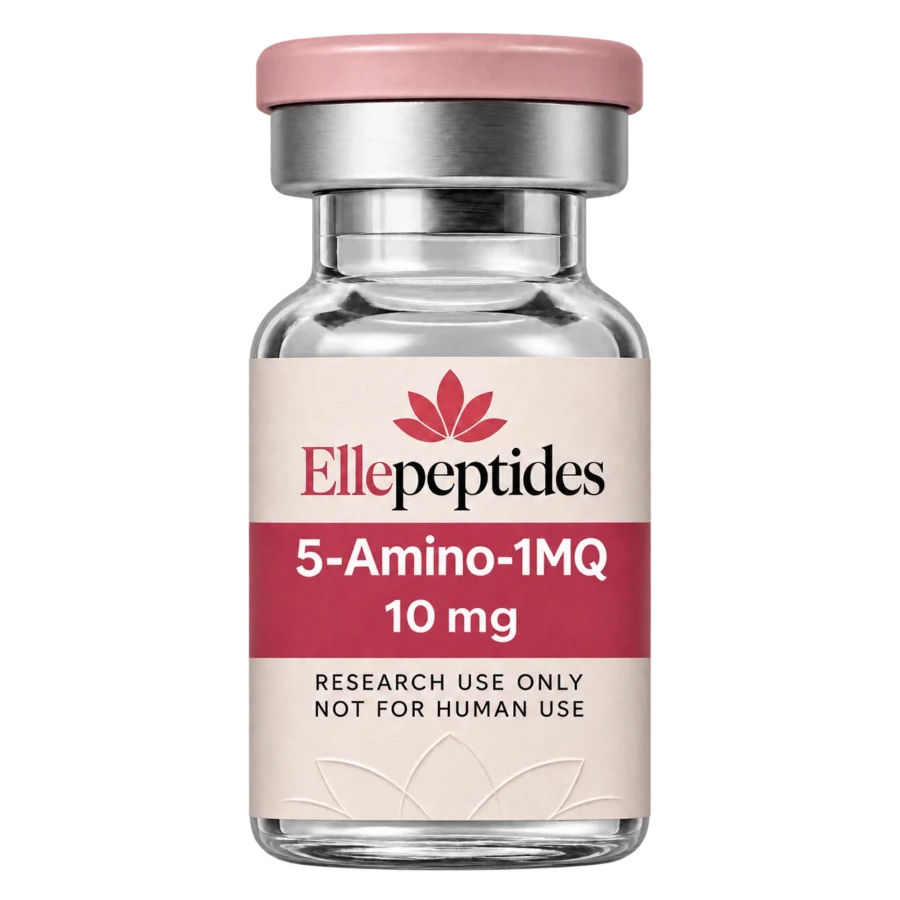
5-Amino-1MQ (5-amino-1-methylquinolinium) is a small molecule, not a peptide, that inhibits the enzyme nicotinamide N-methyltransferase (NNMT). It is studied in fat-cell metabolism, diet-induced obesity in mice and aging muscle. Ellepeptides supplies 5-Amino-1MQ as freeze-dried research material in 10 mg and 50 mg vials, listed in the energy and metabolic collection.
- Molecule type: small-molecule NNMT inhibitor (methylquinolinium), not a peptide
- Vial sizes: 10 mg and 50 mg
- Listed price: from $66.99 USD
- Form: freeze-dried (lyophilized) powder
- Ships within the United States; free shipping when the merchandise subtotal is over $200
- For laboratory research only
5-Amino-1MQ vial sizes and price per mg
| Vial size | Listed price (USD) | Price per mg |
|---|---|---|
| 10 mg | $66.99 | $6.70 |
| 50 mg | $140.00 | $2.80 |
Prices are listed in USD at the time of writing; the size selector above shows the current price. Bulk or combination savings through the cart or coupons are not promised.
5-Amino-1MQ compound profile
| Reference name | 5-amino-1-methylquinolinium |
|---|---|
| Compound class | Small molecule, not a peptide |
| Research target | Nicotinamide N-methyltransferase (NNMT) |
| Molecular reference form | 5-Amino-1MQ cation; not the iodide salt |
| Reference CAS number | 685079-15-6 |
| Reference molecular formula | C10H11N2+ |
| Reference molar mass | 159.21 g/mol |
| Cation PubChem record | CID 950107 |
| Iodide salt, for comparison | CAS 42464-96-0; C10H11IN2; 286.11 g/mol; CID 66522933 |
| Supplied counterion | Check the label and lot documentation |
5-Amino-1MQ is a positively charged ion, so any solid form carries a counterion. That matters for arithmetic: in the iodide salt, the cation accounts for about 56% of the mass (159.21 ÷ 286.11). The table describes reference structures, not the composition of a particular lot.
How 5-Amino-1MQ works in research
NNMT moves a methyl group from S-adenosylmethionine (SAM) onto nicotinamide, producing 1-methylnicotinamide. Every nicotinamide molecule methylated this way is one fewer available for recycling into NAD+, and every SAM used is one fewer methyl donor. Neelakantan et al. (2018)
The target was validated genetically before any drug existed. NNMT expression was raised in the fat and liver of obese and diabetic mice, and knocking it down protected against diet-induced obesity by increasing energy expenditure, with higher SAM and NAD+ in fat tissue. Kraus et al. (2014)
5-Amino-1MQ is a small-molecule way to block the same enzyme. In cultured fat cells it altered NAD+ and SAM levels and reduced lipid synthesis. Neelakantan et al. (2018) That makes it a different strategy from supplying NAD+ or its precursors directly. All of this work is in cells and mice; no human trial results are among these sources.
Key 5-Amino-1MQ studies
| Year | Study & model | What was measured | Main finding | Source |
|---|---|---|---|---|
| 2014 | NNMT knockdown (genetic, not 5-Amino-1MQ) in mice | Diet-induced obesity, energy expenditure | Knockdown protected against obesity; fat SAM and NAD+ rose | Kraus et al. |
| 2018 | Cultured fat cells; diet-induced obese male mice | NAD+, SAM, lipid synthesis, body weight | Lower lipid synthesis in cells; less body weight and white fat without lower food intake | Neelakantan et al. |
| 2019 | Aged mice with muscle injury | Muscle stem cells, fiber size, contractile function | More stem-cell activity, larger regenerated fibers, better contraction | Neelakantan et al. |
| 2022 | Obese mice switched to a lower-fat diet | Adiposity and gut microbiome | Greater fat loss with NNMT inhibition plus diet than diet alone | Dimet-Wiley et al. |
| 2024 | 35 aged (22-month) female mice, four groups | Grip strength, running, muscle lipid and fiber size | About 40% higher grip strength versus sedentary controls; additive with exercise | Dimet-Wiley et al. |
| 2025 | Orbital fibroblasts from 19 Graves’ orbitopathy patients (12 women) | Inflammation-related proteins in cultured cells | Selected inflammatory proteins reduced | Graves’ study |
The 2018 paper is the foundation. Beyond the cell results, diet-induced obese male mice given the inhibitor lost body weight and white-fat mass without eating less, which points to a change in energy handling rather than appetite. These are preclinical results, not a demonstrated weight-loss effect in people. Neelakantan et al. (2018)
The 2019 study looked at repair after experimental injury in aged mouse muscle and found greater muscle stem-cell activity, larger regenerated fibers and better contractile function. Neelakantan et al. (2019) The 2022 diet-switch experiment found that NNMT inhibition added to a lower-fat diet reduced adiposity more than the diet alone, alongside microbiome differences. Dimet-Wiley et al. (2022)
5-Amino-1MQ research involving women
The most relevant female data are from mice. In a 2024 study, 35 aged (22-month) female mice were assigned to sedentary or progressive weighted wheel-running groups, with or without 5-Amino-1MQ for eight weeks. Treated sedentary mice had about 40% greater grip strength than sedentary controls, exercise alone gave about 20%, and the combination about 60%. The inhibitor improved intramyocellular lipid, and the combination increased gastrocnemius fiber size. Dimet-Wiley et al. (2024)
Women also appear as tissue donors. A 2025 Graves’ orbitopathy study cultured orbital fibroblasts from 19 patients, 12 of them women, plus controls; 5-Amino-1MQ reduced selected inflammation-related proteins in those cells. The compound was tested on cells, not given to the women, and the study used an iodide preparation. Graves’ orbitopathy study (2025)
No controlled human administration study of 5-Amino-1MQ, in women or anyone else, appears among these sources. See the peptides for women hub for compounds with human data in women.
5-Amino-1MQ vs MOTS-c, NAD+ and AOD-9604
| Compound | Type | Main research focus | Sizes on Ellepeptides |
|---|---|---|---|
| 5-Amino-1MQ (this page) | Small molecule | NNMT inhibition; fat and muscle metabolism in mice | 10 mg, 50 mg |
| MOTS-c | Mitochondrial-derived peptide | AMPK signaling and insulin sensitivity | 10 mg, 40 mg |
| NAD+ | Dinucleotide coenzyme | Electron transfer; sirtuin and PARP substrate | 500 mg, 1000 mg |
| AOD-9604 | Modified growth-hormone fragment (peptide) | Fat metabolism and cartilage experiments | 10 mg |
5-Amino-1MQ and AOD-9604 are both discussed in fat-metabolism research, but one is an enzyme inhibitor and the other a peptide fragment. MOTS-c and NAD+ share the metabolic theme through other mechanisms. Each compound has its own evidence base; results do not transfer between them.
5-Amino-1MQ handling, storage and reconstitution math
The 5-Amino-1MQ vial contains a freeze-dried solid. Before calculating anything, read the label for the stated amount, the salt form if given, the lot number and the storage conditions. Keep the vial sealed until use.
Concentration is vial mass divided by solvent volume: 10 mg in 2 mL is 5 mg/mL; 50 mg in 5 mL is 10 mg/mL. If the label states the mass of a salt, the cation is only part of it, so molar calculations should use the correct molar mass. The peptide calculator handles the mass-and-volume step for small molecules too. Bacteriostatic water is listed if your protocol specifies it.
Ordering 5-Amino-1MQ in the US
5-Amino-1MQ orders ship to addresses within the United States. Shipping is free when your merchandise subtotal is over $200 after coupon discounts (before taxes and shipping); below that, standard shipping is $15.99 per order. The available payment methods and delivery options are shown at checkout, so check the shipping policy for current details.
5-Amino-1MQ FAQ
What is 5-Amino-1MQ?
5-Amino-1MQ is short for 5-amino-1-methylquinolinium, a small molecule that inhibits the enzyme NNMT. Research groups use it to study how NNMT shapes NAD+ and SAM metabolism in fat cells and muscle. Ellepeptides sells it as freeze-dried research material in 10 mg and 50 mg vials for laboratory use only.
Is 5-Amino-1MQ a peptide?
No. It is a methylquinolinium compound with a molar mass of about 159 g/mol as the cation, far smaller than any peptide and containing no amino acids. It is sold alongside research peptides because it appears in the same metabolic research, but chemically it is a small organic compound.
What is an NNMT inhibitor?
NNMT is an enzyme that transfers a methyl group from SAM to nicotinamide. An NNMT inhibitor blocks that step. In mouse studies, reducing NNMT activity, either genetically or with 5-Amino-1MQ, raised fat-tissue NAD+ and SAM and was linked to resistance to diet-induced obesity.
What benefits of 5-Amino-1MQ have studies reported?
In mice, studies reported lower body weight and white fat in diet-induced obesity without reduced food intake, better muscle repair in aged animals, greater fat loss when combined with a diet switch and higher grip strength in aged female mice. All of these are animal or cell findings; none has been shown in people.
What side effects of 5-Amino-1MQ have been reported?
None of the sources on this page gave 5-Amino-1MQ to people, so there is no published human side-effect profile here. The studies report mouse and cell outcomes. Claims about human tolerability that are not backed by a published administration study should be treated as unverified.
What is the difference between 5-Amino-1MQ and MOTS-c?
5-Amino-1MQ is a small molecule that blocks the NNMT enzyme. MOTS-c is a 16-amino-acid peptide encoded in mitochondrial DNA that activates AMPK in cell and mouse studies. Both are studied in metabolism and aging, but they act on different targets and are different chemical classes.
Is 5-Amino-1MQ the same as NAD+, NMN or NR?
No. NAD+ is a coenzyme, and NMN and NR are precursors that cells convert into it. 5-Amino-1MQ supplies none of these; it inhibits an enzyme that consumes nicotinamide, which can change NAD+ levels indirectly. Results for one should not be credited to another.
Is 5-Amino-1MQ better as a capsule or a vial?
Ellepeptides sells 5-Amino-1MQ only as freeze-dried powder in sealed vials, the format used for laboratory weighing and solution work. The studies on this page used their own preparations and did not compare capsule and vial forms, so they cannot say whether one format behaves differently from another.
How much does 5-Amino-1MQ cost in the US?
At the time of writing, Ellepeptides lists 5-Amino-1MQ at $66.99 USD for 10 mg and $140.00 USD for 50 mg, about $6.70 and $2.80 per mg. Shipping is free when the merchandise subtotal is over $200 after coupons; below that, standard shipping is $15.99.
Why does the counterion of 5-Amino-1MQ matter?
Because the active part is a cation, the solid always includes a partner ion that adds mass. In the iodide salt the cation is roughly 56% of the weight, so a stated milligram amount means different molar quantities depending on the salt. Check the label and documentation rather than borrowing a study supplier’s specification.
5-Amino-1MQ references
- National Library of Medicine, PubChem. 5-Amino-1-methylquinolinium, CID 950107.
- National Library of Medicine, PubChem. 5-Amino-1-methylquinolinium iodide, CID 66522933.
- Kraus D, et al. (2014). NNMT knockdown protects against diet-induced obesity. Nature.
- Neelakantan H, et al. (2018). NNMT inhibitor, fat cells and obese mice. PMC5826726.
- Neelakantan H, et al. (2019). NNMT inhibition and aged muscle repair. PubMed 30753815.
- Dimet-Wiley A, et al. (2022). Diet switch, NNMT inhibition and microbiome. PubMed 35013352.
- Dimet-Wiley AL, et al. (2024). NNMT inhibition and exercise in aged female mice. PMC11226645.
- Graves’ orbitopathy study (2025). NNMT in orbital fibroblasts. PMC12054684.
Related research materials: Energy & Metabolic, weight management research, MOTS-c, NAD+, AOD-9604 and SS-31 (Elamipretide). See how we weigh evidence on the research page. For laboratory research only. Not for human or veterinary use.

Reviews
There are no reviews yet.