
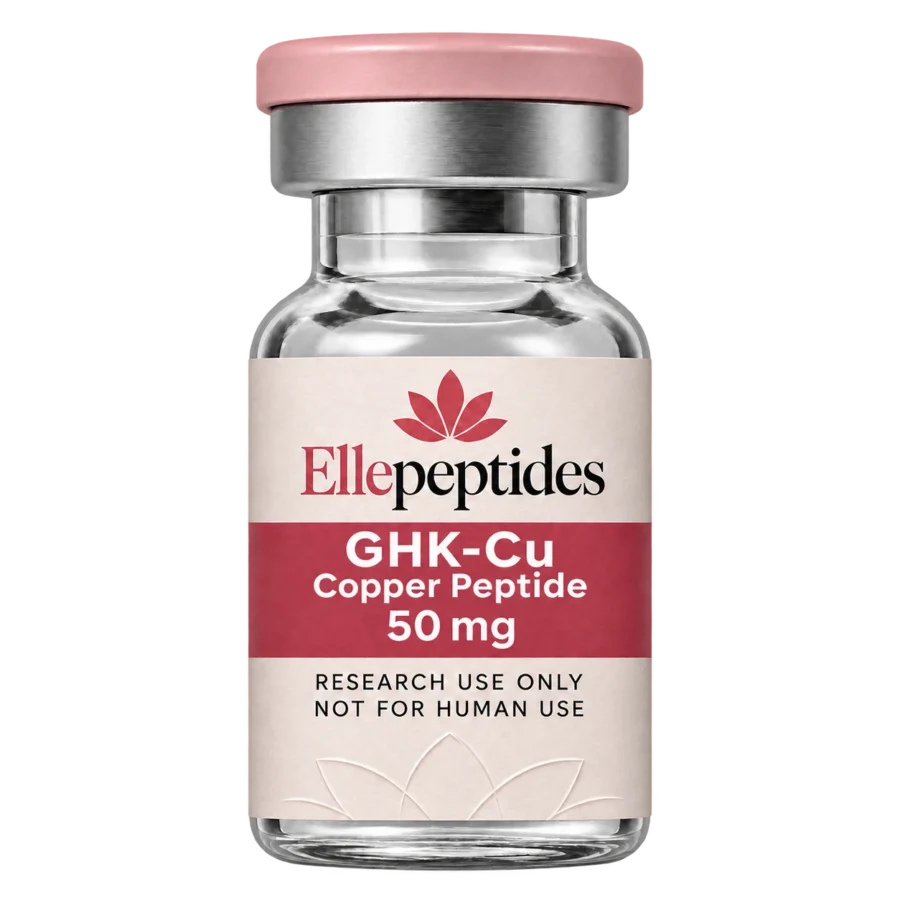
Description
GHK-Cu at a glance
GHK-Cu is the copper(II) complex of glycine–histidine–lysine, a three-amino-acid peptide first reported in human serum and studied mainly in fibroblast, wound-model and topical skin-formulation research. Ellepeptides lists GHK-Cu as freeze-dried research material in 50 mg and 100 mg vials. It is a laboratory reagent, not a finished cosmetic.
- Molecule: copper-binding tripeptide (Gly–His–Lys with Cu2+)
- Vial sizes: 50 mg and 100 mg
- Listed price: from $50.00 USD
- Form: freeze-dried (lyophilized) powder
- Shipping: ships within the United States; free shipping on merchandise subtotals over $200
- Scope: for laboratory research only
GHK-Cu vial sizes and price per mg
| Vial size | Listed price (USD) | Price per mg |
|---|---|---|
| 50 mg | $50.00 | $1.004 |
| 100 mg | $75.00 | $0.750 |
Prices are listed in USD at the time of writing, and the size selector above shows the current price. At these prices the 100 mg vial costs about 25% less per milligram than the 50 mg vial. Any bulk or combination savings depend on the cart and active coupons and are not promised here.
GHK-Cu compound profile
| Reference names | GHK-Cu; prezatide copper; copper tripeptide-1 |
|---|---|
| Peptide length and sequence | 3 amino acids: Gly–His–Lys (GHK) |
| Bound metal | Copper(II) |
| Reference CAS | 89030-95-5 |
| PubChem charged reference formula | C14H23CuN6O4+ |
| Reference molecular mass | 402.92 g/mol (PubChem CID 71587328) |
| Nominal amount per vial | 50 mg or 100 mg |
| Form | Freeze-dried (lyophilized) powder |
The formula is the charged species shown in PubChem’s prezatide-copper record; protonation and counterions change the formula from one chemical database to another. The table describes the reference molecule only. It does not state the salt form, copper content or analytical results of any Ellepeptides lot, so check the label and lot documentation supplied with your vial.
How GHK-Cu works in research
Most researchers attribute GHK’s activity to its ability to bind copper(II) ions, according to a 2018 review by Pickart and Margolina. The review dates GHK-Cu’s discovery to 1973 and reports plasma GHK of about 200 ng/mL at age 20, falling to roughly 80 ng/mL by age 60. That age-related decline is one reason the molecule attracts skin-aging research.
Cell work focuses on the extracellular matrix that fibroblasts build and remodel. Maquart et al. (1988) found increased collagen synthesis in fibroblast cultures exposed to GHK-Cu. Wegrowski et al. (1992) observed more sulfated glycosaminoglycans but no change in hyaluronic-acid synthesis. Simeon et al. (2000) found higher MMP-2 alongside its inhibitors TIMP-1 and TIMP-2, pointing to regulated turnover rather than simple accumulation. In rat wound chambers, Maquart et al. (1993) measured greater collagen and matrix accumulation.
The same review reported, from gene-expression data, that GHK shifted expression by 50% or more in 31.2% of human genes. Such signals generate hypotheses rather than proof of effects in tissue, and the review’s lead author led the 1973 discovery work, so independent replication matters.
Key GHK-Cu studies
| Year | Study & model | What was measured | Main finding | Source |
|---|---|---|---|---|
| 1988 | Maquart et al.; fibroblast cultures | Collagen synthesis | Increased with GHK-Cu | PubMed |
| 1992 | Wegrowski et al.; fibroblast cultures | Glycosaminoglycans, hyaluronic acid | Sulfated glycosaminoglycans up; no effect on hyaluronic acid | PubMed |
| 1993 | Maquart et al.; rat wound chambers | Matrix accumulation | More collagen and other matrix components | JCI |
| 2000 | Simeon et al.; fibroblast cultures | MMP-2, TIMP-1, TIMP-2 | All three increased | PubMed |
| 2006 | Miller et al.; 13 completers after laser resurfacing, 12 weeks | Redness, wrinkles, skin quality | No significant objective differences; satisfaction favored GHK-Cu | PubMed |
| 2007 | Pyo et al.; human hair follicles ex vivo, dermal papilla cells | Follicle elongation, cell proliferation | Increased, but the compound tested was AHK-Cu, not GHK-Cu | DOI |
| 2016 | Badenhorst et al.; 40 women aged 40–65, split-face, 8 weeks; plus adult fibroblasts | Wrinkle volume and depth; collagen and elastin | Serum beat vehicle on wrinkle volume (−24.1% vs −15.0%); collagen and elastin up at 96 h | |
| 2026 | Bo et al.; 18 adults aged 18–40, split-eyebrow, 12 weeks | Eyebrow hair count and diameter | Both improved on the 2% GHK-Cu side versus placebo | Journal |
The most-cited human study is Badenhorst et al. (2016). It was randomized, double-blind and split-face: 40 women enrolled and 39 were analyzed. Against its vehicle (20 participants), a nano-carrier GHK-Cu serum reduced wrinkle volume by 24.1% versus 15.0% and depth by 20.3% versus 15.3% over eight weeks. Against a Matrixyl 3000 product (19 participants), the volume reduction was greater (p = 0.0044), but the depth difference was not statistically significant. The serum maker funded the work and supplied the products.
Results are not uniformly positive. In Miller et al. (2006), 13 participants completed a 12-week comparison after laser resurfacing; objective assessments of redness, wrinkles and skin quality did not differ significantly, although patient satisfaction favored GHK-Cu.
Hair claims need care. The often-quoted follicle study by Pyo et al. (2007) tested AHK-Cu, a different copper tripeptide, at 10−12 to 10−9 M. The only GHK-Cu hair study cited here, Bo et al. (2026), compared a 2% serum with placebo on opposite eyebrows in 18 adults; it does not establish scalp effects.
GHK-Cu research involving women
The clearest female-specific evidence is the Badenhorst trial, in which every participant was a woman aged 40 to 65. It tested a formulated facial serum, not research powder, over eight weeks, and was small and sponsor-funded. The 2026 eyebrow study enrolled 18 adults aged 18 to 40, and its abstract does not report results by sex. We have not used a sex breakdown for the 13-person post-laser study.
The gaps are substantial. We found no published trial of freeze-dried research-grade GHK-Cu in women, no study across life stages such as menopause, and no long-term data. The plasma decline in the 2018 review is an age observation, not a sex-specific one. Ellepeptides’ women-focused identity shapes how we present research; it is not a claim that GHK-Cu works differently in women. See our research page and the Peptides for Women hub.
GHK-Cu vs GLOW, KLOW and copper peptide serum
| Compound | Type | Main research focus | Sizes on Ellepeptides |
|---|---|---|---|
| GHK-Cu Copper Peptide | Single tripeptide–copper complex, freeze-dried | Fibroblast matrix, wound models, skin-formulation trials | 50 mg, 100 mg |
| GLOW Research Blend | Three-part blend: GHK-Cu 50 mg + BPC-157 10 mg + TB-500 10 mg | Component studies only; no trial of the mixture | 70 mg |
| KLOW Research Blend | Four-part blend: GLOW components + KPV 10 mg | Component studies only; no trial of the mixture | 80 mg |
| Copper Peptide Renewal Serum | Finished skincare product | Cosmetic use as directed on its own label | One listing; see its page |
Choose single-compound GHK-Cu when a protocol needs one defined variable. GLOW and KLOW fix the ratio of GHK-Cu to BPC-157 and other components, so results cannot be attributed to any one ingredient. The Copper Peptide Renewal Serum is a finished cosmetic; its formula and directions are on its own label, and this page makes no claim about them.
GHK-Cu handling, storage and reconstitution math
General laboratory practice is to keep freeze-dried material sealed until use, record the lot number and date a vial when it is opened. Storage temperature and shelf life for your GHK-Cu vial belong to its label and lot documentation. Wipe the stopper with an alcohol prep pad and let it dry before access.
Concentration is simple division: vial mass ÷ solvent volume. For example, 50 mg dissolved in 5.0 mL gives 10 mg/mL, and 100 mg in 5.0 mL gives 20 mg/mL. The vial amount alone is not a concentration. Use the peptide calculator to check the arithmetic, and take the solvent from your protocol. If it calls for a preserved aqueous solvent, our bacteriostatic water page explains what that liquid is and how it differs from sterile water.
Ordering GHK-Cu in the US
Orders ship to addresses within the United States, with prices in USD. Shipping is free when your merchandise subtotal exceeds $200 after coupon discounts (before taxes and shipping). Otherwise, standard shipping is $15.99 per order. The available payment methods and delivery options are shown at checkout; see our shipping policy for current terms.
GHK-Cu FAQ
What is GHK-Cu?
GHK-Cu is the copper(II) complex of glycyl-histidyl-lysine, a peptide made of three amino acids. Reference records also list it as prezatide copper and copper tripeptide-1. Researchers study it mainly in fibroblast cultures, wound models and topical skin formulations. Ellepeptides sells it as freeze-dried research material in 50 mg and 100 mg vials, separate from any finished skincare.
How much does GHK-Cu cost in the US?
Ellepeptides lists GHK-Cu from $50.00 USD for the 50 mg vial and $75.00 USD for the 100 mg vial at the time of writing. That is about $1.00 and $0.75 per milligram. The size selector shows the current price, and shipping is free once the merchandise subtotal tops $200 after coupons.
Where can I buy GHK-Cu in the US?
You can order GHK-Cu research vials on this page. Ellepeptides ships to addresses within the United States and charges in U.S. dollars. It sits in our Healing & Recovery category. Whoever you buy from, read the label and ask for lot documentation rather than relying on a product name.
What is the difference between GHK-Cu and a copper peptide serum?
A research vial holds freeze-dried GHK-Cu for laboratory work. A copper peptide serum is a finished cosmetic in which a copper peptide is one ingredient in a formulated base. The human skin trials cited here tested formulated serums, not powder. Our Copper Peptide Renewal Serum is a separate listing whose own label describes its formula.
What GHK-Cu benefits have been studied?
Studies have measured collagen and glycosaminoglycan production and matrix-enzyme balance in fibroblasts, matrix build-up in rat wounds, wrinkle volume and depth in a small trial of women, and eyebrow hair count in 18 adults. Results are mixed: a post-laser study found no objective difference. These are measured research outcomes, not promised benefits of any product.
Has GHK-Cu been studied for hair growth?
Only to a limited extent. The frequently cited 2007 follicle study tested AHK-Cu, a different copper tripeptide, on human hair follicles kept alive outside the body. A 2026 split-eyebrow study of 18 adults reported greater hair count and diameter with a 2% GHK-Cu serum than with placebo over 12 weeks. No study cited here examined scalp hair.
What side effects were reported in GHK-Cu studies?
Reporting is limited. In the 2016 split-face trial, 39 of 40 women tolerated the products; one stopped after minor reactions on both sides of the face, which settled without medical treatment. The 2026 eyebrow study reported no serious adverse effects or allergic reactions. Both were small, short topical studies and cannot characterize research material.
GHK-Cu 50 mg vs 100 mg: which vial should I choose?
Choose the vial that matches the total material your protocol requires. Both contain the same compound; the difference is quantity and cost per milligram, about $1.00 for 50 mg versus $0.75 for 100 mg at listed prices. A larger vial may stay in use longer, so weigh the storage conditions on its label.
Does Ellepeptides sell GHK-Cu capsules, creams or nasal sprays?
No. Ellepeptides sells GHK-Cu only as freeze-dried powder in research vials. We do not offer capsules, nasal sprays or creams made from this material. The Copper Peptide Renewal Serum in our skincare collection is a separate finished product with its own label, and it should not be compared with the vial on formula.
How should GHK-Cu be stored?
Follow the storage conditions printed on your vial’s label and any documentation supplied with the lot. Common laboratory practice is to keep freeze-dried material sealed until use and to date the vial once it is opened. Published GHK-Cu studies do not establish shelf life for a particular commercial lot, so the label takes priority.
How long does GHK-Cu shipping take?
It depends on the delivery option you choose; the available options are shown at checkout. The shipping policy lists current terms, including free shipping over $200.
Has GHK-Cu been studied in women?
Yes, in a small number of studies. The 2016 Badenhorst trial enrolled 40 women aged 40 to 65 and tested a formulated GHK-Cu serum on facial wrinkles for eight weeks. The other human studies cited here did not report results by sex. We found no trial that tested freeze-dried research-grade GHK-Cu in women.
GHK-Cu references
- PubChem. Prezatide copper, CID 71587328. pubchem.ncbi.nlm.nih.gov
- Pickart L, Margolina A. 2018. Regenerative and protective actions of the GHK-Cu peptide in the light of the new gene data. Int J Mol Sci 19(7):1987. MDPI
- Maquart et al. 1988. Collagen synthesis in fibroblast cultures exposed to GHK-Cu. PubMed 3169264
- Wegrowski et al. 1992. Glycosaminoglycan synthesis in fibroblast cultures. PubMed 1522753
- Maquart et al. 1993. Connective-tissue accumulation in rat experimental wounds. J Clin Invest. JCI
- Simeon et al. 2000. MMP-2 and TIMP expression in fibroblast cultures. PubMed 11045606
- Miller et al. 2006. Comparison regimens after laser resurfacing. PubMed 16847171
- Pyo HK et al. 2007. The effect of tripeptide-copper complex on human hair growth in vitro. Arch Pharm Res 30(7):834–839. DOI 10.1007/BF02978833
- Badenhorst T et al. 2016. Effects of GHK-Cu on MMP and TIMP expression, collagen and elastin production, and facial wrinkle parameters. J Aging Sci 4(3):166. PDF
- Bo SL et al. 2026. 2% copper peptide (GHK-Cu) serum for eyebrow hypotrichosis: randomized split-face study. Procedia of Multidisciplinary Research 4(5). Journal page
Related research materials: Healing & Recovery, Skin, Hair & Nails, GLOW Research Blend, KLOW Research Blend, BPC-157 and SNAP-8. For laboratory research only. Not for human or veterinary use.

Reviews
There are no reviews yet.