
Description
Tesamorelin at a glance
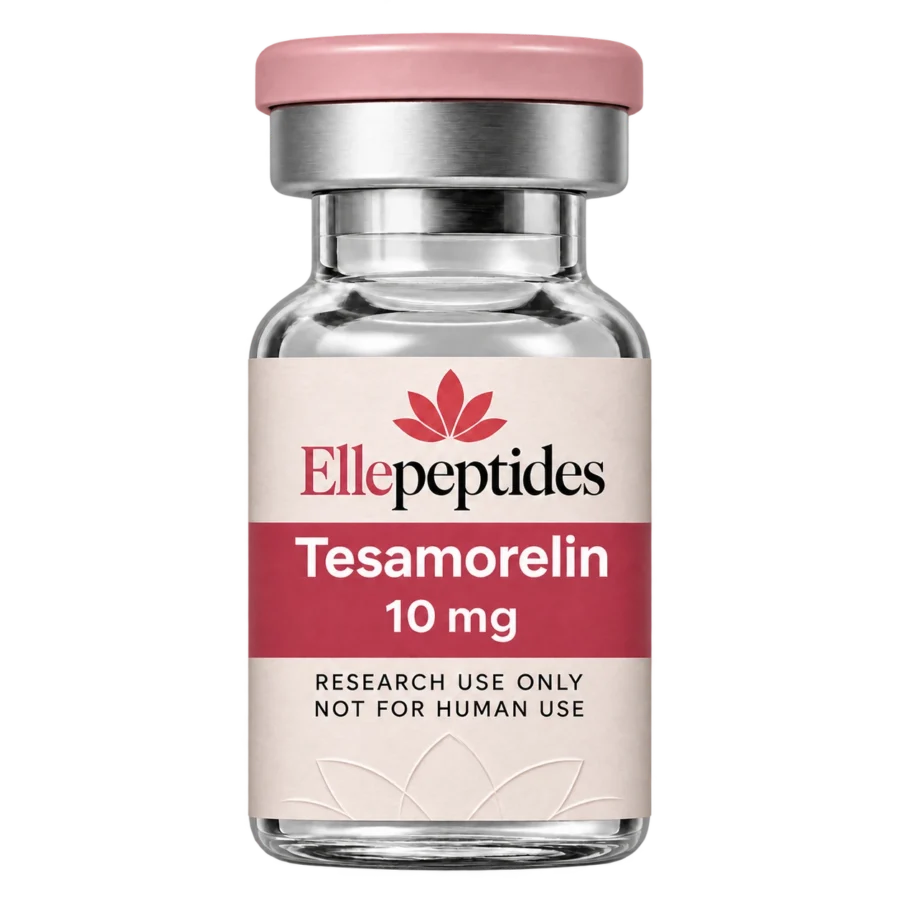
Tesamorelin is a synthetic analogue of growth-hormone-releasing hormone (GHRH): the full 44-amino-acid human GRF sequence with a hexenoyl group at the N-terminus. Controlled trials have measured its effects on visceral and liver fat in adults with HIV-associated abdominal fat. Ellepeptides lists it among its research peptides as freeze-dried material in 5, 10 and 20 mg vials.
- Molecule type: modified GHRH analogue, 44 amino acids (not growth hormone itself)
- Vial sizes: 5 mg, 10 mg and 20 mg
- Listed price: from $68.35 USD for the 5 mg vial
- Form: freeze-dried (lyophilized) powder
- Shipping: ships within the US; free shipping over $200
- Use: for laboratory research only
Tesamorelin vial sizes and price per mg
| Vial size | Listed price (USD) | Price per mg |
|---|---|---|
| 5 mg | $68.35 | $13.67 |
| 10 mg | $120.00 | $12.00 |
| 20 mg | $190.00 | $9.50 |
USD prices were current at the time of writing; the size selector shows the live price. The 20 mg vial has the lowest cost per milligram, but no bulk or combination discount through the cart or coupons is promised.
Tesamorelin compound profile
| Research name | Tesamorelin |
|---|---|
| Compound class | Modified growth-hormone-releasing hormone (GHRH) analogue |
| Peptide length | 44 amino acids |
| Structural modification | Hexenoyl (C6) group on the N-terminal tyrosine |
| Reference molecular formula | C221H366N72O67S |
| Reference molar mass | 5136 g/mol |
| CAS number | 218949-48-5 |
| PubChem record | CID 16137828 |
These rows come from public reference records for the tesamorelin molecule, not from testing of a Ellepeptides lot. Salt form, water content and composition can only be confirmed from documentation for the material supplied.
How tesamorelin works in research
Tesamorelin binds GHRH receptors on the growth-hormone-producing cells of the anterior pituitary. Its US prescribing information states that, in vitro, it binds and stimulates human GRF receptors with potency similar to endogenous GRF. Receptor activation prompts the pituitary to release its own growth hormone in pulses, and circulating IGF-I rises downstream. That chain is what clinical studies measure; tesamorelin is a releasing signal, not growth hormone (Makimura et al., 2012).
The hexenoyl cap is the main structural difference from native GHRH(1–44) and from the shorter fragment sermorelin. Clearance is still quick: the same label reports a mean elimination half-life of about 11 minutes in healthy subjects after a single administration. Trials therefore report downstream markers (IGF-I, CT-measured visceral fat, liver fat composition, glucose and lipids), which show where the compound has actually been characterized.
Key tesamorelin studies
| Year | Study & model | What was measured | Main finding | Source |
|---|---|---|---|---|
| 2007 | RCT; 412 adults with HIV-associated abdominal fat | Visceral fat by CT at 26 weeks | Visceral fat −15.2% with tesamorelin vs +5.0% with placebo | Falutz et al. |
| 2012 | RCT; 60 adults with abdominal obesity, low GH (21 women); 12 months | Visceral fat area; bodyweight | −16 cm² vs +19 cm² (placebo); bodyweight unchanged | Makimura et al. |
| 2012 | RCT; 152 older adults, with or without mild cognitive impairment; 20 weeks | Executive function; verbal memory | Executive function favored the analogue; memory not significant | Baker et al. |
| 2014 | RCT; 50 adults with HIV and abdominal fat; 6 months | Liver lipid-to-water ratio | Net reduction of 2.9 percentage points vs placebo | Stanley et al. |
| 2019 | RCT; 61 adults with HIV-associated fatty liver; 12 months | Hepatic fat fraction | Adjusted difference of 4.1 percentage points favoring tesamorelin | Stanley et al. |
| 2025 | US label; two 26-week placebo-controlled trials (412 and 404 adults) | Adverse reactions | Most common: administration-site reactions 17%, joint pain 13% | FDA label |
The 2007 trial anchors most discussion of this compound. Participants were adults living with HIV and accumulated abdominal fat, and the primary endpoint was visceral fat on CT imaging, not bodyweight. A gap of roughly 20 percentage points after 26 weeks is large for an imaging endpoint, yet it describes that narrow clinical setting rather than adults in general (Falutz et al., 2007).
Two later trials moved to the liver: one measured a lipid-to-water ratio over six months (Stanley et al., 2014), the other hepatic fat fraction over a year in HIV-associated fatty liver (Stanley et al., 2019). Neither addresses other causes of fatty liver.
The cognitive trial is the outlier, since its older participants were not selected for HIV. An executive-function signal beside a non-significant memory result justifies more study, not claims of dementia prevention (Baker et al., 2012). More summaries sit in the Ellepeptides research library.
Tesamorelin research involving women
Women are under-represented in the core evidence. The US label reports that men made up 86% and 84% of participants in its two 26-week placebo-controlled trials. The 12-month Makimura study was more balanced, enrolling 21 women among 60 adults; visceral-fat area changed by −16 cm² with tesamorelin versus +19 cm² with placebo across the whole group (Makimura et al., 2012).
That paper did not publish a separate estimate for women, so the size of any effect in female participants remains uncertain. No women-only tesamorelin trial was identified for this page, and none of the cited studies examined fat distribution around menopause. For female-focused models, the current data are largely male-derived; related compounds are grouped under peptides for women.
Tesamorelin vs sermorelin, CJC-1295 No DAC and ipamorelin
| Compound | Type | Receptor studied | Main research focus | Published half-life | Sizes on Ellepeptides |
|---|---|---|---|---|---|
| Tesamorelin | GRF(1–44) with N-terminal hexenoyl group | GHRH receptor | Visceral and liver fat (HIV); cognition in older adults | About 11 min (US label) | 5, 10 and 20 mg |
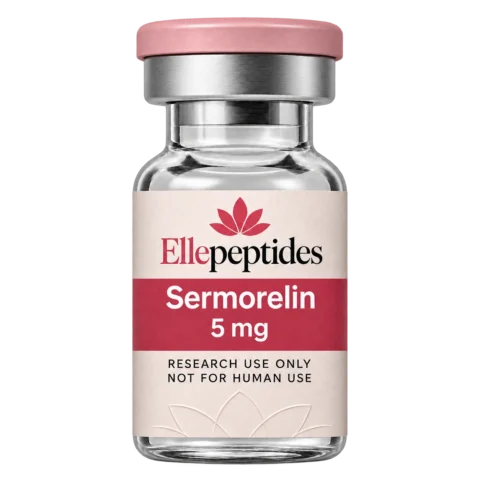
| Sermorelin | GHRH(1–29) amide | GHRH receptor | Growth in GH-deficient children; aging studies | About 4.3 min (healthy men) | 5 and 10 mg |
| CJC-1295 No DAC | Tetrasubstituted GRF(1–29), no DAC | GHRH receptor | Little direct published research | No peer-reviewed human value found | 10 mg |
| Ipamorelin | Synthetic pentapeptide | Ghrelin receptor | Selective GH release (animals); bowel-recovery trial | About 2 h (healthy men) | 5 and 10 mg |
Three of these four compounds act on the GHRH receptor, yet their chemistry differs: tesamorelin carries all 44 residues plus the hexenoyl cap, whereas sermorelin and CJC-1295 No DAC are 29-residue fragments. Ipamorelin takes a separate route through the ghrelin receptor. For visceral- or liver-fat questions, tesamorelin has the deepest controlled human literature of the four.
Tesamorelin handling, storage and reconstitution math
Tesamorelin arrives as a dry, freeze-dried cake, and the vial label is the authority on storage conditions. Sensible laboratory habits include avoiding repeated temperature swings, keeping vials dry and away from light, and logging each reconstitution date. Questions about a specific vial can go to [email protected].
Concentration is straightforward arithmetic: vial mass divided by solvent volume. A 10 mg vial brought up in 2 mL, for example, gives 5 mg/mL. The peptide calculator handles unit conversions, and bacteriostatic water is listed separately as a diluent. None of this describes use in people or animals.
Ordering tesamorelin in the US
Tesamorelin orders ship to addresses within the United States. Shipping is free when the merchandise subtotal exceeds $200 after coupon discounts (before taxes and shipping); below that, standard shipping is $15.99 per order. Available payment methods and delivery options are shown at checkout. Current details are in the shipping policy.
Tesamorelin FAQ
What is tesamorelin?
Tesamorelin is a synthetic GHRH analogue built from the 44-amino-acid human GRF sequence with an added hexenoyl group. In research it prompts the pituitary to release its own growth hormone. It is not growth hormone, and Ellepeptides lists it only as freeze-dried material for laboratory research.
How much does tesamorelin cost in the US?
Listed prices start at $68.35 USD for a 5 mg vial, with 10 mg at $120.00 and 20 mg at $190.00. That works out to about $13.67, $12.00 and $9.50 per mg respectively. The size selector shows the current price, which may change after this page was written.
Where can I buy tesamorelin in the US for research?
Ellepeptides lists tesamorelin research vials that ship to US addresses, priced in U.S. dollars. Shipping is free once the merchandise subtotal passes $200 after coupons. The material is sold for laboratory research only, never for personal use.
What has tesamorelin been studied for?
Mainly visceral fat. The best-known trial found a 15.2% visceral-fat reduction versus a 5.0% increase with placebo after 26 weeks in adults with HIV-associated abdominal fat. Later trials examined liver fat and cognition in older adults. Each result applies to its own study population, not to people generally.
What side effects were reported in tesamorelin trials?
The US label lists administration-site reactions (17%) and joint pain (13%) as the most frequent adverse reactions in its 26-week controlled trials, followed by limb pain, muscle pain and peripheral edema at about 6% each. Those figures come from adults with HIV and may not transfer to other populations.
What is the half-life of tesamorelin?
Short. The US prescribing information reports a mean elimination half-life of about 11 minutes in healthy subjects after a single administration. Effects seen in trials, such as IGF-I changes, reflect the downstream growth-hormone response rather than the peptide itself lingering in circulation for hours.
Tesamorelin vs sermorelin: what is the difference?
Both act on the GHRH receptor. Sermorelin is the 29-residue active fragment of GHRH, while tesamorelin keeps all 44 residues and adds a hexenoyl group. Their evidence also differs: sermorelin was studied in GH-deficient children and older adults, tesamorelin mainly in HIV-associated visceral fat. See the sermorelin page.
Tesamorelin vs ipamorelin: do they work the same way?
No. Tesamorelin signals through the GHRH receptor, while ipamorelin acts at the ghrelin (GH secretagogue) receptor. Both lead toward growth-hormone release, but by separate routes, so findings for one compound should not be assigned to the other. The ipamorelin page summarizes its own studies.
Has tesamorelin been studied in women?
Yes, but sparsely. Men made up 84–86% of participants in the two main 26-week trials, and the 12-month Makimura study included 21 women among 60 adults without reporting a women-only result. No trial enrolling only women was identified, so female-specific effects remain an open question.
Is tesamorelin sold as capsules, a nasal spray or a cream?
Not by Ellepeptides. Tesamorelin is listed only as freeze-dried powder in sealed vials. No capsule, nasal or topical version is offered, and none of the studies summarized on this page evaluated such formats, so their findings cannot be assumed to apply to them.
Tesamorelin references
- US FDA, 2025. EGRIFTA WR (tesamorelin) prescribing information. FDA (PDF)
- PubChem. Tesamorelin, CID 16137828. PubChem
- Makimura et al., 2012. Tesamorelin in abdominal obesity. PMC
- Falutz et al., 2007. Tesamorelin and visceral fat in HIV. PubMed
- Baker et al., 2012. GHRH analogue and cognition in older adults. PMC
- Stanley et al., 2014. Tesamorelin and liver fat. PMC
- Stanley et al., 2019. Tesamorelin in HIV-associated fatty liver. PMC
- Soule et al., 1994. D-Ala2 and GHRH(1–29) half-life in men. PubMed
- Gobburu et al., 1999. Ipamorelin pharmacokinetics in healthy men. PubMed
- Beck et al., 2014. Ipamorelin after bowel resection. PubMed
Related research materials: Muscle & Performance peptides, Sermorelin, Ipamorelin, CJC-1295 No DAC, CJC-1295 No DAC + Ipamorelin Blend and the Ellepeptides research library. For laboratory research only. Not for human or veterinary use.

Reviews
There are no reviews yet.