
Description
TB-500 at a glance
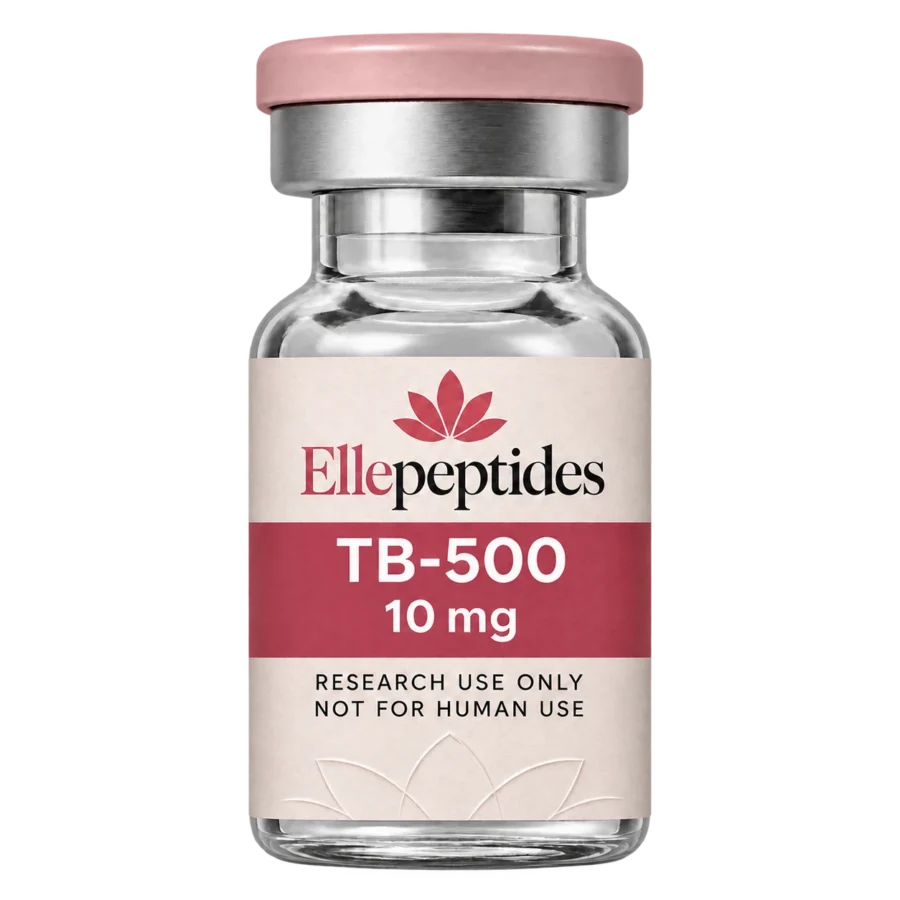
TB-500 is a catalog name tied to thymosin beta-4, a 43-residue actin-binding protein studied in wound, hair-follicle and heart-injury models. The name is not a precise identity: one product sold as TB-500 turned out to contain a 7-residue acetylated fragment instead (Esposito et al., 2012). Ellepeptides lists TB-500 as freeze-dried research material in 5 mg and 10 mg vials.
- Molecule type: thymosin beta-4-related peptide (full protein or fragment)
- Vial sizes: 5 mg or 10 mg nominal per vial
- Listed price: from $52.50 USD
- Form: freeze-dried (lyophilized) powder
- Shipping: within the US; free shipping once the merchandise subtotal tops $200 (shipping policy)
- Intended use: laboratory research only
TB-500 vial sizes and price per mg
| Vial size | Listed price (USD) | Price per mg |
|---|---|---|
| TB-500 5 mg | $52.50 | $10.50 |
| TB-500 10 mg | $100.00 | $10.00 |
Prices in U.S. dollars were current at the time of writing; pick a size above for today’s figure. The larger vial lowers the cost per milligram by about 5%; no extra bulk or coupon discount is implied.
TB-500 compound profile
| Listed material | TB-500 |
|---|---|
| Vial options | 5 mg or 10 mg |
| Parent protein | Thymosin beta-4, 43 amino-acid residues |
| Fragment found in a TB-500 product | Ac-LKKTETQ: N-terminally acetylated residues 17–23 of thymosin beta-4 |
| Molecular form of this stock | Must be confirmed from the material documentation |
| Reference constants | None assigned: the full protein and the fragment are different structures |
| Physical form | Freeze-dried powder in a sealed vial |
Protein length comes from the original characterization of thymosin beta-4 (Low and Goldstein, 1982) and the fragment sequence from a mass-spectrometry analysis of a TB-500 product (Esposito et al., 2012). They describe reference structures only, not what a given Ellepeptides lot contains.
How TB-500 works in research
The mechanistic knowledge here belongs to full-length thymosin beta-4; whether the short fragment reproduces any of it has not been established in the sources reviewed.
Actin regulation. Thymosin beta-4 binds individual actin monomers and limits their assembly into filaments, as shown in a biochemical assay (Safer et al., 1991). Since the actin skeleton drives cell shape and crawling, this binding is a common starting point for explaining its effects on cell migration.
Cell survival signaling. In heart cells, thymosin beta-4 was linked to PINCH and integrin-linked kinase (ILK) signaling and to activation of Akt, a survival enzyme. After coronary artery ligation in mice, treated animals showed better early heart-muscle-cell survival and cardiac function (Bock-Marquette et al., 2004).
Tissue remodelling. Treated rat skin wounds re-epithelialized more and showed greater collagen deposition and new vessel formation than controls (Malinda et al., 1999). In rodent hair-follicle work it promoted follicular-cell migration and differentiation and raised the matrix enzyme MMP-2 (Philp et al., 2004).
Key TB-500 studies
| Year | Study & model | What was measured | Main finding | Source |
|---|---|---|---|---|
| 1999 | Malinda et al. — rat skin wounds, keratinocytes | Re-epithelialization, collagen, vessels | Treated wounds showed more epithelium, collagen and vessel growth | PubMed |
| 2004 | Philp et al. — rats and mice | Hair growth, follicle-cell migration, MMP-2 | Increased hair growth and follicular-cell migration | PubMed |
| 2004 | Bock-Marquette et al. — heart cells, mice after coronary ligation | Akt activation, cell survival, cardiac function | Better early heart-cell survival and function | PubMed |
| 2010 | Ruff et al. — 40 healthy volunteers, randomized vs placebo | Safety and pharmacokinetics of intravenous thymosin beta-4 | Adverse events infrequent, mild to moderate; no serious events | PubMed |
| 2012 | Esposito et al. — product sold as TB-500 | Molecular identity | Contained acetylated fragment 17–23 (Ac-LKKTETQ) | PubMed |
| 2015 | Sosne and Ousler — 72 adults with dry eye, 54 women | Signs and symptoms vs placebo, eye drops | Primary endpoints not met; some secondary measures improved | PMC |
| 2026 | Biçer et al. — 32 male rats after Achilles repair | Load to failure, histology | Thymosin beta-4 group improved load to failure | PubMed |
The human safety study. Ruff and colleagues randomized four cohorts of 10 healthy volunteers to synthetic thymosin beta-4 or placebo, given intravenously once at four ascending levels and then daily for 14 days. Adverse events were infrequent and mild to moderate, with no serious events; exposure rose in proportion to the amount given and half-life lengthened at higher levels. The abstract does not report the sex breakdown (Ruff et al., 2010).
Why identity changes the reading. Apart from the 2012 identity analysis, the studies above tested thymosin beta-4 itself rather than material identified as the fragment, so their results cannot be assumed for fragment material (Esposito et al., 2012).
TB-500 research involving women
The clearest data on women come from a 2015 randomized, placebo-controlled dry-eye trial. Of its 72 participants, 54 were women, and it tested an eye-drop formulation of full-length thymosin beta-4. Neither primary endpoint differed significantly from placebo, although some secondary signs and symptoms did (Sosne and Ousler, 2015).
That was a topical formulation for one eye condition, not this stock. The healthy-volunteer study abstract gives no sex breakdown, and the tendon comparison used male rats. No study of TB-500 material in women was identified in the sources reviewed. For compounds with female study populations, see our peptides for women collection.
TB-500 vs BPC-157, the Wolverine blend and KLOW
| Compound | Type | Main research focus | Sizes on Ellepeptides |
|---|---|---|---|
| TB-500 (this page) | Thymosin beta-4 or its 7-residue fragment | Actin binding, wound, hair-follicle and cardiac models | 5 mg, 10 mg |
| BPC-157 | 15-amino-acid synthetic peptide | Tendon-cell migration, vessel formation | 5 mg, 10 mg |
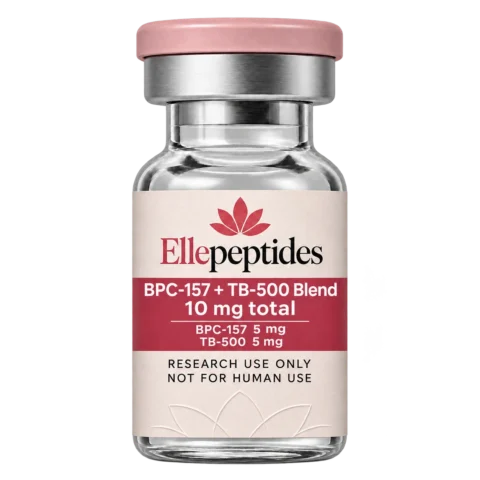
| BPC-157 + TB-500 Blend | Two-peptide mixture (Wolverine) | Combination designs | 5 mg + 5 mg |
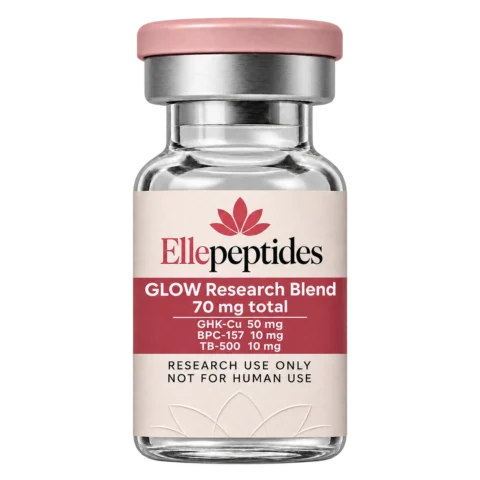
| KLOW Research Blend | Four-component mixture | GHK-Cu, BPC-157, TB-500 and KPV together | 80 mg |
TB-500 and BPC-157 are unrelated molecules: thymosin beta-4 works through actin, while BPC-157 has been linked to FAK–paxillin signaling in rat tendon cells (Chang et al., 2011). The blend fixes a 1:1 mixture, and KLOW adds GHK-Cu, a copper peptide studied for fibroblast collagen synthesis (Maquart et al., 1988), plus KPV.
TB-500 handling, storage and reconstitution math
Store unopened vials as the label specifies and note the lot number on arrival. Once opened, mark the solvent, volume and date so colleagues can reproduce your figures.
Mass concentration is the vial’s milligrams divided by milliliters of solvent: a 5 mg vial taken up in 2.5 mL gives 2 mg per mL. Molar concentration is a different matter for TB-500, because the 7-residue fragment and the 43-residue protein differ greatly in molar mass, so the same milligrams represent very different numbers of molecules. The peptide calculator does the mass arithmetic only and gives no usage amounts. Bacteriostatic water is stocked in lab supplies for methods that specify it.
Ordering TB-500 in the US
Orders ship to addresses within the United States. Shipping is free when the merchandise subtotal exceeds $200 after coupon discounts (before taxes and shipping); below that, standard shipping is $15.99 per order. Available payment methods and delivery options are shown at checkout. Current details are in the shipping policy.
TB-500 FAQ
Where can I buy TB-500 in the US?
TB-500 research vials can be ordered on this page and are shipped to US addresses. Both the 5 mg and 10 mg sizes are freeze-dried powder intended strictly for laboratory work, not consumer use. Related materials, including BPC-157, sit in the Healing & Recovery category.
Can you buy TB-500 over the counter?
Ellepeptides does not sell TB-500 as an over-the-counter or consumer product. What is offered here is research material: a sealed vial of freeze-dried powder labeled for laboratory use only. It is not packaged or labeled as a finished health product, and should not be treated as one.
Is TB-500 the same as thymosin beta-4?
Not necessarily. Thymosin beta-4 is the natural 43-residue protein, while a 2012 analysis of a TB-500 product found only the acetylated fragment Ac-LKKTETQ, residues 17–23 (Esposito et al., 2012). Ask [email protected] about the molecular form before matching this material to a full-protein study.
What are the benefits of TB-500 in studies?
Studies of full-length thymosin beta-4 reported faster wound re-epithelialization in rats (Malinda et al., 1999), increased hair growth in rodents and better early heart-cell survival in mice. These are animal and cell findings, and an eye-drop trial in people missed its primary endpoints, so no benefit in humans has been established.
What side effects of TB-500 have been reported?
For full-length thymosin beta-4 given intravenously to 40 healthy volunteers, adverse events were infrequent and mild to moderate, with no serious events over 14 days (Ruff et al., 2010). No comparable safety data were found for the TB-500 fragment, and short trials cannot show long-term effects.
What is the half-life of TB-500?
No published half-life was found for the TB-500 fragment. For full-length thymosin beta-4 in healthy volunteers, the half-life lengthened as the amount given increased (Ruff et al., 2010). Half-life describes how fast a measured concentration falls, not how long an effect lasts or how long a vial keeps.
What is the difference between TB-500 and BPC-157?
They are different molecules with separate research histories and targets. TB-500 relates to thymosin beta-4 and actin regulation, while BPC-157 is a 15-amino-acid synthetic peptide studied mainly for tendon-cell migration and blood-vessel formation in rodent models. Neither has established human benefits.
Can TB-500 and BPC-157 be tested in the same experiment?
Only if the combination itself is the research question, with arms for each peptide alone, the mixture and a control. The one controlled comparison, in rats after tendon repair, found the pair did not beat the single peptides (Biçer et al., 2026). A premixed BPC-157 + TB-500 Blend is also listed.
Is TB-500 available as a pill or nasal spray?
Not from Ellepeptides. TB-500 is listed only as freeze-dried powder in 5 mg and 10 mg vials for laboratory research. Products sold as pills, capsules or sprays are different formulations, and their contents and molecular form would need to be checked separately.
How much does TB-500 cost?
The 5 mg vial is listed at $52.50 USD and the 10 mg vial at $100.00, which is $10.50 and $10.00 per mg. The size selector above always shows the current price. Shipping is free once the merchandise subtotal is over $200 after coupons.
Is there TB-500 research in women?
Only indirectly. A 2015 dry-eye trial of thymosin beta-4 eye drops enrolled 54 women among 72 participants and missed both primary endpoints (Sosne and Ousler, 2015). No study of TB-500 material in women was found, and the main animal comparison used male rats.
TB-500 references
- Low and Goldstein (1982). Chemical characterization of thymosin beta-4.
- Safer et al. (1991). Thymosin beta-4 binds actin monomers.
- Malinda et al. (1999). Thymosin beta-4 in wound healing. J Invest Dermatol.
- Philp et al. (2004). Thymosin beta-4 and hair-follicle cells. FASEB J.
- Bock-Marquette et al. (2004). Thymosin beta-4, ILK and cardiac repair. Nature.
- Ruff, Crockford, Girardi and Zhang (2010). Thymosin beta-4 in healthy volunteers. Ann N Y Acad Sci.
- Esposito et al. (2012). Fragment 17–23 identified in TB-500. Drug Test Anal.
- Sosne and Ousler (2015). Thymosin beta-4 eye drops in dry eye.
- Biçer et al. (2026). Rat tendon repair study. Jt Dis Relat Surg.
- Chang et al. (2011). BPC 157 and tendon fibroblasts. J Appl Physiol.
- Maquart et al. (1988). GHK-Cu and fibroblast collagen.
Related research materials: Healing & Recovery peptides, research peptides, BPC-157, BPC-157 + TB-500 Blend, KLOW, KPV and our research overview. For laboratory research only. Not for human or veterinary use.

Reviews
There are no reviews yet.