
Description
CJC-1295 No DAC + Ipamorelin Blend at a glance
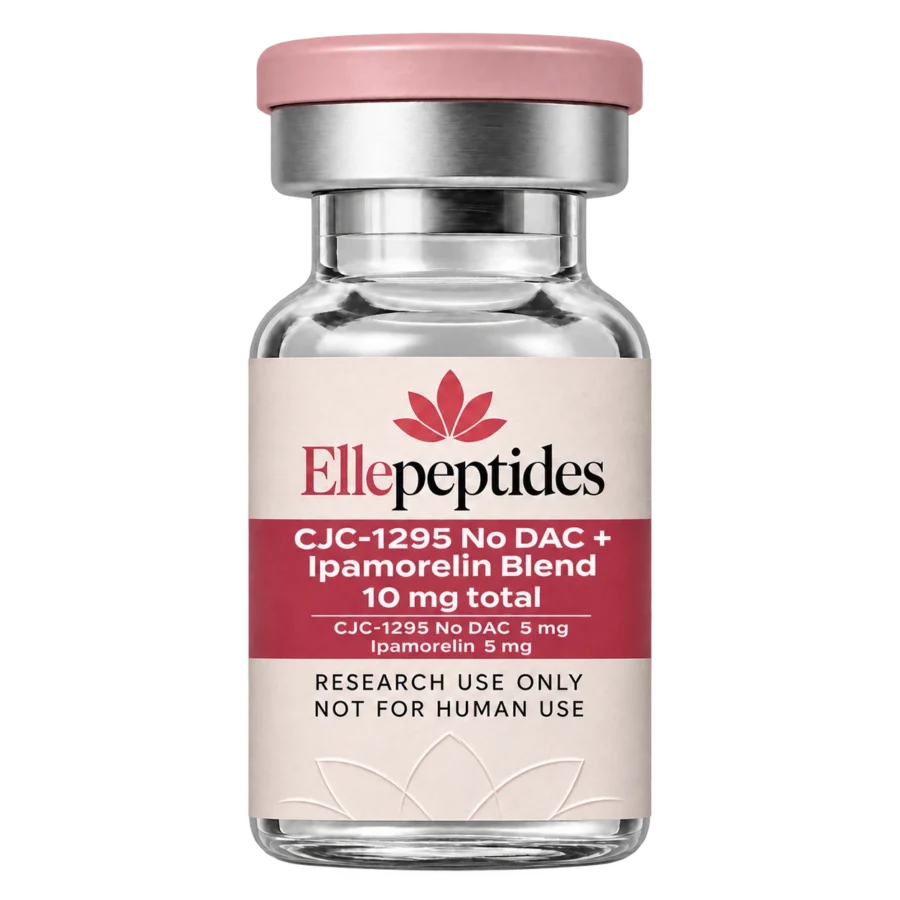
The CJC-1295 No DAC + Ipamorelin Blend combines two growth-hormone secretagogues from different receptor classes in one freeze-dried vial: 5 mg of CJC-1295 No DAC, a modified GRF(1–29) fragment acting at the GHRH receptor, and 5 mg of ipamorelin, a pentapeptide acting at the ghrelin receptor. No published study has tested this exact mixture, so the evidence below is component-level. It sits with the other peptide blends.
- Composition: 5 mg CJC-1295 No DAC + 5 mg ipamorelin (10 mg total) in one vial
- Molecule types: modified GRF(1–29) analogue without DAC, and a synthetic pentapeptide
- Listed price: from $90.00 USD per vial
- Form: freeze-dried (lyophilized) powder
- Shipping: within the United States; free shipping on merchandise over $200
- Use: for laboratory research only
CJC-1295 + Ipamorelin blend vial size and price per mg
| Vial size | Listed price (USD) | Price per mg |
|---|---|---|
| 5 mg + 5 mg (10 mg total) | $90.00 | $7.60 |
The per-milligram figure divides the $90.00 listed price by the 10 mg combined content. It was current at the time of writing; the product page shows any update. No bundle saving through the cart or coupons is promised.
CJC-1295 + Ipamorelin blend compound profile
| CJC-1295 No DAC | 5 mg |
|---|---|
| Ipamorelin | 5 mg |
| Total per vial | 10 mg |
| Composition | Two listed compounds in one vial |
| CJC component reference | GRF(1–29) core with D-Ala2, Gln8, Ala15 and Leu27 substitutions; no albumin-binding linker |
| Ipamorelin reference record | PubChem CID 9831659 |
| Molecular description | Two distinct compounds; no single sequence, CAS, molecular formula or molar mass describes the mixture. |
Each component has its own reference description; the mixture has none. These entries say nothing about the ratio, identity or composition measured in a Ellepeptides lot, which requires material documentation.
How the CJC-1295 + Ipamorelin blend works in research
The blend pairs two routes to the same pituitary output. The CJC-1295 No DAC component is a GHRH-receptor analogue whose four core substitutions match those of CJC-1295, minus the albumin-binding linker (Jetté et al., 2005). Ipamorelin acts at the ghrelin receptor and, in animal work, released GH without raising ACTH or cortisol (Raun et al., 1998).
Human evidence for combining the two classes is older and indirect. In 18 healthy men, submaximal amounts of a GH-releasing peptide (GHRP) given together with GHRH released GH synergistically, which the authors read as a sign that the two act independently (Bowers et al., 1990). It used GHRP and GHRH(1–44), not ipamorelin or CJC-1295 No DAC, so synergy for this pairing remains a hypothesis.
Key studies behind the CJC-1295 + Ipamorelin blend
| Year | Study & model | What was measured | Main finding | Source |
|---|---|---|---|---|
| 1990 | 18 healthy men; GHRP alone and with GHRH(1–44) | Peak GH; other pituitary hormones | Combination released GH synergistically; prolactin and cortisol roughly doubled only at the highest GHRP level | Bowers et al. |
| 1998 | Rat pituitary cells, rats and swine (ipamorelin) | GH release; ACTH and cortisol | Selective GH release; no ACTH or cortisol rise | Raun et al. |
| 1999 | Healthy men (ipamorelin) | Plasma levels; GH response | Terminal half-life about 2 h; single GH peak at about 40 min | Gobburu et al. |
| 2005 | Rat cells and rats (CJC-1295 with DAC vs unconjugated analogue) | GH secretion; plasma persistence | 4-fold GH area under the curve vs unconjugated hGRF(1–29); present beyond 72 h | Jetté et al. |
| 2006 | Healthy men (CJC-1295 with DAC) | GH pulsatility; trough and mean GH | Pulses preserved; trough GH 7.5-fold; mean GH +46% | Ionescu & Frohman |
| 2014 | 117 adults after bowel resection (ipamorelin) | Recovery of gut function; adverse events | No significant efficacy difference; well tolerated for up to 7 days | Beck et al. |
None of these rows tested the blend. Three involve ipamorelin alone, two involve CJC-1295 with DAC rather than the No DAC component, and the synergy study used older compounds. Together they explain why the pairing is studied, not how this vial performs.
The pulsatility result shapes interpretation: continuous GHRH-receptor stimulation by the DAC compound raised trough GH 7.5-fold while leaving pulse frequency and size intact (Ionescu & Frohman, 2006). Because the No DAC component lacks the albumin linker, that sustained pattern should not be assumed for the blend. Plain-language context for each component is collected in the Ellepeptides research library.
CJC-1295 + Ipamorelin blend research involving women
No study of this mixture in women, or in female animals, was identified. Component evidence is thin as well: the ipamorelin surgery trial enrolled women and men without a women-specific result (Beck et al., 2014), and the CJC-1295 trials that included women used the DAC form, not the No DAC component (Teichman et al., 2006). The synergy and pulsatility studies enrolled men only.
For female-focused research, the blend has no direct evidence base, and mostly male cohorts cannot fill that gap. The peptides for women collection groups related compounds.
CJC-1295 + Ipamorelin blend vs separate vials and sermorelin
| Compound | Type | Receptor studied | Main research focus | Published half-life | Sizes on Ellepeptides |
|---|---|---|---|---|---|
| CJC-1295 No DAC + Ipamorelin Blend | Two-component mixture | GHRH + ghrelin receptors | No study of this mixture | Not established | 5 mg + 5 mg |
| CJC-1295 No DAC | Tetrasubstituted GRF(1–29), no DAC | GHRH receptor | Little direct published research | No peer-reviewed human value found | 10 mg |
| Ipamorelin | Synthetic pentapeptide | Ghrelin receptor | Selective GH release (animals); bowel-recovery trial | About 2 h (healthy men) | 5 and 10 mg |
| Sermorelin | GHRH(1–29) amide | GHRH receptor | Growth in GH-deficient children; aging studies | About 4.3 min (healthy men) | 5 and 10 mg |
The practical choice is between one fixed-ratio vial and two standalone vials. The blend locks the components at 1:1 by mass. Separate CJC-1295 No DAC (10 mg) and ipamorelin (5 or 10 mg) vials let a study test each compound alone or vary the ratio, which is needed to attribute an effect to one component. Sermorelin is the closest unmodified GHRH-receptor alternative to the CJC component.
CJC-1295 + Ipamorelin blend handling, storage and reconstitution math
The blend arrives as a single freeze-dried cake containing both peptides, and the label is the reference for storage conditions. Because two compounds share one vial, record lot and reconstitution date for every aliquot so results trace back to the mixed material. Questions go to [email protected].
Concentration arithmetic needs one extra step. With 10 mg of total peptide, 2 mL of solvent gives 5 mg/mL combined, or 2.5 mg/mL of each component. The peptide calculator handles the total; divide by two for each compound. Bacteriostatic water is listed separately. This is lab arithmetic only, not guidance for use in people or animals.
Ordering the CJC-1295 + Ipamorelin blend in the US
CJC-1295 No DAC + Ipamorelin Blend orders ship to addresses within the United States. Shipping is free when the merchandise subtotal exceeds $200 after coupon discounts, before taxes and shipping. Otherwise, standard shipping is $15.99 per order. The available payment methods and delivery options are shown at checkout. Current details are in the shipping policy.
CJC-1295 + Ipamorelin blend FAQ
What is the CJC-1295 and ipamorelin blend?
It is one freeze-dried vial holding 5 mg of CJC-1295 No DAC and 5 mg of ipamorelin, 10 mg in total. The first targets the GHRH receptor, the second the ghrelin receptor. Ellepeptides sells it for laboratory research; the mixture itself has not been evaluated in any published study.
Does 10 mg total mean 10 mg of each peptide?
No. The listed composition is 5 mg of CJC-1295 No DAC plus 5 mg of ipamorelin, which adds up to 10 mg in the vial. When working out concentrations, divide the combined figure by two to get the amount of each component per milliliter.
How much does the CJC-1295 ipamorelin blend cost in the US?
The blend is listed at $90.00 USD per vial, about $9.00 per mg of combined peptide, at the time of writing. The product page always shows the current price. Standalone CJC-1295 No DAC and ipamorelin vials are priced on their own pages.
Where can I buy CJC-1295 with ipamorelin in the US?
Ellepeptides lists the 5 mg + 5 mg blend, shipped within the United States with prices in U.S. dollars and payment methods shown at checkout. Free shipping applies once the merchandise subtotal passes $200 after coupons. It is sold for laboratory research only, never for personal use.
What CJC-1295 and ipamorelin benefits have been studied?
Only the components have been studied. Ipamorelin released GH selectively in animals, and long-acting CJC-1295 raised GH and IGF-I in healthy adults. A 1990 study showed synergy between a GH-releasing peptide and GHRH. None of this was measured with this blend, and none shows muscle or fat outcomes.
What side effects were reported for CJC-1295 and ipamorelin?
Component data only. In a 117-patient surgical trial, ipamorelin was described as well tolerated for up to seven days, and the trials of CJC-1295 with DAC reported no serious adverse reactions. No adverse-event data exist for this blend or for the No DAC component on its own.
Is the CJC-1295 in this blend the DAC version?
No. The blend contains CJC-1295 No DAC, which lacks the albumin-binding linker. Long-acting CJC-1295 with DAC had an estimated half-life of 5.8–8.1 days in healthy adults, and that figure does not apply here. If an experiment depends on the exact sequence, ask for material documentation.
Blend or separate vials: which suits a study better?
It depends on the design. The blend fixes a 1:1 ratio in one vial, which simplifies handling and record-keeping. Separate vials of CJC-1295 No DAC and ipamorelin let researchers test each compound alone or change the ratio, which is needed to attribute an effect to one component.
Has the CJC-1295 ipamorelin blend been studied in women?
No. No study of this mixture in women or in female animals was identified for this page. Component trials either enrolled men only, reported no women-specific results, or, in the case of the Teichman trials, used CJC-1295 with DAC instead of the No DAC component.
Is the blend available as a nasal spray or capsules?
Ellepeptides offers the CJC-1295 No DAC + Ipamorelin Blend only as freeze-dried powder in a sealed vial. No nasal, oral or topical version is listed, and none of the component studies evaluated such formats, so their findings should not be applied to them.
CJC-1295 + Ipamorelin blend references
- Beck et al., 2014. Ipamorelin after bowel resection. PubMed
- Jetté et al., 2005. hGRF(1–29)-albumin conjugates and CJC-1295. PubMed
- PubChem. Ipamorelin, CID 9831659. PubChem
- Raun et al., 1998. Ipamorelin, the first selective GH secretagogue. PubMed
- Bowers et al., 1990. GHRP and GHRH synergy in normal men. Oxford Academic
- Gobburu et al., 1999. Ipamorelin pharmacokinetics in healthy men. PubMed
- Ionescu & Frohman, 2006. GH pulsatility during CJC-1295. PubMed
- Teichman et al., 2006. Long-acting CJC-1295 in healthy adults. PubMed
- Soule et al., 1994. D-Ala2 and GHRH(1–29) half-life in men. PubMed
Related research materials: Peptide Blends, Muscle & Performance peptides, CJC-1295 No DAC, Ipamorelin, Sermorelin and Tesamorelin. For laboratory research only. Not for human or veterinary use.

Reviews
There are no reviews yet.