
Description
BPC-157 + TB-500 Blend (Wolverine blend) at a glance
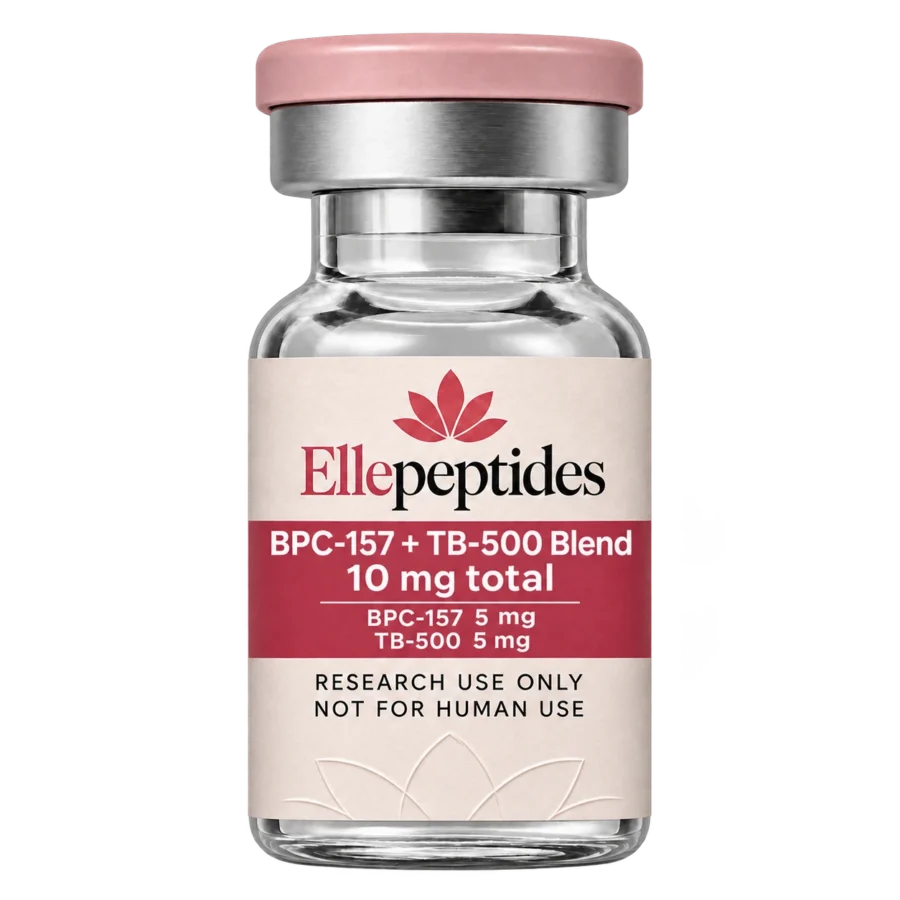
The BPC-157 + TB-500 Blend puts 5 mg of BPC-157 and 5 mg of TB-500 into one freeze-dried research vial, 10 mg of peptide in total. “Wolverine” is an informal market nickname borrowed from the fast-healing comic-book character, not a scientific name. The only controlled study of the pair, a 2026 rat tendon experiment, found no advantage over either peptide alone (Biçer et al., 2026).
- Type of material: fixed two-peptide mixture, 1:1 by listed mass
- Vial size: one vial, 5 mg BPC-157 + 5 mg TB-500
- Listed price: from $82.50 USD
- Form: freeze-dried (lyophilized) powder
- Shipping: within the United States; free shipping over a $200 merchandise subtotal (shipping policy)
- Intended use: laboratory research only
BPC-157 + TB-500 Blend vial sizes and price per mg
| Vial size | Listed price (USD) | Price per mg |
|---|---|---|
| 5 mg BPC-157 + 5 mg TB-500 (10 mg total) | $82.50 | $7.60 (combined peptide) |
The blend comes in one size, priced in U.S. dollars at the time of writing; the price beside Add to cart is current. Separate 5 mg vials of BPC-157 and TB-500 would list at $112.50; no further bundle or coupon saving is promised.
BPC-157 + TB-500 Blend compound profile
| Catalog name | BPC-157 + TB-500 Blend (nickname: Wolverine) |
|---|---|
| Components per vial | BPC-157 5 mg; TB-500 5 mg |
| Total listed peptide | 10 mg |
| BPC-157 reference identity | 15 amino acids, GEPPPGKPADDAGLV; 1419.5 g/mol; CAS 137525-51-0 |
| TB-500 reference identity | Name used for full thymosin beta-4 (43 residues) or for the acetylated fragment Ac-LKKTETQ (residues 17–23); the form supplied must be confirmed |
| Mixture descriptors | No single sequence, CAS number or formula applies |
| Physical form | Freeze-dried powder, single vial |
Rows describe reference molecules from PubChem for BPC-157 and from Low and Goldstein (1982) and Esposito et al. (2012) for thymosin beta-4 and the TB-500 fragment, not the lot composition of a specific vial.
How the BPC-157 + TB-500 Blend works in research
No mechanism has been published for the mixture itself, only separate work on two molecules acting through unrelated routes.
BPC-157 side. In rat tendon fibroblasts, BPC-157 increased cell migration and survival under oxidative stress and activated FAK–paxillin signaling without directly raising proliferation (Chang et al., 2011). In vessel models it raised VEGFR2 expression and Akt–eNOS signaling, speeding blood-flow recovery in ischemic rat limbs (Hsieh et al., 2017).
Thymosin beta-4 side. Full-length thymosin beta-4 binds single actin molecules and holds them back from assembling into filaments in a biochemical assay (Safer et al., 1991). In rat skin wounds it increased re-epithelialization, collagen deposition and new vessel growth (Malinda et al., 1999).
Pairing them rests on a hypothesis that cell-movement signaling and actin regulation might complement each other. Testing it needs a control, each peptide alone and the mixture, and the TB-500 identity question applies throughout: a 7-residue fragment is not the 43-residue protein these studies used.
Key BPC-157 + TB-500 Blend studies
| Year | Study & model | What was measured | Main finding | Source |
|---|---|---|---|---|
| 1999 | Malinda et al. — rat skin wounds, keratinocytes (thymosin beta-4) | Re-epithelialization, collagen, vessel growth | Treated wounds healed with more epithelium, collagen and vessels than controls | PubMed |
| 2011 | Chang et al. — rat tendon fibroblasts (BPC-157) | Migration, survival, signaling | Greater migration and stress survival; FAK–paxillin activation | PubMed |
| 2012 | Esposito et al. — analysis of a product sold as TB-500 | Molecular identity by mass spectrometry | Found the acetylated thymosin beta-4 fragment Ac-LKKTETQ | PubMed |
| 2021 | Lee and Padgett — retrospective knee-pain review | Patient-reported pain by telephone | 3 of 4 patients given the combination reported improvement; no controls | PubMed |
| 2026 | Biçer et al. — 32 male rats after Achilles repair | Load to failure, histology | Thymosin group improved load to failure; combination did not beat single peptides | PubMed |
The only head-to-head comparison. Biçer and colleagues repaired Achilles tendons in 32 male rats and compared BPC-157, synthetic thymosin beta-4 and the two together. The thymosin group showed a significant gain in load to failure; the combination improved one histology score but did not outperform the single treatments. This exploratory work offers no evidence of an additive effect (Biçer et al., 2026).
The human signal is anecdotal. In the 2021 knee-pain chart review, four of the 16 patients reached by telephone had received BPC-157 with thymosin beta-4, and three of those four reported improvement. Four uncontrolled cases cannot establish synergy or tissue repair (Lee and Padgett, 2021).
BPC-157 + TB-500 Blend research involving women
No study of BPC-157 and TB-500 together in women was identified in the sources reviewed; the 2026 combination experiment used male rats only. Evidence involving women exists only for each component, in narrow settings. For BPC-157, a 2024 uncontrolled chart review described 12 women with interstitial cystitis, 10 of whom reported complete symptom resolution (Lee, Walker and Ayadi, 2024).
For thymosin beta-4, a 2015 randomized dry-eye trial enrolled 72 participants, 54 of them women, and tested an eye-drop formulation of the full-length protein; neither primary endpoint differed from placebo, though some secondary measures did (Sosne and Ousler, 2015). Neither tested a mixture, so neither describes this blend in women; see our peptides for women collection for related materials.
BPC-157 + TB-500 Blend vs BPC-157, TB-500 and KLOW
| Compound | Type | Main research focus | Sizes on Ellepeptides |
|---|---|---|---|
| BPC-157 + TB-500 Blend (this page) | Two-peptide mixture | Combination designs; one 2026 rat tendon study | 5 mg + 5 mg |
| BPC-157 | 15-amino-acid synthetic peptide | Tendon-cell migration, vessel formation | 5 mg, 10 mg |
| TB-500 | Thymosin beta-4 or its 7-residue fragment | Actin binding, wound and cardiac models | 5 mg, 10 mg |
| KLOW Research Blend | Four-component mixture | GHK-Cu 50 mg + BPC-157, TB-500, KPV 10 mg each | 80 mg |
Separate vials are more flexible when a design needs single-agent arms or a ratio other than 1:1; the blend suits work that calls for an equal-mass mixture. KLOW and the three-component GLOW add GHK-Cu, a copper peptide studied for collagen synthesis in fibroblast cultures (Maquart et al., 1988), so results from those vials cannot be attributed to BPC-157 and TB-500 alone.
BPC-157 + TB-500 Blend handling, storage and reconstitution math
Keep the sealed two-component vial closed until use, store it as the label directs, and record the lot number and the dates received and opened. Once dissolved, both peptides share one solution and cannot be separated.
Divide each component’s mass by the solvent volume: in 5 mL, each 5 mg component works out to 1 mg per mL, or 2 mg per mL of combined peptide. The peptide calculator handles the division; it does not suggest amounts for any use. Bacteriostatic water and alcohol prep pads are available if your method calls for them.
Ordering the BPC-157 + TB-500 Blend in the US
Orders ship to addresses within the United States. Shipping is free when your merchandise subtotal exceeds $200 after coupon discounts (before taxes and shipping). Otherwise, standard shipping is $15.99 per order. The available payment methods and delivery options are shown at checkout—see the shipping policy for current details.
BPC-157 + TB-500 Blend FAQ
What is the Wolverine peptide stack?
Wolverine is a market nickname for BPC-157 combined with TB-500, borrowed from the comic-book character known for rapid healing. It is not a scientific name and implies no fixed amounts; on Ellepeptides it means this single freeze-dried vial with 5 mg of each peptide, 10 mg in total rather than 10 mg of either.
How much does the BPC-157 and TB-500 blend cost?
The blend is listed at $82.50 USD, about $8.25 per mg of combined peptide, while separate 5 mg vials of each would list at $112.50. Shipping is free on merchandise subtotals over $200, and the price beside Add to cart is always current.
What does TB-500 do compared with BPC-157?
They act through different routes in laboratory models. Thymosin beta-4, the protein behind the TB-500 name, binds actin and limits filament assembly (Safer et al., 1991), while BPC-157 has been linked to FAK–paxillin and VEGFR2 signaling in rat cells. Neither mechanism has been shown in people.
Is it worth studying BPC-157 and TB-500 together?
Only if the question is about the combination. A sound design compares a control, each peptide alone and the mixture. The single controlled study built that way, in rats after tendon repair, found the pair did not outperform either peptide alone, so it does not support synergy claims (Biçer et al., 2026).
Is a pre-mixed blend or separate vials better for research?
It depends on the design. Separate BPC-157 and TB-500 vials allow single-agent arms and any ratio, which a combination study needs. The blend fixes a 1:1 ratio by mass in one vial, convenient only when the protocol specifies exactly that mixture.
Is the TB-500 in this blend full-length thymosin beta-4?
The name alone does not tell you. One product sold as TB-500 contained the seven-residue acetylated fragment Ac-LKKTETQ rather than the 43-residue protein (Esposito et al., 2012). Ask [email protected] about the material before matching it to a study that used the full protein.
What side effects have been reported for BPC-157 and TB-500 together?
No controlled safety data on the combination were found. A 2025 review found no clinical safety data for BPC-157 (Vasireddi et al., 2025). In 40 healthy volunteers given intravenous full-length thymosin beta-4, adverse events were infrequent and mild to moderate (Ruff et al., 2010); neither finding describes this mixture.
Is the Wolverine blend sold as a nasal spray or capsules?
No. Ellepeptides sells this blend only as freeze-dried powder in a sealed vial for laboratory work. It is not a capsule, nasal spray, cream or ready-made liquid, and products sold in those forms are a different type of material with their own composition.
Can I buy the Wolverine blend in the US, and how does it ship?
Yes, from this page; it ships to addresses within the United States. Delivery options are shown at checkout, and shipping is free on merchandise subtotals over $200 after coupons; see the shipping policy.
Has the BPC-157 and TB-500 combination been studied in women?
Not that we could find. The combination study used male rats, and the 2021 knee-pain review had only four combination patients. Data involving women exist only for each peptide alone, in a bladder-pain chart review and an eye-drop trial (Sosne and Ousler, 2015).
BPC-157 + TB-500 Blend references
- Biçer et al. (2026). Rat Achilles repair comparison. Jt Dis Relat Surg.
- Lee and Padgett (2021). Knee-pain retrospective review. Altern Ther Health Med.
- Chang et al. (2011). BPC 157 and tendon fibroblasts. J Appl Physiol.
- Hsieh et al. (2017). BPC 157 and VEGFR2. J Mol Med.
- Vasireddi et al. (2025). BPC-157 systematic review. HSS J.
- Lee, Walker and Ayadi (2024). Interstitial cystitis pilot.
- Safer et al. (1991). Thymosin beta-4 and actin binding.
- Malinda et al. (1999). Thymosin beta-4 wound model. J Invest Dermatol.
- Low and Goldstein (1982). Thymosin beta-4 characterization.
- Esposito et al. (2012). TB-500 fragment analysis. Drug Test Anal.
- Sosne and Ousler (2015). Dry-eye randomized trial.
- Ruff et al. (2010). Thymosin beta-4 in healthy volunteers. Ann N Y Acad Sci.
- Maquart et al. (1988). GHK-Cu and fibroblast collagen.
- PubChem CID 9941957 (BPC-157).
Related research materials: Peptide Blends, Healing & Recovery, BPC-157, TB-500, KLOW, KPV and the Ellepeptides research library. For laboratory research only. Not for human or veterinary use.

Reviews
There are no reviews yet.