
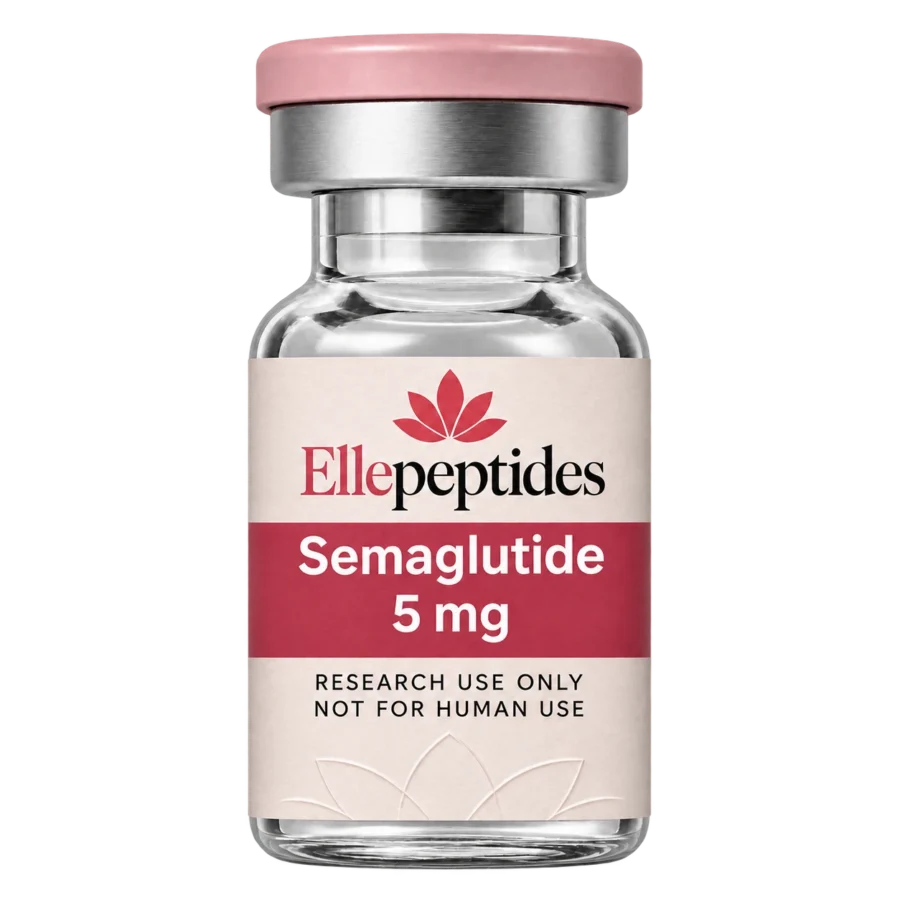
Description
Semaglutide at a glance
Semaglutide is a modified, long-acting analogue of the gut hormone GLP-1, designed in the 2010s for once-weekly activity. It is the reference GLP-1 receptor agonist in metabolic research, with large trials on weight, blood glucose, cardiovascular events and kidney outcomes. This page covers the research material: Ellepeptides lists freeze-dried semaglutide in 5, 10, 20 and 30 mg vials among its weight management research peptides.
- Molecule: 31-amino-acid lipidated GLP-1 analogue; single-receptor (GLP-1) agonist
- Vial sizes: 5 mg, 10 mg, 20 mg and 30 mg
- Listed price: from $60.00 USD (5 mg); the 30 mg vial is the lowest per mg at $7.00
- Form: freeze-dried (lyophilized) powder
- Shipping: within the US; free shipping once the subtotal passes $200 after coupons
- Use: laboratory research only — see the full research peptide range
Semaglutide vial sizes and price per mg
| Vial size | Listed price (USD) | Price per mg |
|---|---|---|
| 5 mg | $60.00 | $12.00/mg |
| 10 mg | $90.00 | $9.00/mg |
| 20 mg | $160.00 | $8.00/mg |
| 30 mg | $210.00 | $7.00/mg |
Prices are in U.S. dollars at the time of writing; the size selector always reflects the current listing. The 30 mg vial works out cheapest per mg, so check the table for each size’s cost per mg. Bulk or combination savings are not promised; any discount would show only in the cart or through a valid coupon.
Semaglutide compound profile
| Research name | Semaglutide |
|---|---|
| Compound class | Modified GLP-1 analogue; lipidated peptide |
| Peptide length | 31 amino acids |
| Structural changes | Two amino-acid substitutions versus human GLP-1; fatty-acid side chain at lysine 26 |
| Reference molecular formula | C187H291N45O59 |
| Reference molar mass | 4114 g/mol |
| CAS number | 910463-68-2 |
| PubChem record | CID 56843331 |
The formula, mass and identifiers come from the PubChem reference record; the structural changes are described in the discovery paper by Lau et al. (2015). These values describe the standard reference molecule. Salt form, hydrate and the analytical profile of a supplied lot are separate questions that a reference record cannot answer.
How Semaglutide works in research
Natural GLP-1 is released from the intestine after a meal and acts on GLP-1 receptors in the pancreas, gut and brain, where it is studied for glucose-dependent insulin release, slower stomach emptying and appetite signaling. Its weakness as a research tool is that the native hormone is rapidly degraded. Semaglutide was built to solve that problem while keeping receptor activity.
Lau et al. (2015) describe the design logic. The goal was full stability against metabolic degradation plus high affinity for albumin, the main blood protein; two amino-acid substitutions and a fatty-acid chain linked at lysine 26 delivered both, prolonging exposure. Compared with liraglutide, semaglutide’s GLP-1 receptor affinity was about three-fold lower (0.38 nM) while its albumin affinity was higher. The plasma half-life was 46.1 hours in minipigs, and the paper cites a reported human half-life of about 165 hours — roughly one week. This is why clinical research uses weekly schedules. All of these are properties of the reference molecule studied by the investigators, not measurements of a research vial.
Key Semaglutide studies
| Year | Study & model | What was measured | Main finding | Source |
|---|---|---|---|---|
| 2015 | Lau et al.; molecular design, receptor assays, minipigs | Receptor and albumin affinity, half-life | GLP-1 receptor affinity 0.38 nM; higher albumin affinity; half-life 46.1 h in minipigs | PubMed |
| 2016 | SUSTAIN-6; 3,297 adults with type 2 diabetes at high cardiovascular risk | Cardiovascular death, heart attack or stroke over 104 weeks | 6.6% vs 8.9% with placebo | PubMed |
| 2021 | STEP 1; 1,961 adults with overweight or obesity, no diabetes | Weight change at 68 weeks | −14.9% vs −2.4% with placebo | PubMed |
| 2021 | SURPASS-2; 1,879 adults with type 2 diabetes, semaglutide as comparator | HbA1c at 40 weeks | −1.86 points with semaglutide vs −2.01 to −2.30 with tirzepatide | PubMed |
| 2023 | SELECT; 17,604 adults with overweight or obesity and cardiovascular disease, no diabetes | Major cardiovascular events, mean 39.8 months | 6.5% vs 8.0% with placebo | PubMed |
| 2024 | FLOW; 3,533 adults with type 2 diabetes and chronic kidney disease | Composite of kidney events and kidney or cardiovascular death | 24% lower hazard vs placebo | PubMed |
| 2025 | SURMOUNT-5; 751 adults with obesity, open-label vs tirzepatide | Weight change at 72 weeks | −13.7% with semaglutide vs −20.2% with tirzepatide | PubMed |
| 2025 | REDEFINE 1; 3,417 adults with overweight or obesity | Weight change at 68 weeks with cagrilintide plus semaglutide | −20.4% vs −3.0% with placebo | ACC summary |
STEP 1 is the core obesity trial. Its 1,961 participants received semaglutide or placebo with lifestyle intervention for 68 weeks. Gastrointestinal adverse events occurred in 74.2% of the semaglutide group versus 47.9% on placebo, and 4.5% versus 0.8% stopped treatment because of them (Wilding et al., 2021).
Outcome trials look beyond weight. SUSTAIN-6 was designed to show cardiovascular non-inferiority in type 2 diabetes (Marso et al., 2016); SELECT enrolled a high-risk population with established heart disease, not a general sample (Lincoff et al., 2023). FLOW’s 24% figure refers to the hazard of a combined outcome, not a 24% improvement in kidney function (Perkovic et al., 2024).
Comparisons and combinations. In head-to-head trials semaglutide is usually the comparator: it trailed tirzepatide in SURPASS-2 and SURMOUNT-5, both open-label. REDEFINE 1 tested it alongside the amylin analogue cagrilintide, a pairing often called CagriSema (Garvey et al., 2025, via ACC).
Semaglutide research involving women
Representation of women varies sharply across the semaglutide program. STEP 1 was 74.1% women (STEP 1 participant characteristics), so its obesity findings rest mainly on female participants. SELECT was the opposite: only 28% of participants were female (ACC summary of SELECT), which means the cardiovascular-outcome evidence leans heavily on men.
Neither trial reported a separate women-specific primary result; the figures above are pooled. None of the studies cited here measured menopause, fertility, pregnancy or polycystic ovary syndrome as outcomes, so those questions remain open in this evidence base. We include semaglutide in our peptides for women collection for browsing convenience, not because of a women-specific finding.
Semaglutide vs tirzepatide, retatrutide and cagrilintide
| Compound | Type | Receptor targets | Main research focus | Sizes on Ellepeptides |
|---|---|---|---|---|
| Semaglutide (this page) | Lipidated GLP-1 analogue | GLP-1 | Weight, glucose, cardiovascular and kidney outcomes | 5, 10, 20, 30 mg |
| Tirzepatide | Lipidated dual agonist | GIP and GLP-1 | Weight, glucose, sleep apnea; compared directly with semaglutide | 10, 15, 20, 30, 60 mg |
| Retatrutide | Lipidated triple agonist | GIP, GLP-1 and glucagon | Weight, glucose; one sponsor-reported trial vs semaglutide | 5, 10, 30, 50, 60 mg |
| Cagrilintide | Lipidated amylin analogue | Amylin and calcitonin receptors | Weight, alone and combined with semaglutide | 5, 10 mg |
Each newer incretin compound has been measured against semaglutide. Tirzepatide led on weight in SURMOUNT-5 (Aronne et al., 2025); retatrutide led on HbA1c and weight in TRANSCEND-T2D-2, a sponsor-reported open-label trial (Lilly, 2026), and adds glucagon-receptor activity (Coskun et al., 2022). Cagrilintide works through amylin receptors instead (Kruse et al., 2021), which is why it is studied as a partner to semaglutide rather than a replacement.
Handling, storage and reconstitution math
Semaglutide is shipped dry. As with most lyophilized peptides, moisture is the main enemy of the powder: leave the vial sealed until the day it is needed, and allow a cold vial to come up to room temperature before you open it. Follow the storage temperature and light conditions printed on your label; guidance written for a pharmacy pen product does not describe a research powder. A stopper wipe with an alcohol prep pad is standard bench practice.
Concentration is vial mass divided by solvent volume. Reconstituting a 5 mg vial with 2.5 mL of solvent gives 2 mg/mL; a 20 mg vial with 2.5 mL gives 8 mg/mL. The peptide calculator does this for any volume and unit. Labs that want a preserved diluent often use bacteriostatic water, but the protocol sets the solvent. The result is a concentration for bench work and nothing more — it is not an amount for a person or animal.
Ordering Semaglutide in the US
Ellepeptides ships semaglutide to addresses within the United States, with prices in U.S. dollars. Shipping is free when the merchandise subtotal exceeds $200 after coupon discounts (before taxes and shipping); below that, standard shipping is $15.99 per order. Available payment methods and delivery options are shown at checkout. Current details are in the shipping policy.
Semaglutide FAQ
How much does semaglutide cost in the US?
Ellepeptides lists research semaglutide from $60.00 USD for 5 mg, $90.00 for 10 mg, $160.00 for 20 mg and $210.00 for 30 mg. The 30 mg vial is the lowest per mg at $7.00, below the 20 mg vial at $8.00. Those figures date from November 2026, and the selector above always carries the current price.
Is this the same as generic semaglutide?
No. Ellepeptides sells freeze-dried research material, which is not a generic or brand-name medicine.
What is semaglutide peptide?
Semaglutide is a 31-amino-acid synthetic analogue of GLP-1 with two substitutions and a fatty-acid side chain that binds albumin, giving it a half-life of about a week (Lau et al., 2015). Novo Nordisk developed it; on Ellepeptides it is supplied only as freeze-dried powder for laboratory research.
What side effects were reported in the STEP trials?
Gastrointestinal events were the main finding. In STEP 1, 74.2% of semaglutide participants reported them versus 47.9% on placebo and 4.5% versus 0.8% stopped treatment because of them (Wilding et al., 2021). These figures describe trial participants, not research material.
What is the half-life of semaglutide?
About one week in humans. The discovery paper cites a reported human half-life of roughly 165 hours and measured 46.1 hours in minipigs (Lau et al., 2015). Albumin binding explains the long duration. Half-life describes clearance from the body; it is not a shelf life for powder or a guide to storage.
Semaglutide vs tirzepatide: what did trials show?
Tirzepatide produced larger changes in both direct comparisons. In SURMOUNT-5, weight changed −20.2% with tirzepatide versus −13.7% with semaglutide at 72 weeks (Aronne et al., 2025); in SURPASS-2, HbA1c fell 2.01–2.30 points versus 1.86 (Frías et al., 2021). Both were open-label trials of specific regimens.
Semaglutide vs retatrutide: has there been a direct trial?
Yes, one sponsor-reported trial. TRANSCEND-T2D-2 compared retatrutide with semaglutide in 1,298 adults with type 2 diabetes for 80 weeks. Lilly reported HbA1c changes of −2.2 versus −1.8 points and weight changes of −19.5% to −20.9% versus −9.4% (Lilly, October 2026); journal publication was pending.
What is CagriSema?
CagriSema is the research name for semaglutide combined with the amylin analogue cagrilintide. In REDEFINE 1, 3,417 adults with overweight or obesity saw a mean weight change of −20.4% at 68 weeks versus −3.0% with placebo (ACC summary). Ellepeptides lists the two compounds separately, not as a blend.
Does Ellepeptides sell semaglutide tablets, drops or cream?
No. Semaglutide is listed only as freeze-dried powder in sealed vials of 5, 10, 20 or 30 mg. There are no tablets, sublingual drops, nasal sprays, creams, pens or pre-mixed solutions. Tablet formulations exist only as separate pharmacy products; research labs reconstitute the vial powder according to their own written methods.
How should semaglutide vials be stored?
Go by the label on the vial you receive. Dry peptide powder is generally kept sealed, away from moisture and light, and the label overrides any general rule of thumb. If anything is unclear or missing, contact [email protected] before starting. The Ellepeptides research page explains how our product information is sourced.
Has semaglutide been studied in women?
Yes, though unevenly. Women made up 74.1% of STEP 1 (STEP 1) but only 28% of SELECT (ACC). The published headline results are pooled rather than women-specific, and none of the trials cited here measured menopause, fertility or pregnancy outcomes.
Semaglutide references
- National Center for Biotechnology Information. Semaglutide, PubChem CID 56843331. PubChem
- Lau J, et al. 2015. Discovery of the once-weekly GLP-1 analogue semaglutide. PubMed 26308095
- Marso SP, et al. 2016. SUSTAIN-6. PubMed 27633186
- Wilding JPH, et al. 2021. STEP 1. PubMed 33567185; PMC8089593
- Frías JP, et al. 2021. SURPASS-2. PubMed 34170647
- Lincoff AM, et al. 2023. SELECT. PubMed 37952131; American College of Cardiology trial summary. ACC
- Perkovic V, et al. 2024. FLOW. PubMed 38785209
- Aronne LJ, et al. 2025. SURMOUNT-5. PubMed 40353578
- Garvey WT, et al. 2025. REDEFINE 1 (cagrilintide with semaglutide); American College of Cardiology journal scan. ACC
- Eli Lilly and Company. October 28, 2026. TRANSCEND-T2D-2 results. Lilly announcement (PDF)
- Coskun T, et al. 2022. Retatrutide (LY3437943) discovery. PubMed 35985340
- Kruse T, et al. 2021. Cagrilintide development. PubMed 34288673
Related research materials: weight management peptides, tirzepatide, retatrutide, cagrilintide, AOD-9604 and our research sources page. For laboratory research only. Not for human or veterinary use.

Reviews
There are no reviews yet.