
Description
GLOW Peptide Blend at a glance
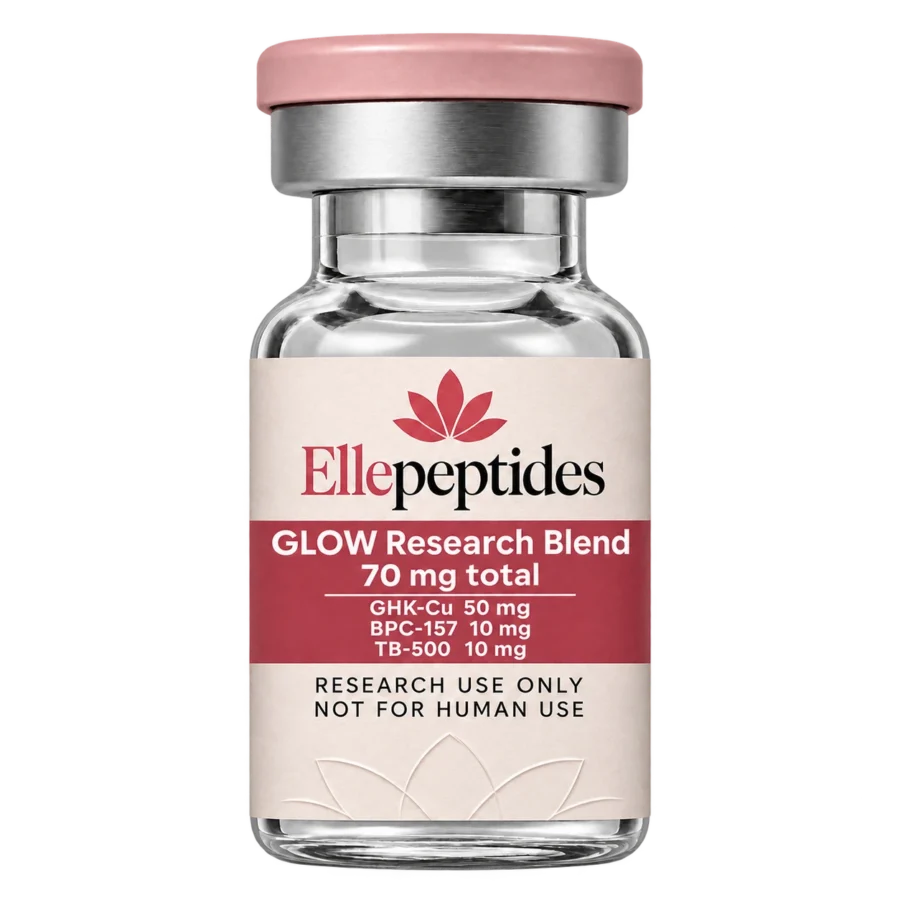
GLOW is a three-component research blend sold as one 70 mg freeze-dried vial: GHK-Cu 50 mg, BPC-157 10 mg and TB-500 10 mg. Its ingredients are studied mainly for skin-matrix, wound and connective-tissue questions in cells and animals, plus a small GHK-Cu serum trial in women. GLOW itself has never been tested in a published study.
- Type of material: fixed blend of a copper–peptide complex and two peptides
- Vial size: 70 mg combined (50 + 10 + 10 mg)
- Listed price: from $150.00 USD
- Form: lyophilized (freeze-dried) powder
- Shipping: within the US, free shipping over $200
- Scope: for laboratory research only
GLOW vial sizes and price per mg
| Vial size | Listed price (USD) | Price per mg |
|---|---|---|
| 70 mg (GHK-Cu 50 mg + BPC-157 10 mg + TB-500 10 mg) | $150.00 | $2.14 |
Listed USD prices reflect the time of writing; the size selector always shows the current price, and no bulk or combination discount through the cart or coupons is promised. KLOW, which adds KPV, lists 80 mg at $174.38 ($2.18 per mg).
GLOW compound profile
| Catalog name | GLOW Research Blend (70 mg) |
|---|---|
| Nominal amount per vial | 70 mg combined |
| Declared components | GHK-Cu 50 mg + BPC-157 10 mg + TB-500 10 mg |
| Mass ratio | 5 : 1 : 1 (about 71.4% GHK-Cu, 14.3% each of BPC-157 and TB-500) |
| GHK-Cu reference | Gly-His-Lys copper(II) complex, prezatide copper (PubChem CID 71587328) |
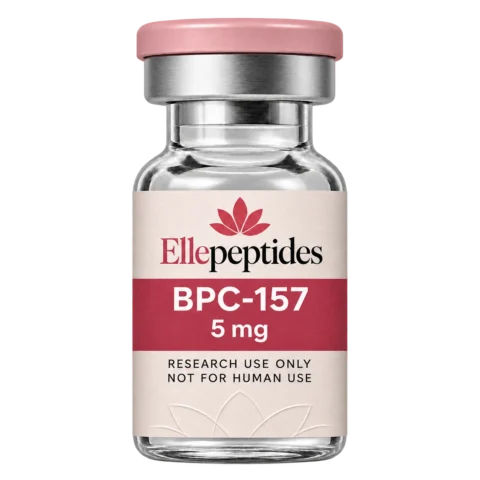
| BPC-157 reference | GEPPPGKPADDAGLV, 15 residues (PubChem CID 9941957) |
| TB-500 reference | Name linked to thymosin beta-4; molecular form needs confirmation |
| Mixture identity | Three distinct compounds; no shared CAS number, formula or molar mass |
| Intended scope | Laboratory research |
The profile lists what the label declares and the reference identity behind each name; it is not a measurement of any vial’s contents. The ratio matters for design: GHK-Cu outweighs each other component five to one.
How GLOW works in research
Because nobody has studied GLOW as a mixture, its mechanism is really three separate research stories. GHK-Cu, the largest share by mass, belongs to extracellular-matrix biology: fibroblasts exposed to it made more collagen (Maquart et al., 1988), and a later fibroblast study reported higher MMP-2 alongside its inhibitors TIMP-1 and TIMP-2, a picture of regulated matrix turnover rather than simple build-up (Simeon et al., 2000).
BPC-157 research centers on cell movement. Rat tendon fibroblasts treated with it migrated more and survived oxidative stress better, with FAK–paxillin signaling activated, although proliferation did not increase directly (Chang et al., 2011).
TB-500 is the least clear-cut ingredient. The name points to thymosin beta-4, which in rat skin wounds increased re-epithelialization, collagen deposition and new vessel growth (Malinda et al., 1999). Yet one analyzed TB-500 product contained a seven-residue acetylated fragment instead of the full protein (Esposito et al., 2012), so full-protein results may not transfer.
Key GLOW component studies
| Year | Study & model | What was measured | Main finding | Source |
|---|---|---|---|---|
| 1999 | Malinda et al. — rat skin wounds (thymosin beta-4) | Wound closure, collagen, vessels | Faster re-epithelialization; more collagen and new vessels | PubMed |
| 2000 | Simeon et al. — fibroblasts (GHK-Cu) | MMP-2, TIMP-1, TIMP-2 | Enzyme and inhibitor levels both rose | PubMed |
| 2011 | Chang et al. — rat tendon fibroblasts (BPC-157) | Migration, survival | More migration and survival; FAK–paxillin activated | PubMed |
| 2012 | Esposito et al. — product labeled TB-500 | Molecular identity | Seven-residue fragment, not full thymosin beta-4 | PubMed |
| 2016 | Badenhorst et al. — 40 women aged 40–65, split-face (GHK-Cu serum) | Wrinkle volume, depth | Volume reduced 55.8% more than vehicle | Open-access PDF |
| 2026 | Biçer et al. — 32 male rats, repaired Achilles | Load to failure, histology | TB-500 alone significant; BPC-157 + TB-500 gave no extra benefit | Journal abstract |
Read every row as indirect evidence. None of these papers used the GLOW combination, and we found no published animal or human study of GHK-Cu, BPC-157 and TB-500 given together.
Two studies come closest. Badenhorst et al. is the only controlled trial in people: 40 women, eight weeks, a GHK-Cu serum in a lipid nano-carrier, which is a cosmetic vehicle very different from a research powder. Biçer et al. combined two of GLOW’s three components in rats with repaired Achilles tendons; TB-500 alone produced the significant gain in load to failure, and adding BPC-157 brought no benefit beyond either peptide alone.
GLOW research involving women
GLOW comes up often in women’s skin-research searches, but no trial of the blend in women, or in anyone, has been published. Women-specific evidence covers single components only:
- GHK-Cu serum: 40 female volunteers aged 40–65, 39 analyzed, randomized and double-blind. Wrinkle volume fell 55.8% more than with the vehicle and 31.6% more than with a Matrixyl 3000 product; the depth difference against Matrixyl was not statistically significant (Badenhorst et al., 2016).
- BPC-157: 12 women aged 39–76 with interstitial cystitis at one clinic, with no control group and self-reported outcomes; 10 reported full symptom resolution (Lee, Walker and Ayadi, 2024).
- TB-500: no women-specific outcome data were identified.
None of these participants received GLOW, and a serum’s results depend on its vehicle. Treat them as background for a research question, not expected outcomes. More materials are grouped under peptides for women.
GLOW vs KLOW, GHK-Cu and BPC-157 + TB-500
| Material | Composition | Main research focus | Sizes on Ellepeptides |
|---|---|---|---|
| GLOW (this page) | GHK-Cu 50 mg + BPC-157 10 mg + TB-500 10 mg | Matrix turnover, tendon-cell migration, wound models | 70 mg vial |
| KLOW | GLOW + KPV 10 mg | As GLOW, plus PepT1 and inflammatory signaling | 80 mg vial |
| GHK-Cu | GHK-Cu only | Collagen synthesis, MMP/TIMP balance | 50 mg and 100 mg vials |
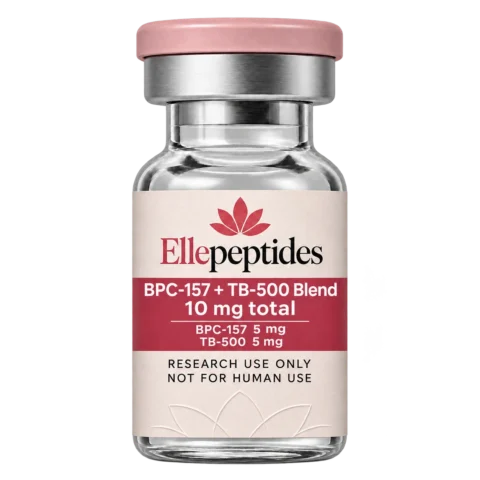
| BPC-157 + TB-500 Blend | BPC-157 5 mg + TB-500 5 mg | Tendon and wound models | 10 mg vial |
GLOW vs KLOW comes down to one ingredient: KLOW adds 10 mg of KPV and costs $24.38 more at listed prices. Against single-compound GHK-Cu, GLOW trades flexibility for convenience. Its ratio is fixed at 5 : 1 : 1, so a study that must separate GHK-Cu’s contribution from that of the other two will usually use individual vials such as BPC-157 and TB-500.
Handling, storage and reconstitution math
Common practice for freeze-dried peptides is to keep sealed vials dry, dark and cool as the label directs, warm them to room temperature before opening, and label any prepared solution with the date and solvent. Specific temperatures and shelf life belong on the product label, not on this page.
To find concentration, divide vial mass by solvent volume, then repeat for each component. Dissolving a 70 mg GLOW vial in 3.5 mL gives 20 mg/mL total: about 14.29 mg/mL GHK-Cu and 2.86 mg/mL each of BPC-157 and TB-500. Use the peptide calculator for other volumes; bacteriostatic water and other lab supplies are listed separately.
Ordering GLOW in the US
GLOW ships to addresses within the United States. Free shipping applies once the merchandise subtotal tops $200 after coupon discounts, before taxes and shipping. Below that, standard shipping costs $15.99 per order. Delivery options and the available payment methods are shown at checkout. Details are in the shipping policy.
GLOW Peptide FAQ
What is the GLOW peptide?
GLOW is a research blend, not one peptide. A single freeze-dried vial holds GHK-Cu, BPC-157 and TB-500, 70 mg in total. The name is a market label for this fixed combination; each ingredient has its own literature, but the blend has no published studies of its own.
What is in GLOW peptide?
GHK-Cu 50 mg, BPC-157 10 mg and TB-500 10 mg. The 70 mg is the combined total, not 70 mg of each. Because the TB-500 name has been applied to a fragment of thymosin beta-4, check the documentation for that component before matching it to a paper.
GLOW vs KLOW: what changes?
Only KPV. KLOW keeps GLOW’s three amounts and adds 10 mg of KPV, a tripeptide studied for PepT1 transport and inflammatory signaling, for 80 mg in total. That extra component raises the listed price by $24.38. Neither blend has been tested, and no study compares them.
What GLOW peptide benefits have been studied?
No benefits of GLOW have been studied, because no GLOW trial exists. The components have been examined separately: GHK-Cu for collagen and matrix turnover, BPC-157 for tendon-cell migration, thymosin beta-4 for rat wound healing. Those are research observations, not blend outcomes.
Are there GLOW peptide before and after results?
Not from any published study. Before-and-after images online are anecdotes with unknown materials and no controls. The closest measured data come from a GHK-Cu serum trial in which 40 women had wrinkle volume measured before and after eight weeks, a different product from this powder.
What are the side effects of the GLOW peptide?
No study has reported side effects for GLOW because none has tested it. In the GHK-Cu serum trial one of 40 women stopped after minor skin reactions. A 2025 systematic review of BPC-157 found no study that assessed human safety (Vasireddi et al., 2025). Absence of data is not evidence of safety.
What is a GLOW peptide stack?
In online use, a “stack” means combining several compounds; GLOW is a pre-mixed version of GHK-Cu, BPC-157 and TB-500 in one vial. Whether stacked or pre-mixed, no published research has shown that these three together behave differently from each one alone.
Is there a GLOW peptide pen?
Ellepeptides sells GLOW only as lyophilized powder in a sealed research vial. We do not offer pens, cartridges or pre-mixed liquids, and no published data exist for any such format of this blend. Concentration arithmetic for preparing a solution from the powder is covered in the handling section above.
How much is GLOW peptide in the US?
The 70 mg vial is listed at $150.00 USD at the time of writing, about $2.14 per mg; the selector shows the current price. Shipping is free on merchandise subtotals over $200 after coupons. Related products are in peptide blends.
Has GLOW been studied in women?
No. Women-specific data exist only for components in other forms: a 40-woman split-face GHK-Cu serum trial and a 12-woman uncontrolled BPC-157 report in interstitial cystitis. Neither used GLOW, and neither supports a promised result in women; treat both as background for a research question.
GLOW references
- Maquart et al. (1988). GHK-Cu and fibroblast collagen synthesis. PubMed 3169264
- Malinda et al. (1999). Thymosin beta-4 accelerates wound healing. PubMed 10469335
- Simeon et al. (2000). GHK-Cu and MMP-2/TIMP regulation. PubMed 11045606
- Chang et al. (2011). BPC-157 and tendon fibroblasts. PubMed 21030672
- Esposito et al. (2012). Analysis of a TB-500 product. PubMed 22962027
- Badenhorst T et al. (2016). GHK-Cu serum split-face trial. J Aging Sci. Open-access PDF
- Lee E, Walker C, Ayadi B (2024). BPC-157 interstitial cystitis pilot. PubMed 39325560
- Vasireddi N et al. (2025). BPC-157 systematic review. HSS J. PMC12313605
- Biçer O et al. (2026). BPC-157 and TB-500 in rat tendon repair. Journal abstract
- NCBI PubChem: GHK-Cu and BPC-157 records.
Related research materials: Peptide Blends, Skin, Hair & Nails, KLOW Research Blend (80 mg), GHK-Cu Copper Peptide, Copper Peptide Renewal Serum (finished skincare) and our research overview. For laboratory research only. Not for human or veterinary use.

Reviews
There are no reviews yet.