
Description
MOTS-c at a glance
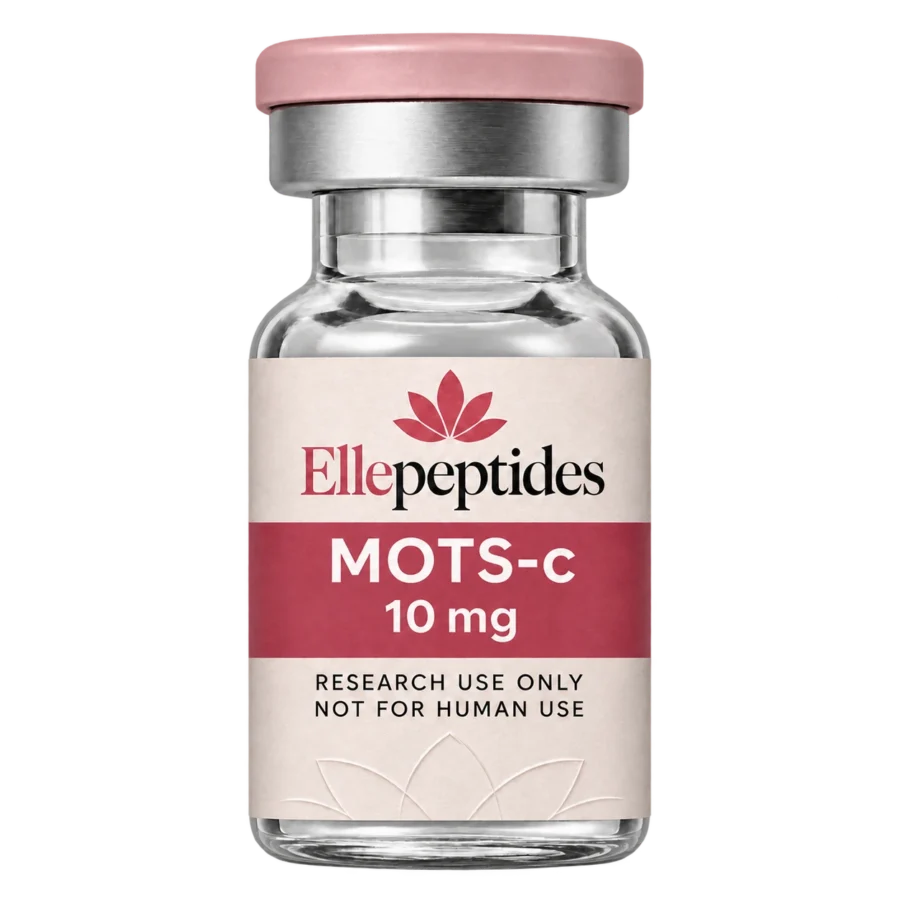
MOTS-c is a 16-amino-acid peptide encoded in mitochondrial DNA and studied for its role in cellular energy sensing, insulin sensitivity and exercise biology. Ellepeptides supplies MOTS-c as freeze-dried research material in 10 mg and 40 mg vials, listed in our energy and metabolic research collection. Below: what the studies found, and where the evidence stops.
- Molecule type: mitochondrial-derived peptide, 16 amino acids
- Vial sizes: 10 mg and 40 mg
- Listed price: from $100.00 USD
- Form: freeze-dried (lyophilized) powder
- Ships within the US; free shipping when the merchandise subtotal is over $200
- For laboratory research only
MOTS-c vial sizes and price per mg
| Vial size | Listed price (USD) | Price per mg |
|---|---|---|
| 10 mg | $100.00 | $10.00 |
| 40 mg | $160.00 | $4.00 |
Prices are listed in USD at the time of writing; the size selector above shows the current price. Bulk or combination savings through the cart or coupons are not promised.
MOTS-c compound profile
| Research name | MOTS-c (mitochondrial open reading frame of the 12S rRNA-c) |
|---|---|
| Compound class | Mitochondrial-derived peptide |
| Peptide length | 16 amino acids |
| Amino-acid sequence | MRWQEMGYIFYPRKLR |
| Reference molecular formula | C101H152N28O22S2 |
| Reference molar mass | 2174.6 g/mol |
| CAS number | 1627580-64-6 |
| PubChem record | CID 146675088 |
These rows describe the reference MOTS-c molecule in PubChem, not an analysis of any particular lot; salt form and water content can differ between materials. Check the vial label and any documentation supplied.
How MOTS-c works in research
The name spells out its origin: a short open reading frame inside the mitochondrial 12S rRNA region. In the 2015 discovery study, cultured cells exposed to MOTS-c showed shifts in folate and purine metabolism that raised AICAR, an intermediate that activates AMPK, the enzyme cells use to sense low energy. Mice given the peptide showed better insulin sensitivity and resisted diet-induced obesity. Lee et al. (2015)
A 2018 follow-up found that under metabolic stress MOTS-c moves into the nucleus of cultured cells and influences stress-response genes through an AMPK-dependent process. That is unusual biology: a peptide coded by the mitochondrial genome taking part in nuclear gene regulation. Kim et al. (2018)
Both findings describe mechanisms in cells and rodents. They do not show that a research vial produces these effects in a person, and no human trial of native MOTS-c has posted results yet.
Key MOTS-c studies
| Year | Study & model | What was measured | Main finding | Source |
|---|---|---|---|---|
| 2015 | Discovery study; cultured cells and mice | Folate metabolism, AMPK, insulin sensitivity | AMPK activated; treated mice resisted diet-induced obesity | Lee et al. |
| 2018 | Cultured cells under metabolic stress | Cell location; gene expression | Moved into the nucleus; regulated stress-response genes | Kim et al. |
| 2019 | Ovariectomized female mice | Fat mass, insulin resistance, brown-fat activity | Prevented ovariectomy-induced obesity and insulin resistance | Lu et al. |
| 2019 | Women with PCOS and healthy controls | Circulating MOTS-c before and after 8 weeks of exercise | No change in either group; MOTS-c was not given | Ramanjaneya et al. |
| 2021 | 10 young men (cycling); mice of three ages | Muscle and blood MOTS-c; mouse performance | Muscle MOTS-c rose 11.9-fold; treated mice performed better | Reynolds et al. |
| 2026 | MOTS-MET registry record; adults with prediabetes | Insulin sensitivity versus placebo, 12 weeks | Recruiting; no results posted | NCT07505745 |
| 2021 | CB4211 phase 1a/1b record (an analogue) | Safety of the analogue | Completed, 88 participants; no registry results | NCT03998514 |
In the 2021 exercise paper, muscle MOTS-c rose 11.9-fold after cycling in 10 young men, and blood levels climbed temporarily. Those volunteers were not given MOTS-c; the performance gains came from a separate arm in which mice of three ages received it. Reynolds et al. (2021)
The MOTS-MET record, checked on 5 November 2026, lists a recruiting placebo-controlled study of native MOTS-c: an estimated 120 adults with prediabetes and overweight or obesity, 12 weeks, insulin sensitivity as the focus and safety monitoring through week 16. Last updated 1 April 2026; no posted results. ClinicalTrials.gov NCT07505745
CB4211 is often confused with MOTS-c. CohBar described CB4211 as an analogue of MOTS-c, and its phase 1a/1b record lists a completed study with 88 participants and no posted registry results. CB4211 findings concern a modified molecule, not MOTS-c. Our research standards page explains how we separate these categories of evidence.
MOTS-c research involving women
The only human study on this page that focused on women measured MOTS-c rather than giving it. Researchers compared circulating MOTS-c in women with polycystic ovary syndrome (PCOS) and healthy controls; eight weeks of moderate exercise did not change levels in either group. That is baseline biology, not a PCOS treatment result. Ramanjaneya et al. (2019)
The most direct female-model data come from mice. In ovariectomized mice, a laboratory model of the estrogen loss that follows menopause, MOTS-c prevented ovariectomy-induced weight gain and insulin resistance, increased brown-fat activation, reduced white-fat accumulation and inflammatory infiltration, and lowered fatty acids in serum and liver. Surgical removal of the ovaries in mice is not human menopause, so these results raise questions rather than answer them. Lu et al. (2019)
The evidence gap is plain: the human exercise data come from men, and MOTS-MET lists both women and men as eligible but reports no enrollment by sex or sex-specific outcomes. Browse the peptides for women hub for other compounds with women-specific study notes.
MOTS-c vs NAD+, SS-31 and 5-Amino-1MQ
| Compound | Type | Main research focus | Sizes on Ellepeptides |
|---|---|---|---|
| MOTS-c (this page) | Mitochondrial-derived peptide, 16 amino acids | AMPK signaling, insulin sensitivity, exercise biology | 10 mg, 40 mg |
| NAD+ | Dinucleotide coenzyme, not a peptide | Redox reactions; substrate for sirtuins and PARPs | 500 mg, 1000 mg |
| SS-31 (Elamipretide) | Synthetic tetrapeptide | Binding to cardiolipin in the inner mitochondrial membrane | 10 mg, 50 mg |
| 5-Amino-1MQ | Small molecule, not a peptide | Inhibition of the NNMT enzyme | 10 mg, 50 mg |
All four appear in mitochondrial research but act at different points: a signaling peptide, a reaction cofactor, a membrane-lipid binder and an enzyme inhibitor. A finding for one cannot be borrowed for another.
MOTS-c handling, storage and reconstitution math
MOTS-c is supplied as a lyophilized solid. Read the vial label for the stated amount and storage conditions, keep the vial sealed until your protocol calls for it, and log the lot number with your experiment.
Concentration is vial mass divided by solvent volume. Adding 2 mL to a 10 mg vial gives 5 mg/mL; the same 2 mL in a 40 mg vial gives 20 mg/mL. The peptide calculator handles these conversions. Labs that draw from a vial more than once often use bacteriostatic water; choose the solvent your protocol specifies.
Ordering MOTS-c in the US
MOTS-c orders ship to addresses within the United States. Shipping is free when your merchandise subtotal is over $200 after coupon discounts (before taxes and shipping); below that, standard shipping is $15.99 per order. Delivery options and the available payment methods are shown at checkout, so check the shipping policy for current details.
MOTS-c FAQ
What is MOTS-c?
MOTS-c is a 16-amino-acid peptide encoded by a short reading frame in the mitochondrial 12S rRNA region. It belongs to a group called mitochondrial-derived peptides. In cell and mouse studies it activated the energy sensor AMPK and moved into the nucleus under stress. Ellepeptides sells it as freeze-dried research material in 10 mg and 40 mg vials.
What benefits of MOTS-c have studies reported?
In mice, MOTS-c improved insulin sensitivity, resisted diet-induced obesity, prevented ovariectomy-induced weight gain and improved physical performance in young, middle-aged and old animals. No human trial of native MOTS-c has posted results, so none of these animal findings has been shown in people.
What side effects of MOTS-c have been reported?
No peer-reviewed human safety profile for native MOTS-c appears in the sources on this page. The human studies cited measured endogenous MOTS-c rather than giving it. The MOTS-MET record lists safety monitoring through week 16 but has posted no results, and the completed CB4211 study involved an analogue, not MOTS-c, with no registry results.
What is the half-life of MOTS-c?
A human half-life for native MOTS-c is not reported in the studies cited here. The human work so far tracked endogenous levels, such as the temporary rise in circulating MOTS-c after cycling in the 2021 exercise study. Treat any half-life figure that is quoted without a published pharmacokinetic study behind it with caution.
What is the difference between MOTS-c and NAD+?
MOTS-c is a peptide made of amino acids; NAD+ is a dinucleotide coenzyme that carries electrons in redox reactions and feeds enzymes such as sirtuins and PARPs. Both appear in metabolic research, but they are different chemical classes and are not interchangeable.
Is CB4211 the same as MOTS-c?
No. CohBar described CB4211 as an analogue of MOTS-c, meaning a modified molecule developed from it. Its phase 1a/1b study completed with 88 participants but posted no registry results. Statements about CB4211 should not be read as evidence about native MOTS-c, and this listing is for MOTS-c only.
Should I choose MOTS-c 10 mg or 40 mg?
Choose by how much material your experiment needs. The 10 mg vial is listed at $100.00 ($10.00 per mg) and the 40 mg vial at $160.00 ($4.00 per mg). The larger vial contains four times the nominal amount; it is not a different concentration or a more active product.
How do you reconstitute MOTS-c?
Reconstitution follows your laboratory protocol. The arithmetic is the same for any lyophilized material: vial mass divided by solvent volume gives concentration, so 10 mg in 2 mL is 5 mg/mL. The peptide calculator does the conversion. Solvent choice and storage after mixing follow the label and your protocol.
How much does MOTS-c cost in the US?
At the time of writing, Ellepeptides lists MOTS-c from $100.00 USD for 10 mg and $160.00 USD for 40 mg. The size selector shows the current price. Shipping is free when the merchandise subtotal is over $200 after coupons; otherwise standard shipping is $15.99.
Is MOTS-c available as a capsule or nasal spray?
Ellepeptides sells MOTS-c only as freeze-dried powder in sealed vials. The studies cited on this page did not test capsule or nasal spray versions, so their findings say nothing about those forms. Results from vial-based studies cannot be assumed to carry over to another form.
MOTS-c references
- National Library of Medicine, PubChem. MOTS-c, CID 146675088.
- Lee C, et al. (2015). MOTS-c discovery study. PMC4350682.
- Kim KH, et al. (2018). MOTS-c nuclear translocation. PMC6185997.
- Lu H, et al. (2019). MOTS-c in ovariectomized mice. PubMed 30725119.
- Ramanjaneya M, et al. (2019). MOTS-c in PCOS. PubMed 31066084.
- Reynolds JC, et al. (2021). MOTS-c, exercise and aging. PMC7817689.
- ClinicalTrials.gov (2026). MOTS-MET, NCT07505745.
- ClinicalTrials.gov (2021). CB4211 phase 1a/1b, NCT03998514.
- CohBar (2022). Form 10-K for 2021, SEC filing.
Related research materials: Energy & Metabolic, all research peptides, NAD+, SS-31 (Elamipretide), 5-Amino-1MQ and Epitalon. For laboratory research only. Not for human or veterinary use.

Reviews
There are no reviews yet.