Description
NAD+ at a glance
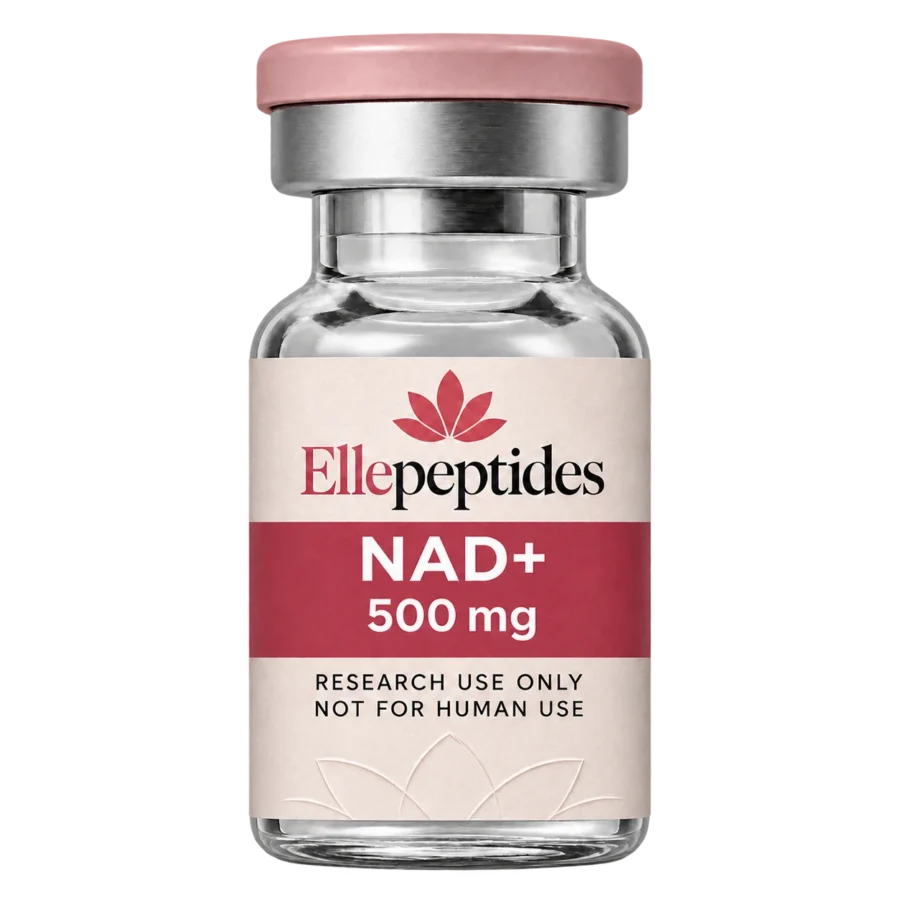
NAD+ is the oxidized form of nicotinamide adenine dinucleotide, a coenzyme rather than a peptide, even though it is often searched as “NAD+ peptide”. Researchers study it in electron-transfer reactions, in the enzymes that consume it during DNA repair and cellular regulation, and in age-related changes in tissue levels. Ellepeptides supplies NAD+ as freeze-dried research material in 500 mg and 1000 mg vials, part of the energy and metabolic collection.
- Molecule type: dinucleotide coenzyme, not a peptide
- Vial sizes: 500 mg and 1000 mg
- Listed price: from $100.00 USD
- Form: freeze-dried (lyophilized) powder
- Ships within the US; free shipping when the merchandise subtotal is over $200
- For laboratory research only
NAD+ vial sizes and price per mg
| Vial size | Listed price (USD) | Price per mg |
|---|---|---|
| 500 mg | $100.00 | $0.200 |
| 1000 mg | $210.00 | $0.210 |
Prices are listed in USD at the time of writing; the size selector above shows the current price. Bulk or combination savings through the cart or coupons are not promised.
NAD+ compound profile
| Research name | Nicotinamide adenine dinucleotide, oxidized form (NAD+; nadide) |
|---|---|
| Compound class | Dinucleotide coenzyme; not a peptide |
| Peptide length | Not applicable: not an amino-acid chain |
| Reference molecular formula | C21H27N7O14P2 |
| Reference molar mass | 663.4 g/mol |
| CAS number | 53-84-9 |
| PubChem record | CID 5892 |
The table identifies the NAD+ reference structure recorded in PubChem. It is not a lot analysis: the salt or free-acid form, water content and the actual composition of a given vial are matters for the label and any documentation supplied with it.
How NAD+ works in research
NAD+ and NADH are the oxidized and reduced forms of the same molecule. Enzymes pass electrons to NAD+ and later take them back from NADH, which is why the pair sits at the center of energy metabolism. The two names describe different reaction states and are not interchangeable reagents. National Library of Medicine MeSH: NAD
NAD+ is also used up. PARP enzymes consume it during DNA-damage responses, and sirtuins use it in cellular regulation, so tissue NAD+ reflects a balance between production and consumption. Massudi et al. (2012) A 2016 mouse study identified the NAD-consuming enzyme CD38 as a driver of age-related NAD decline and mitochondrial dysfunction. Camacho-Pereira et al. (2016)
A third lever is the enzyme NNMT, which methylates nicotinamide. In mice, reducing NNMT in fat and liver raised adipose NAD+ and SAM and protected against diet-induced obesity. Kraus et al. (2014) That is the target of 5-Amino-1MQ, a separate research compound. None of these pathways shows that adding NAD+ to a system reverses aging.
Key NAD+ studies
| Year | Study & model | What was measured | Main finding | Source |
|---|---|---|---|---|
| 2012 | Human skin samples from 49 people | Tissue NAD+ and age | Lower NAD+ with greater age in both sexes; observational | Massudi et al. |
| 2016 | Aging mice | Role of CD38 in NAD decline | CD38 contributed to age-related NAD decline and mitochondrial dysfunction | Camacho-Pereira et al. |
| 2018 | Healthy middle-aged and older adults; randomized crossover | NAD-related metabolism with NR (a precursor) | NR raised NAD-related metabolism over two six-week periods | Martens et al. |
| 2019 | 11 men: 8 NAD+ recipients, 3 controls | Plasma and urine NAD+ metabolites during intravenous infusion | Plasma NAD+ unchanged for two hours, then rose | Grant et al. |
| 2021 | 25 postmenopausal women with prediabetes and overweight or obesity | Muscle insulin sensitivity with NMN (a precursor) versus placebo | Improved after 10 weeks | Yoshino et al. |
| 2026 | Retrospective clinic review: 6 NAD+ recipients plus an NR group | Tolerability | All six NAD+ recipients reported unpleasant infusion-related symptoms | Reyna et al. |
Only two rows involve NAD+ itself being given to people, and both are small. The 2019 pilot followed eight men receiving NAD+ and three controls. Plasma NAD+ did not rise during the first two hours but increased later in the observation window, and urinary metabolites were tracked alongside. The study describes short-term metabolic handling, not anti-aging efficacy. Grant et al. (2019)
The other rows concern NAD biology or precursors. Nicotinamide riboside (NR) and nicotinamide mononucleotide (NMN) are distinct compounds, and a precursor result is not automatically a result for NAD+. Martens et al. (2018) is a crossover trial of NR; it supports studying a precursor, not equivalence between products.
NAD+ research involving women
The strongest women-specific result on this page is for a precursor, not for NAD+. In 25 postmenopausal women with prediabetes and overweight or obesity, 10 weeks of NMN improved muscle insulin sensitivity compared with placebo. The population was small and specific, and NMN is a different molecule. Yoshino et al. (2021)
For NAD+ itself, a 2026 retrospective clinic study included two women among six NAD+ recipients, alongside a separate NR group. All six NAD+ recipients reported unpleasant infusion-related symptoms such as abdominal cramping or nausea. With tiny groups, no placebo and no women-specific analysis, it cannot define a safety profile or benefit for women. Reyna et al. (2026)
The skin-tissue study found the age-related NAD+ decline in both sexes but did not test supplementation. Massudi et al. (2012) In short, there is no controlled trial of NAD+ in women among these sources. More women-focused study notes are collected on the peptides for women hub.
NAD+ vs MOTS-c, 5-Amino-1MQ and SS-31
| Compound | Type | Main research focus | Sizes on Ellepeptides |
|---|---|---|---|
| NAD+ (this page) | Dinucleotide coenzyme | Electron transfer; substrate for PARPs, sirtuins and CD38 | 500 mg, 1000 mg |
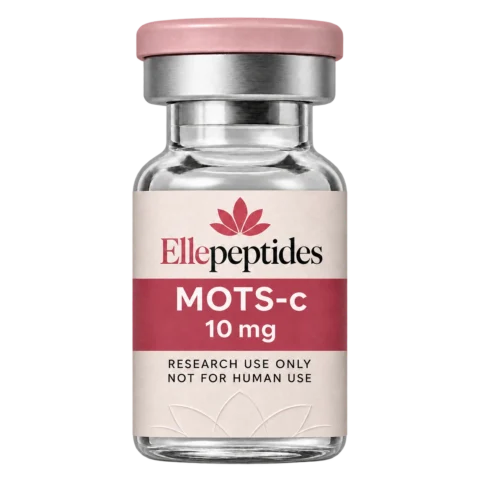
| MOTS-c | Mitochondrial-derived peptide | AMPK signaling and insulin sensitivity | 10 mg, 40 mg |
| 5-Amino-1MQ | Small molecule | NNMT inhibition, which affects NAD-related metabolism | 10 mg, 50 mg |
| SS-31 (Elamipretide) | Synthetic tetrapeptide | Cardiolipin binding in mitochondrial membranes | 10 mg, 50 mg |
NAD+ is the cofactor itself; 5-Amino-1MQ changes how a cell handles nicotinamide; MOTS-c is a signaling peptide; SS-31 binds a membrane lipid. That is why vial sizes differ by orders of magnitude: 500 mg of a cofactor is a different kind of reagent from 10 mg of a peptide.
NAD+ handling, storage and reconstitution math
Each NAD+ vial holds a freeze-dried solid. Confirm that the label reads NAD+ (the oxidized form) rather than NADH, note the lot number, and follow the storage conditions printed on the label. Keep the vial sealed until the experiment requires it.
Concentration is vial mass divided by solvent volume, and the numbers run large here: 500 mg in 5 mL is 100 mg/mL, while 1000 mg in the same volume is 200 mg/mL. The peptide calculator works for any freeze-dried solid, not only peptides. Bacteriostatic water is listed separately if your protocol calls for it.
Ordering NAD+ in the US
NAD+ orders ship to addresses within the United States. Shipping is free when your merchandise subtotal is over $200 after coupon discounts (before taxes and shipping); below that, standard shipping is $15.99 per order. Delivery options and the available payment methods are shown at checkout, so check the shipping policy for current details.
NAD+ FAQ
Is NAD+ a peptide?
No. NAD+ is a dinucleotide coenzyme built from two nucleotides, not a chain of amino acids. It is often searched as “NAD+ peptide” because it is sold alongside research peptides, but its chemistry, molar mass and typical vial sizes are very different. Peptides such as MOTS-c and SS-31 are listed separately.
What does NAD+ do in the body?
NAD+ accepts electrons in metabolic reactions and becomes NADH, which hands them on, so the pair links many energy-producing pathways. NAD+ is also consumed by PARP enzymes during DNA-damage responses, by sirtuins in cellular regulation and by CD38. Those roles explain why NAD+ levels are measured in aging research.
What benefits of NAD+ have studies reported?
Direct NAD+ studies in people are small and mostly describe metabolism or tolerability. A 2019 pilot in men tracked plasma and urine metabolites, and a 2026 clinic review focused on symptoms. Benefit-style findings, such as improved muscle insulin sensitivity, come from precursor trials of NMN and NR, which are different molecules.
What side effects of NAD+ have been reported?
In a 2026 retrospective clinic study, all six people who received intravenous NAD+ reported unpleasant infusion-related symptoms, including abdominal cramping or nausea. The groups were very small and there was no placebo, so the report cannot define how common such effects are. It concerns clinical administration, not laboratory use of a research vial.
What is the difference between NAD+ and MOTS-c?
NAD+ is a coenzyme; MOTS-c is a 16-amino-acid peptide encoded in mitochondrial DNA. NAD+ works as an electron carrier and enzyme substrate, while MOTS-c is studied as a signaling molecule that activates AMPK in cell and mouse models. They are often compared in metabolic research but are not substitutes.
Is NAD+ the same as NMN or NR?
No. Nicotinamide mononucleotide (NMN) and nicotinamide riboside (NR) are precursors that cells can convert into NAD+. They are separate chemical identities with their own trials. A result from an NMN or NR study should not be credited to NAD+, and this listing contains NAD+ only.
Is NAD+ the same as NADH?
No. NAD+ is the oxidized form and NADH the reduced form of nicotinamide adenine dinucleotide. They represent different reaction states, behave differently as reagents and have different reference records. Check that the label on your material names the form your experiment requires.
How much does NAD+ cost in the US?
At the time of writing, Ellepeptides lists NAD+ at $100.00 USD for 500 mg and $210.00 USD for 1000 mg, about $0.20 and $0.21 per mg. These are prices for research vials only; clinic service pricing is a different matter. Free shipping applies when the merchandise subtotal is over $200.
Should I choose NAD+ 500 mg or 1000 mg?
Pick the amount your experiment needs. The 1000 mg vial contains twice the nominal mass of the 500 mg vial and costs less per mg, but it is not a different concentration or formulation. Concentration only exists once a defined volume of solvent is added.
Is NAD+ available in capsules or nasal spray?
This listing is a sealed vial of freeze-dried NAD+ and nothing else. The human studies on this page used intravenous infusion or, for precursors, other routes, and their results cannot be transferred to capsules, sprays or creams. None of those forms is offered here.
NAD+ references
- National Library of Medicine, PubChem. NAD+, CID 5892.
- National Library of Medicine. MeSH: NAD, D009243.
- Massudi H, et al. (2012). NAD+ and age in human tissue. PLOS ONE.
- Camacho-Pereira J, et al. (2016). CD38 and age-related NAD decline. PMC4911708.
- Kraus D, et al. (2014). NNMT knockdown and diet-induced obesity. Nature.
- Martens CR, et al. (2018). NR crossover trial. PubMed 29599478.
- Grant R, et al. (2019). NAD+ plasma and urine metabolome pilot. PMC6751327.
- Yoshino M, et al. (2021). NMN in postmenopausal women. PubMed 33888596.
- Reyna et al. (2026). NAD+ and NR tolerability review. PMC12907335.
Related research materials: Energy & Metabolic, all research peptides, MOTS-c, 5-Amino-1MQ, SS-31 (Elamipretide) and Epitalon. Read how we assess evidence on the research page. For laboratory research only. Not for human or veterinary use.

Reviews
There are no reviews yet.