
Description
Retatrutide at a glance
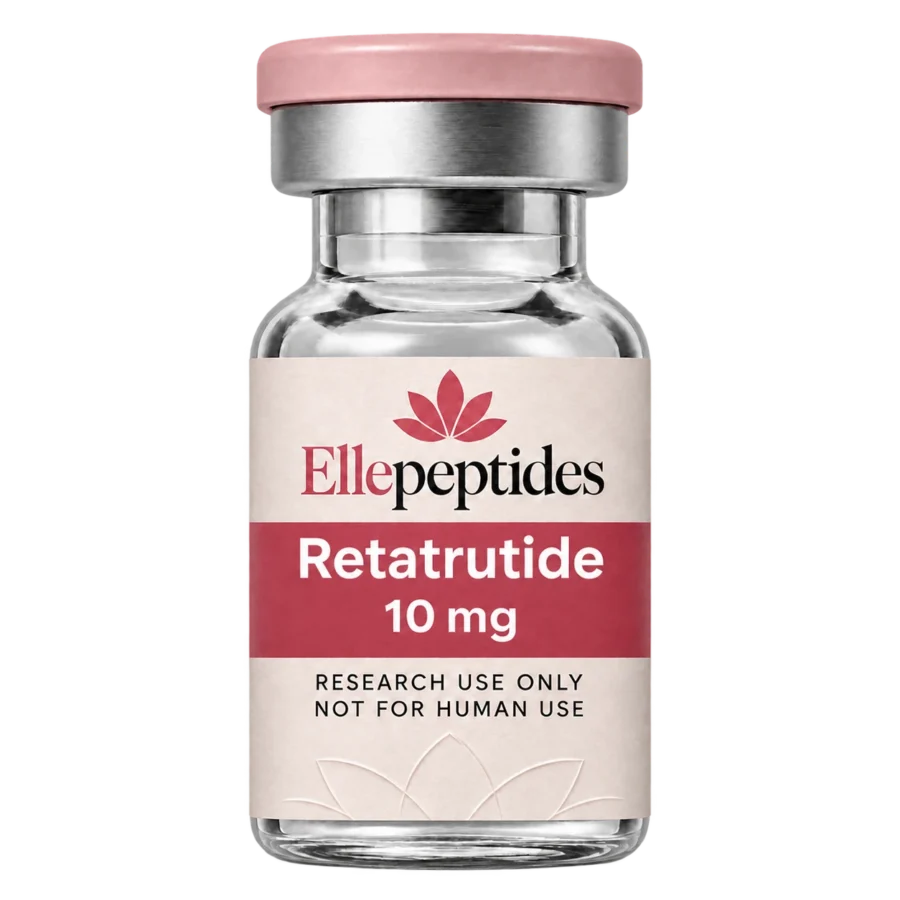
Retatrutide (development code LY3437943) is one synthetic peptide that activates three hormone receptors — GIP, GLP-1 and glucagon — which is why researchers call it a triple agonist. Trials have examined it in obesity, type 2 diabetes, knee osteoarthritis and cardiovascular or kidney risk. Ellepeptides lists it as freeze-dried material in five vial sizes within our weight management research peptides.
- Molecule: modified, lipidated 39-amino-acid peptide acting at GIP, GLP-1 and glucagon receptors
- Vial sizes: 5 mg, 10 mg, 30 mg, 50 mg and 60 mg
- Listed price: from $33.50 USD (5 mg); the 50 mg vial has the lowest cost per mg
- Form: freeze-dried (lyophilized) powder in a sealed vial
- Shipping: ships within the US; free shipping when the subtotal exceeds $200 after coupons
- Use: for laboratory research only — part of the wider research peptide catalogue
Retatrutide vial sizes and price per mg
| Vial size | Listed price (USD) | Price per mg |
|---|---|---|
| 5 mg | $33.50 | $6.70/mg |
| 10 mg | $105.00 | $10.50/mg |
| 30 mg | $240.00 | $8.00/mg |
| 50 mg | $278.00 | $5.56/mg |
| 60 mg | $400.00 | $6.67/mg |
Prices are listed in U.S. dollars at the time of writing (November 2026); the size selector above always shows the current price. Cost per mg differs by vial size, but no bulk or combination discount is promised; any saving appears only in the cart or through a valid coupon.
Retatrutide compound profile
| Reference names | Retatrutide; LY3437943; LY-3437943 |
|---|---|
| Molecule class | GIP, GLP-1 and glucagon receptor triple agonist |
| Peptide length | 39 amino acids; modified, lipidated peptide |
| Reference CAS / UNII | 2381089-83-2 / NOP2Y096GV |
| Reference formula | C221H342N46O68 |
| Reference molecular mass | 4731.34 g/mol (KEGG D12430) |
| Backbone shorthand | YXQGTFTSDY SILLDKKAQX AFIEYLLEGG PSSGAPPPS |
In the shorthand, X marks Aib at positions 2 and 20; the full molecule also carries α-methyl-leucine at position 13, a C20 fatty diacid linked to Lys17 and an amidated C-terminus. These rows come from KEGG D12430 and the FDA substance identity record. They describe the reference molecule only — not the salt form, counterion or analytical results of any Ellepeptides lot.
How Retatrutide works in research
Retatrutide was engineered to engage three receptors at once. GLP-1 and GIP are incretin hormones released from the gut after eating; their receptors are studied for effects on insulin release, appetite signaling and fat tissue. The glucagon receptor, concentrated in the liver, is linked to energy use and fat metabolism. Combining all three in one molecule tests whether adding glucagon activity raises energy expenditure on top of the reduced food intake seen with incretin agonists.
The discovery paper by Coskun et al. (2022) reported activity at all three human receptors, strongest at the GIP receptor. In obese mice, the glucagon component added higher energy expenditure to the lower food intake associated with GIP/GLP-1 activity. The fatty-acid side chain is a design feature used to prolong circulation, the same strategy described for semaglutide by Lau et al. (2015). A phase 1b study measured a half-life of about six days for the clinical formulation (Urva et al., 2022), which is why trials use once-weekly schedules. None of this describes a commercial vial.
Key Retatrutide studies
| Year | Study & model | What was measured | Main finding | Source |
|---|---|---|---|---|
| 2022 | Coskun et al.; receptor assays and obese mice | Receptor activity, food intake, energy expenditure | Active at GIP, GLP-1 and glucagon receptors, most potent at GIP; glucagon activity added energy expenditure in mice | PubMed |
| 2022 | Urva et al.; phase 1b, type 2 diabetes | Pharmacokinetics and safety | Half-life about 6 days | PubMed |
| 2023 | Jastreboff et al.; phase 2, 338 adults with obesity | Weight change at 48 weeks | −8.7% to −24.2% across study arms vs −2.1% placebo | PubMed |
| 2025 | TRIUMPH-4; 445 adults with obesity or overweight and knee osteoarthritis | Weight and WOMAC knee pain at 68 weeks | Treatment-regimen weight change −20.0% and −23.7% vs −4.6%; pain scores fell 62.6–67.2% vs 35.1% | Lilly release |
| 2026 | TRIUMPH-1; 2,339 adults without diabetes | Weight change at 80 weeks | −17.6%, −23.7% and −25.0% vs −3.9% placebo | NEJM |
| 2026 | TRIUMPH-2; 1,152 adults with type 2 diabetes | Weight change at 80 weeks | −11.9% to −18.8% vs −5.1% placebo | PubMed |
| 2026 | TRANSCEND-T2D-1; 537 adults with type 2 diabetes | HbA1c and weight at 40 weeks | HbA1c −1.69 to −1.94 points vs −0.81; weight −11.5% to −15.3% vs −2.6% | PubMed |
| 2026 | TRANSCEND-T2D-2; 1,298 adults, open-label vs semaglutide | HbA1c and weight at 80 weeks | HbA1c −2.2 vs −1.8 points; weight −19.5% to −20.9% vs −9.4% | Lilly release |
Phase 2 (2023). The 48-week trial randomized 338 adults with obesity to several retatrutide study arms or placebo. Gastrointestinal events were the most common adverse events, and heart rate rose, peaking at week 24 before declining (Jastreboff et al., 2023).
TRIUMPH program (2025–2026). The phase 3 figures above use the treatment-regimen estimand, which counts participants who stopped or interrupted treatment; sponsor “efficacy estimand” numbers are higher because they assume continued treatment. In TRIUMPH-4, nausea affected 38.1–43.2% of retatrutide participants versus 10.7% on placebo, dysesthesia 8.8–20.9% versus 0.7%, and adverse events led 12.2–18.2% to stop versus 4.0% (Lilly, December 11, 2025).
Cardiovascular and kidney questions. Lilly reported −21.6% and −22.6% weight change versus −3.2% at 80 weeks in TRIUMPH-3, which enrolled people with severe obesity and established cardiovascular disease; the cardiovascular-event confidence intervals included no difference, so the trial does not show event prevention (Lilly, July 23, 2026). TRANSCEND-T2D-3, in adults with diabetes and kidney impairment, was listed as having completed enrollment on November 5, 2026 — an enrollment status, not an outcome (Lilly trial listing).
Retatrutide research involving women
Women are well represented in retatrutide trials. The 2023 phase 2 study enrolled 163 women among 338 participants, and its prespecified subgroup analysis found greater percentage weight reduction in women than in men (NEJM phase 2 report). TRIUMPH-2 included 554 women, 48% of its 1,152 participants (TRIUMPH-2), and TRANSCEND-T2D-1 randomized 296 women among 537 adults (Bajaj et al., 2026).
The gaps matter just as much. None of these trials was designed around women-specific endpoints such as menopause, polycystic ovary syndrome, fertility or pregnancy,. For the related dual agonist tirzepatide, prescribing information describes reduced exposure to an oral contraceptive linked to delayed gastric emptying (Zepbound label); whether the same applies to retatrutide is not established by the sources cited here. We list it among our peptides for women for brand navigation only, not as a women-specific claim.
Retatrutide vs tirzepatide, semaglutide and cagrilintide
| Compound | Type | Receptor targets | Main research focus | Sizes on Ellepeptides |
|---|---|---|---|---|
| Retatrutide (this page) | Lipidated peptide, triple agonist | GIP, GLP-1, glucagon | Obesity, type 2 diabetes, knee osteoarthritis, cardiovascular and kidney risk | 5, 10, 30, 50, 60 mg |
| Tirzepatide | Lipidated peptide, dual agonist | GIP, GLP-1 | Obesity, type 2 diabetes, sleep apnea | 10, 15, 20, 30, 60 mg |
| Semaglutide | Lipidated GLP-1 analogue | GLP-1 | Obesity, type 2 diabetes, cardiovascular and kidney outcomes | 5, 10, 20, 30 mg |
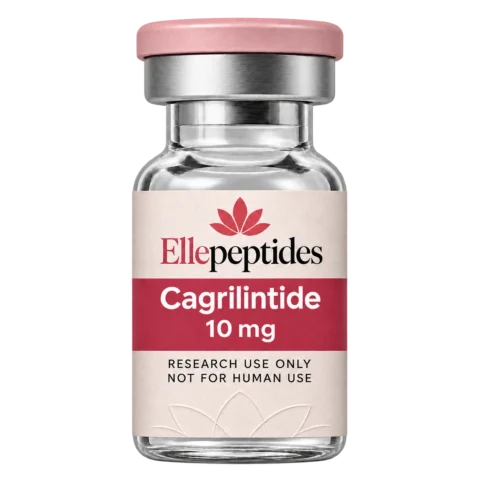
| Cagrilintide | Lipidated amylin analogue | Amylin and calcitonin receptors | Weight research via a non-incretin pathway | 5, 10 mg |
The three incretin-based compounds form a ladder: semaglutide targets one receptor, tirzepatide two (Coskun et al., 2018) and retatrutide three. The only published-or-reported head-to-head retatrutide comparison in these sources is TRANSCEND-T2D-2 against semaglutide in type 2 diabetes (Lilly release); no retatrutide-versus-tirzepatide trial result is cited here. Cagrilintide sits apart as an amylin analogue (Kruse et al., 2021).
Handling, storage and reconstitution math
Retatrutide arrives as a freeze-dried cake or powder, and lyophilized peptides are usually treated as moisture-sensitive: keep the vial sealed until it is needed, let a refrigerated vial reach room temperature before opening so condensation does not form. Storage temperature and light protection belong to the label on your vial, so treat that label — not a paper about a clinical formulation — as the reference. Labs often wipe stoppers with alcohol prep pads before puncturing them.
Reconstitution math is one division: vial mass ÷ solvent volume = concentration. Adding 2 mL of solvent to a 10 mg vial gives 5 mg/mL; the same 2 mL in a 30 mg vial gives 15 mg/mL. Our peptide calculator handles the arithmetic and unit conversions for other volumes. Where a protocol calls for a preserved diluent, labs often choose bacteriostatic water; the solvent your method specifies is the one that counts. These numbers describe concentration only — nothing about amounts for a person or animal.
Ordering Retatrutide in the US
Ellepeptides ships retatrutide to addresses within the United States, with prices in U.S. dollars. Orders whose merchandise subtotal exceeds $200 after coupon discounts (before taxes and shipping) qualify for free shipping. Otherwise, standard shipping is $15.99 per order. Delivery options and the available payment methods are shown at checkout. Full details are in our shipping policy.
Retatrutide FAQ
How much does retatrutide cost in the US?
On Ellepeptides, retatrutide starts at $33.50 USD for a 5 mg vial and reaches $400.00 for 60 mg. Per milligram, that runs from $10.50 (10 mg) down to $5.56 (50 mg), so cost per mg does not fall steadily with vial size. Prices were current in November 2026; the size selector shows the live price.
Where can I buy retatrutide in the US for research?
Ellepeptides sells retatrutide as freeze-dried research material, shipped to US addresses, with the available payment methods shown at checkout. It is supplied for laboratory work only. Orders over $200 after coupons ship free; the ordering section above lists the standard shipping rate.
What is retatrutide?
Retatrutide (LY3437943) is a synthetic 39-amino-acid peptide developed by Eli Lilly that activates GIP, GLP-1 and glucagon receptors in a single molecule. It remains an investigational compound studied in obesity, type 2 diabetes and related conditions (Coskun et al., 2022).
Is retatrutide a “GLP-3”?
No. “GLP-3” is an online nickname, not a hormone or receptor used in the scientific literature. Its actual targets are the GIP, GLP-1 and glucagon receptors, which is why published papers describe it as a triple hormone receptor agonist rather than a new “GLP”.
What side effects were reported in retatrutide trials?
Gastrointestinal events — nausea, diarrhea, vomiting and constipation — were the most frequent in trials, alongside a temporary rise in heart rate in phase 2. Phase 3 reports added low blood pressure (TRIUMPH-2) and dysesthesia, an altered skin sensation seen in up to 20.9% of one TRIUMPH-4 study arm (Lilly, 2025). These describe trial participants, not research vials.
What is the half-life of retatrutide?
About six days. A phase 1b study of the clinical formulation in people with type 2 diabetes reported a half-life of roughly 6 days, which supports the once-weekly schedules used in trials (Urva et al., 2022). Half-life describes elimination from the body; it is not a shelf life or a storage time for powder in a vial.
Retatrutide vs tirzepatide: what is the difference?
Retatrutide adds glucagon-receptor activity to the GIP and GLP-1 activity that tirzepatide already has. In mice, that glucagon component raised energy expenditure. Both are lipidated 39-amino-acid peptides, but they are distinct molecules with separate trial programs, and no direct head-to-head result between them is cited on this page.
Retatrutide vs semaglutide: has it been compared directly?
Yes, in one sponsor-reported trial. TRANSCEND-T2D-2 compared retatrutide with semaglutide in 1,298 adults with type 2 diabetes over 80 weeks; HbA1c fell 2.2 points versus 1.8 and weight 19.5–20.9% versus 9.4% in the efficacy analysis. The open-label results were awaiting journal publication (Lilly, October 2026).
Are there retatrutide clinical trials?
Yes. ClinicalTrials.gov lists retatrutide studies. Check the ClinicalTrials.gov registry for current status and contacts. Ellepeptides is a research-material supplier; it does not run, recruit for or refer people to clinical trials.
Does Ellepeptides sell retatrutide capsules, nasal spray or cream?
No. Ellepeptides lists retatrutide only as freeze-dried powder in sealed vials of 5, 10, 30, 50 or 60 mg. There are no capsules, tablets, nasal sprays, creams or pre-mixed solutions. Laboratories reconstitute the powder themselves, following their own documented protocols.
How should retatrutide vials be stored?
Follow the label on the vial you receive. As a general rule, lyophilized peptides are kept sealed, dry and away from light. If storage information is unclear, email [email protected] before starting work. Our research page explains how we present product information.
Has retatrutide been studied in women?
Yes, as part of mixed trial populations. Women made up 163 of 338 phase 2 participants, 48% of TRIUMPH-2 and 296 of 537 people in TRANSCEND-T2D-1. A phase 2 subgroup analysis found greater percentage weight reduction in women (NEJM, 2023). No trial cited here tested menopause, fertility or pregnancy outcomes.
Retatrutide references
- Coskun T, et al. 2022. Discovery of LY3437943, a triple receptor agonist. PubMed 35985340
- Urva S, et al. 2022. Phase 1b study in type 2 diabetes. PubMed 36354040
- Jastreboff AM, et al. 2023. Retatrutide phase 2 obesity trial. PubMed 37366315; NEJM full text
- Eli Lilly and Company. December 11, 2025. TRIUMPH-4 results. Lilly investor release
- Jastreboff AM, et al. 2026. TRIUMPH-1. NEJM
- TRIUMPH-2 investigators. 2026. TRIUMPH-2 results. PubMed 42810372
- Eli Lilly and Company. July 23, 2026. TRIUMPH-3 results. Lilly investor release
- Bajaj M, et al. 2026. TRANSCEND-T2D-1. PubMed 42250575
- Eli Lilly and Company. October 28, 2026. TRANSCEND-T2D-2 results. Lilly announcement (PDF)
- Eli Lilly and Company. TRANSCEND-T2D-3 study description. Lilly clinical trials
- Coskun T, et al. 2018. Tirzepatide (LY3298176) discovery. PubMed 30473097
- Lau J, et al. 2015. Discovery of semaglutide. PubMed 26308095
- Kruse T, et al. 2021. Cagrilintide development. PubMed 34288673
- US National Library of Medicine. Zepbound prescribing information. DailyMed
- KEGG DRUG. Retatrutide, entry D12430. KEGG; US FDA. Substance record UNII NOP2Y096GV. FDA precision UNII search
- Retatrutide studies. ClinicalTrials.gov
Related research materials: weight management peptides, tirzepatide, semaglutide, cagrilintide, AOD-9604 and how we cite research. For laboratory research only. Not for human or veterinary use.

Reviews
There are no reviews yet.