
Description
Sermorelin at a glance
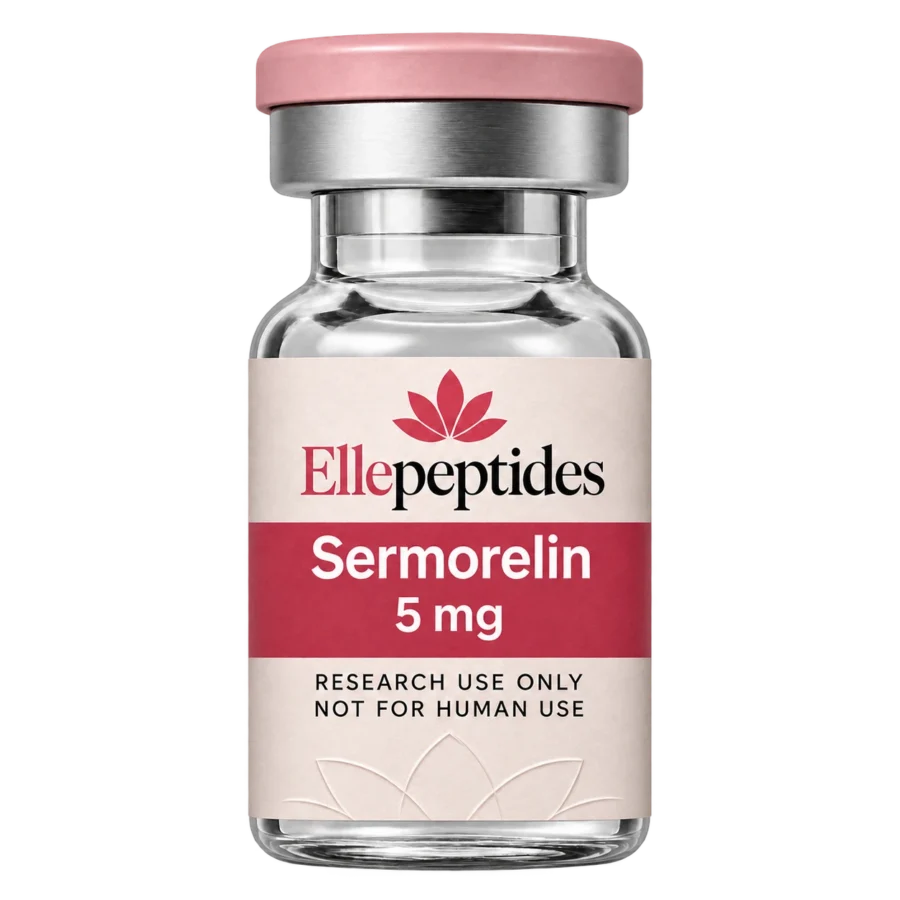
Sermorelin is the synthetic, amidated form of the first 29 amino acids of growth-hormone-releasing hormone, written GHRH(1–29)-NH2 and also known as hGRF(1–29). It was studied clinically in children with growth-hormone deficiency and in healthy older men. Ellepeptides lists sermorelin among its research peptides as freeze-dried material in 5 mg and 10 mg vials.
- Molecule type: GHRH(1–29) amide, 29 amino acids (a releasing signal, not growth hormone)
- Vial sizes: 5 mg and 10 mg
- Listed price: from $60.00 USD for the 5 mg vial
- Form: freeze-dried (lyophilized) powder
- Shipping: ships within the US; free shipping on merchandise subtotals over $200
- Use: laboratory research only
Sermorelin vial sizes and price per mg
| Vial size | Listed price (USD) | Price per mg |
|---|---|---|
| 5 mg | $60.00 | $12.00 |
| 10 mg | $76.00 | $7.60 |
Prices are in U.S. dollars as of writing; the selector reflects any later change. Per milligram, the 10 mg vial costs about 37% less than the 5 mg vial; savings on multiple vials through the cart or a coupon are not guaranteed.
Sermorelin compound profile
| Catalog compound | Sermorelin |
|---|---|
| Reference identity | GHRH(1–29)-NH2; 29-residue peptide |
| Reference family | Growth-hormone-releasing hormone |
| Molecular reference form | Amidated GHRH(1–29); counterion excluded |
| Reference CAS number | 86168-78-7 |
| Reference molecular formula | C149H246N44O42S |
| Reference molar mass | 3357.9 g/mol |
| Reference sequence | YADAIFTNSYRKVLGQLSARKLLQDIMSR-NH2 |
| PubChem record | CID 16132413 |
The identity values describe the named reference structure of sermorelin with its counterion excluded. They do not confirm the salt form or analytical identity of any Ellepeptides vial; only lot-specific documentation can do that.
How sermorelin works in research
Sermorelin acts on the GHRH receptor of the anterior pituitary, the same receptor used by native GHRH. Activation releases the pituitary’s own growth hormone, and IGF-I follows downstream. In one study, 14 days of twice-daily GHRH(1–29) raised 24-hour mean GH, GH peak amplitude and IGF-I in 10 healthy older men; with the larger of two regimens, those markers no longer differed significantly from the values of 9 younger men (Corpas et al., 1992).
The unmodified fragment is short-lived. In 10 healthy men, GHRH(1–29)-NH2 had a plasma half-life of 4.3 ± 1.4 minutes, against 6.7 minutes for an analogue carrying D-alanine at position 2, and metabolic clearance nearly halved with that single swap (Soule et al., 1994). D-Ala2 later became one of the four substitutions in the modified fragment at the core of CJC-1295 (Jetté et al., 2005), which is why data for such analogues should never be credited to sermorelin.
Key sermorelin studies
| Year | Study & model | What was measured | Main finding | Source |
|---|---|---|---|---|
| 1992 | 10 older men vs 9 young men; 14 days, twice daily | 24-h GH, GH peaks, IGF-I | GH and IGF-I rose; the larger regimen closed the age gap | Corpas et al. |
| 1994 | 10 healthy men; plasma kinetics | Half-life; metabolic clearance | 4.3 min unmodified vs 6.7 min for the D-Ala2 analogue | Soule et al. |
| 1996 | 110 untreated prepubertal GH-deficient children, open-label (86 analyzed); up to 12 months | Height velocity | 4.1 cm/yr at baseline, 8.0 at 6 months, 7.2 at 12 months | Thorner et al. |
| 1997 | 11 older men; 6-week before-and-after design | Nocturnal GH, IGF-I, body composition, strength | Nocturnal GH rose; IGF-I and body composition unchanged; 2 of 6 strength measures improved | Vittone et al. |
| 2006 | 100 healthy adults aged 60–85 randomized; 89 completers (54 women); 6 months | Cognition; IGF-I | Several cognitive scores improved; IGF-I +33.8% vs +0.8% with placebo | Vitiello et al. |
The pediatric trial is the largest sermorelin dataset. Its 110 children had never been treated, height velocity nearly doubled within six months, and 74% counted as good responders at that point. No adverse changes in general biochemical or hormonal tests were found. Without a placebo arm, the true effect size is less certain, and nothing here extends to adults (Thorner et al., 1996).
Work in older men shows how hormone markers and physical outcomes can part ways. Six weeks of the peptide in 11 men raised nocturnal GH, yet IGF-I and body composition stayed flat and only two of six strength measures improved (Vittone et al., 1997). Such a small before-and-after design cannot establish muscle effects. Further plain-language summaries live in the Ellepeptides research library.
Sermorelin research involving women
The clearest data on women come from a six-month placebo-controlled trial in healthy adults aged 60 to 85. Of the 89 participants who finished, 54 were women, and the investigators recorded estrogen therapy: each arm held 27 women, split between users and non-users (Vitiello et al., 2006). IGF-I rose 33.8% with GHRH versus 0.8% with placebo, and several cognitive tests improved within the treatment group.
Results were reported for the whole cohort rather than as a separate estimate for women, and not every cognitive measure moved. The study used a clinical sermorelin preparation, not this catalog material. Every other study above enrolled only men or children, so women-specific evidence rests on this single trial. Related compounds sit in the peptides for women collection.
Sermorelin vs tesamorelin, CJC-1295 No DAC and ipamorelin
| Compound | Type | Receptor studied | Main research focus | Published half-life | Sizes on Ellepeptides |
|---|---|---|---|---|---|
| Sermorelin | GHRH(1–29) amide | GHRH receptor | Growth in GH-deficient children; aging studies | About 4.3 min (healthy men) | 5 and 10 mg |
| Tesamorelin | GRF(1–44) with N-terminal hexenoyl group | GHRH receptor | Visceral and liver fat (HIV); cognition in older adults | About 11 min (US label) | 5, 10 and 20 mg |
| CJC-1295 No DAC | Tetrasubstituted GRF(1–29), no DAC | GHRH receptor | Little direct published research | No peer-reviewed human value found | 10 mg |
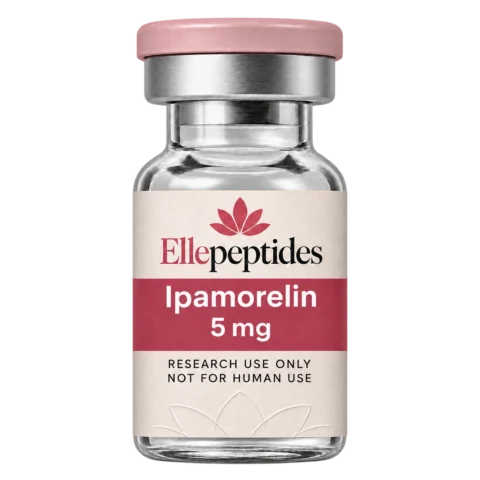
| Ipamorelin | Synthetic pentapeptide | Ghrelin receptor | Selective GH release (animals); bowel-recovery trial | About 2 h (healthy men) | 5 and 10 mg |
Sermorelin is the reference point for the other GHRH-receptor compounds. Tesamorelin restores the full 44-residue chain and adds a hexenoyl cap, while CJC-1295 No DAC keeps the 29-residue length but swaps four amino acids, D-Ala2 among them. Ipamorelin is not a GHRH analogue at all; it works through the ghrelin receptor. Choosing between them starts with that receptor and structure difference.
Sermorelin handling, storage and reconstitution math
Each sermorelin vial holds a freeze-dried solid, and the storage conditions printed on its label are the ones to follow. Good practice is to log lot number, solvent and reconstitution date for every vial so results can be traced, and to send unanswered questions to [email protected].
For concentration, divide the vial’s mass by the volume of solvent added: 5 mg in 2.5 mL gives 2 mg/mL. The peptide calculator runs the same arithmetic with unit conversion, and bacteriostatic water has its own listing. This is bench arithmetic only, not guidance for use in people or animals.
Ordering sermorelin in the US
Sermorelin orders ship to addresses within the United States. Shipping is free when the merchandise subtotal exceeds $200 after coupon discounts (before taxes and shipping); below that, standard shipping is $15.99 per order. Available payment methods and delivery options are shown at checkout. Current details are in the shipping policy.
Sermorelin FAQ
What is sermorelin?
Sermorelin is a synthetic peptide matching the first 29 amino acids of human growth-hormone-releasing hormone, with an amidated end, written GHRH(1–29)-NH2. In research it stimulates the pituitary to release growth hormone. It is a releasing signal rather than growth hormone, and Ellepeptides lists it as freeze-dried research material.
How much does sermorelin cost in the US?
The 5 mg vial is listed at $60.00 USD and the 10 mg vial at $76.00, roughly $12.00 and $7.60 per mg. The size selector shows the current price, so any change made after publication appears there rather than on this page.
Where can I buy sermorelin in the US?
Ellepeptides lists sermorelin research vials shipped to US addresses, priced in U.S. dollars. Shipping is free once the merchandise subtotal tops $200 after coupons; below that, standard shipping is $15.99. Every vial is sold strictly for laboratory research.
Is GRF 1-29 the same as sermorelin?
Essentially, yes. GRF(1–29) and GHRH(1–29) name the same 29-residue fragment of growth-hormone-releasing hormone, and sermorelin is its amidated form. The modified fragment described in CJC-1295 research is different: it carries four amino-acid substitutions, so data for the two should not be mixed. See CJC-1295 No DAC.
What has sermorelin been studied for?
Mainly growth and hormone markers. In GH-deficient children, height velocity rose from 4.1 to 8.0 cm per year within six months. In older adults, studies measured GH, IGF-I, strength and cognition, with mixed results. None of these studies establishes a general benefit outside its own population.
What side effects were reported in sermorelin studies?
In the six-month trial in older adults, redness or swelling at the administration site occurred in about 2% of participants, and two withdrawals were linked to the study protocol: one for a rash, one for malaise. The pediatric study reported no adverse changes in general biochemical or hormonal tests.
What is the half-life of sermorelin?
Very short. In 10 healthy men, GHRH(1–29)-NH2 had a plasma half-life of about 4.3 minutes, compared with 6.7 minutes for an analogue carrying D-alanine at position 2. Clinical studies therefore tracked GH and IGF-I responses rather than lasting blood levels of the peptide itself.
Sermorelin vs tesamorelin: which should a study compare?
It depends on the question. Both act on the GHRH receptor, but tesamorelin has 44 residues plus a hexenoyl group, against sermorelin’s 29. Sermorelin was studied for pediatric growth and aging; tesamorelin mainly for visceral and liver fat in adults with HIV. The tesamorelin page lists its trials.
Sermorelin vs ipamorelin: how do they differ?
They use different receptors. Sermorelin stimulates the GHRH receptor, while ipamorelin is a pentapeptide acting on the ghrelin receptor; in swine it raised GH without increasing ACTH or cortisol. Findings for one cannot stand in for the other, and the ipamorelin page covers its own studies.
Has sermorelin been studied in women?
Yes, in one notable trial. Fifty-four of the 89 healthy older adults who completed a six-month placebo-controlled study were women, including both users and non-users of estrogen therapy. Results were reported for the whole group, so a women-specific effect size is not available from that paper.
Sermorelin references
- Jetté et al., 2005. hGRF(1–29)-albumin conjugates and CJC-1295. PubMed
- Thorner et al., 1996. GHRH(1–29) in GH-deficient children. PubMed
- Corpas et al., 1992. GHRH(1–29) in older men. PubMed
- PubChem. Sermorelin, CID 16132413. PubChem
- Soule et al., 1994. D-Ala2 and GHRH(1–29) half-life in men. PubMed
- Vittone et al., 1997. GHRH(1–29), hormones and muscle in older men. PubMed
- Vitiello et al., 2006. GHRH and cognition in aging. PDF
- US FDA, 2025. EGRIFTA WR (tesamorelin) prescribing information. FDA (PDF)
- Gobburu et al., 1999. Ipamorelin pharmacokinetics in healthy men. PubMed
- Beck et al., 2014. Ipamorelin after bowel resection. PubMed
- Raun et al., 1998. Ipamorelin, the first selective GH secretagogue. PubMed
Related research materials: Muscle & Performance peptides, Tesamorelin, Ipamorelin, CJC-1295 No DAC, CJC-1295 No DAC + Ipamorelin Blend and the research library. For laboratory research only. Not for human or veterinary use.

Reviews
There are no reviews yet.