
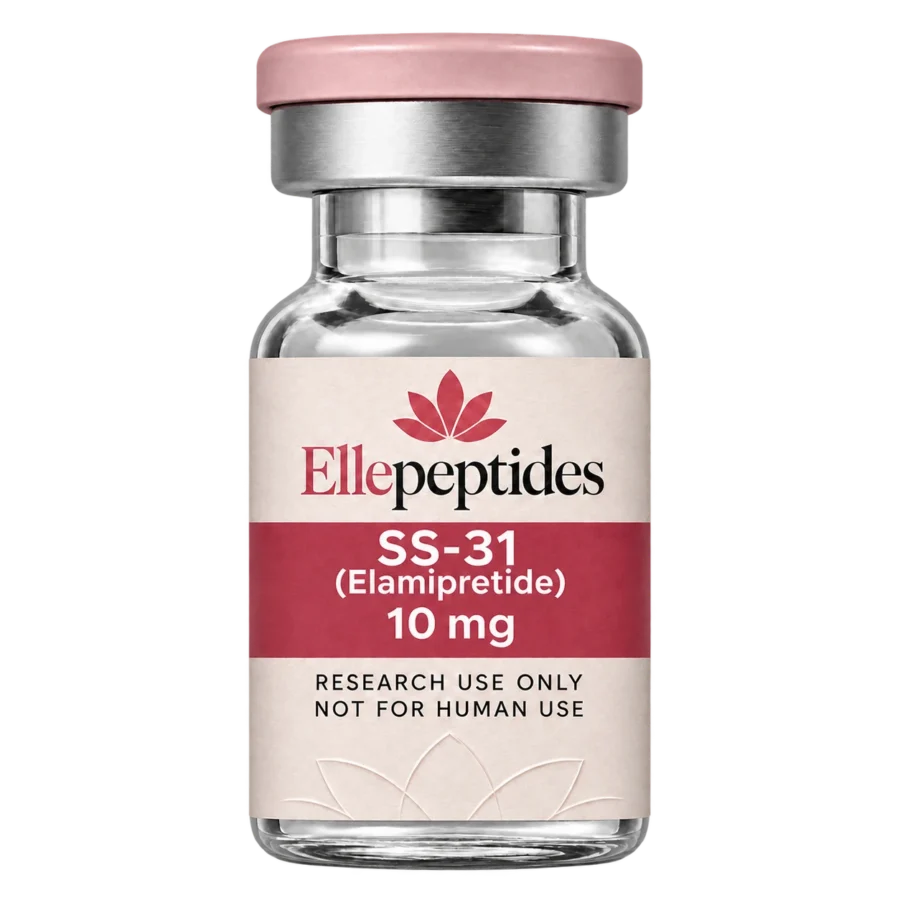
Description
SS-31 (Elamipretide) at a glance
SS-31, also called elamipretide, is a synthetic four-amino-acid peptide that binds cardiolipin, a lipid of the inner mitochondrial membrane. In September 2025 the US FDA granted accelerated approval to an elamipretide drug for Barth syndrome, a rare inherited mitochondrial disorder; research vials are a different material from that medicine. Ellepeptides supplies SS-31 as freeze-dried research material in 10 mg and 50 mg vials, listed under energy and metabolic research.
- Molecule type: synthetic tetrapeptide (D-Arg-Dmt-Lys-Phe-NH2)
- Vial sizes: 10 mg and 50 mg
- Listed price: from $70.00 USD
- Form: freeze-dried (lyophilized) powder
- Ships within the US; free shipping when the merchandise subtotal is over $200
- For laboratory research only
SS-31 vial sizes and price per mg
| Vial size | Listed price (USD) | Price per mg |
|---|---|---|
| 10 mg | $70.00 | $7.00 |
| 50 mg | $215.00 | $4.30 |
Prices are listed in USD at the time of writing; the size selector above shows the current price. Bulk or combination savings through the cart or coupons are not promised.
SS-31 compound profile
| Catalog name | SS-31 (Elamipretide) |
|---|---|
| Research reference identity | Synthetic tetrapeptide; SS-31 / elamipretide |
| Reference sequence | H-D-Arg-Tyr(2,6-diMe)-Lys-Phe-NH2 |
| Reference molecular formula | C32H49N9O5 |
| Reference molar mass | 639.8 g/mol |
| CAS reference | 736992-21-5 |
| Molecular reference source | PubChem CID 11764719 |
These are reference values for the free peptide structure. The approved medicine is a hydrochloride salt, and research material may carry a different counterion or water content, which changes how much of the vial mass is peptide. Treat the table as an identity check, not a description of any lot.
How SS-31 works in research
Cardiolipin is the signature lipid of the inner mitochondrial membrane, where the machinery that makes ATP sits. Birk’s 2013 work showed SS-31 interacting with cardiolipin; in biochemical experiments and a rat kidney-ischemia model, that interaction was linked to preserved membrane structure and faster ATP recovery. Birk et al. (2013)
The cardiolipin connection explains the clinical interest in Barth syndrome. In that disorder, faulty tafazzin protein leaves cells short of functional cardiolipin. MedlinePlus Genetics
Aging models point the same way. In aged female mice, eight weeks of SS-31 reversed the age-related decline in maximum mitochondrial ATP production, improved coupling and shifted glutathione toward a more reduced state. Treadmill endurance and muscle fatigue resistance improved without any increase in mitochondrial content, which suggests better function of existing mitochondria rather than more of them. Campbell et al. (2019) These are rat and mouse results; they do not establish an energy or anti-aging effect in people.
Key SS-31 studies
| Year | Study & model | What was measured | Main finding | Source |
|---|---|---|---|---|
| 2013 | Biochemical assays; rat kidney ischemia | Cardiolipin interaction, membrane structure, ATP | Bound cardiolipin; preserved membrane structure and ATP recovery | Birk et al. |
| 2019 | Young and aged female mice, 8 weeks | Mitochondrial energetics in muscle; exercise tolerance | Reversed age-related loss of maximum ATP production; better endurance | Campbell et al. |
| 2021 | TAZPOWER: 12 people with Barth syndrome; crossover, then open-label | Six-minute walk; fatigue score | Neither primary endpoint met in the controlled part; gains at 36 weeks open-label | Thompson et al. |
| 2023 | MMPOWER-3: 218 adults with primary mitochondrial myopathy, 140 women | Six-minute walk; fatigue score at 24 weeks | No significant improvement on either primary endpoint | Karaa et al. |
| 2025 | FDA review of the Barth syndrome program | Knee extensor strength (intermediate endpoint) | Accelerated approval for patients weighing at least 30 kg | Sponsor release |
TAZPOWER randomized 12 people with Barth syndrome to elamipretide or placebo for 12 weeks in a crossover design. Neither primary endpoint was met. In the open-label extension, walking distance rose by 95.9 m and the fatigue score improved by 2.1 points at 36 weeks, but open-label gains lack a placebo comparison. Thompson et al. (2021)
Regulatory status, checked November 2026: on 19 September 2025 the FDA granted accelerated approval to Forzinity (elamipretide HCl) to improve muscle strength in adult and pediatric patients with Barth syndrome weighing at least 30 kg. The decision rested on knee extensor strength, an intermediate endpoint, and continued approval may depend on confirmatory trials. Sponsor announcement (2025) In January 2026 the sponsor said the required post-marketing trial was on track to start in the first half of the year and noted that the EMA had approved no Barth syndrome therapy. Sponsor update (2026) That approval covers one medicine for one indication, not research vials.
SS-31 research involving women
Women made up most of the largest elamipretide trial. MMPOWER-3 randomized 218 adults with primary mitochondrial myopathy, 140 of them women, and found no significant improvement in walking distance or fatigue at 24 weeks. Being well represented in a null trial is not evidence of a benefit for women. Karaa et al. (2023)
The approval-track trials tell us little about women for a simple reason: Barth syndrome is X-linked and occurs almost exclusively in males. MedlinePlus Genetics On the preclinical side, the 2019 aging study used female mice, one of the few female-model data sets for SS-31. Campbell et al. (2019) No controlled study among these sources reports a sex-specific human result. More women-focused study notes are on the peptides for women hub.
SS-31 vs MOTS-c, NAD+ and 5-Amino-1MQ
| Compound | Type | Main research focus | Sizes on Ellepeptides |
|---|---|---|---|
| SS-31 (this page) | Synthetic tetrapeptide | Cardiolipin binding; mitochondrial membrane function | 10 mg, 50 mg |
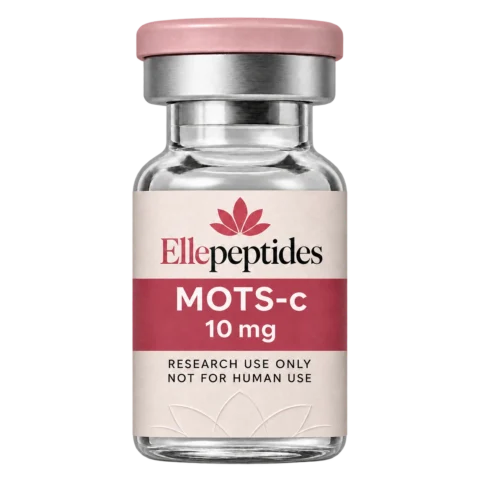
| MOTS-c | Mitochondrial-derived peptide, 16 amino acids | AMPK signaling and insulin sensitivity | 10 mg, 40 mg |
| NAD+ | Dinucleotide coenzyme, not a peptide | Electron transfer; sirtuin and PARP substrate | 500 mg, 1000 mg |
| 5-Amino-1MQ | Small molecule, not a peptide | NNMT enzyme inhibition | 10 mg, 50 mg |
SS-31 is the only compound here that targets a structural component of mitochondria; it also has the most human trial data, including the null MMPOWER-3 result and a Barth syndrome approval. MOTS-c is a peptide the mitochondria make themselves, while NAD+ and 5-Amino-1MQ are not peptides at all.
SS-31 handling, storage and reconstitution math
SS-31 arrives as a lyophilized solid. Check the label for the nominal amount, lot number and storage conditions, and keep the vial closed until you need it. Because counterions affect the peptide fraction of the mass, record exactly what the label states.
Concentration equals vial mass divided by solvent volume: 10 mg in 1 mL gives 10 mg/mL, and 50 mg in 5 mL gives the same 10 mg/mL. The peptide calculator runs the numbers for either vial. For multi-draw work many labs use bacteriostatic water, but your protocol decides the solvent.
Ordering SS-31 in the US
SS-31 orders ship to addresses within the United States. Shipping is free when the merchandise subtotal exceeds $200 after coupon discounts (before taxes and shipping); below that, standard shipping is $15.99 per order. Available payment methods and delivery options are shown at checkout. Current details are in the shipping policy.
SS-31 FAQ
What is SS-31 peptide?
SS-31 is a synthetic tetrapeptide, D-Arg-Dmt-Lys-Phe-NH2, designed to reach the inner mitochondrial membrane and bind cardiolipin. It is studied in mitochondrial disease, aging and ischemia models. Ellepeptides sells SS-31 as freeze-dried research material in 10 mg and 50 mg vials for laboratory work only.
Is SS-31 the same as elamipretide?
Yes, as a molecule. Elamipretide is the nonproprietary name for SS-31, and Forzinity is the brand name of the approved elamipretide hydrochloride medicine. A research vial labeled SS-31 shares the peptide sequence but is not that drug product, its formulation or its quality controls.
What does SS-31 do to mitochondria?
In laboratory studies SS-31 binds cardiolipin, a lipid concentrated in the inner mitochondrial membrane. Experiments linked this to preserved membrane structure and ATP recovery after kidney ischemia in rats, and to restored maximum ATP production in muscle of aged female mice. These are animal findings, not demonstrated human effects.
What did the elamipretide Barth syndrome trials find?
In TAZPOWER, 12 people with Barth syndrome did not meet either primary endpoint during the 12-week placebo-controlled crossover; open-label follow-up at 36 weeks showed better walking distance and fatigue scores. The FDA granted accelerated approval in September 2025 based on knee extensor strength, with continued approval tied to confirmatory trials.
What are the benefits of SS-31 in studies?
Animal studies reported preserved mitochondrial membrane structure, faster ATP recovery and better exercise tolerance in aged mice. In people, the evidence is mixed: the large MMPOWER-3 trial missed both primary endpoints, while Barth syndrome data supported an accelerated approval on muscle strength. None of these results applies to a research vial.
What side effects of elamipretide have been reported?
For the approved medicine, the sponsor reported reactions at the administration site as the most common adverse reaction. The label also warns against use in neonates because the formulation contains benzyl alcohol. Those findings come from clinical use of a specific drug product and do not describe laboratory handling of research material.
What is the difference between SS-31 and MOTS-c?
Both are peptides linked to mitochondria, but they work differently. SS-31 is a synthetic four-residue peptide that binds cardiolipin in the membrane. MOTS-c is a 16-residue peptide encoded in mitochondrial DNA that acts as a signal, activating AMPK in cell and mouse studies. SS-31 has far more human trial data.
How much does SS-31 cost in the US?
At the time of writing, Ellepeptides lists SS-31 at $70.00 USD for 10 mg and $215.00 USD for 50 mg, or about $7.00 and $4.30 per mg. Shipping is free when the merchandise subtotal is over $200 after coupons; otherwise standard shipping is $15.99.
Should I choose SS-31 10 mg or 50 mg?
Choose by the total material your experiment needs. The 50 mg vial costs much less per mg, but it is the same peptide in a larger amount, not a stronger product. Concentration is set by how much solvent you add, which the peptide calculator can work out.
Is SS-31 available as a nasal spray or capsule?
No. Ellepeptides lists SS-31 as a freeze-dried vial product only. The clinical trials discussed here studied a specific medicine and route, and the animal studies used their own preparations, so none of them describes nasal, oral or cream forms. This listing does not offer those formats.
SS-31 references
- National Library of Medicine, PubChem. Elamipretide, CID 11764719.
- Birk AV, et al. (2013). SS-31 and cardiolipin: membrane and kidney experiments. PubMed 23813215.
- Campbell MD, et al. (2019). SS-31 in aged female mice. PubMed 30597195.
- Thompson WR, et al. (2021). TAZPOWER phase 2/3 trial in Barth syndrome. PubMed 33077895.
- Karaa A, et al. (2023). MMPOWER-3 trial. PMC10382259.
- Stealth BioTherapeutics (2025). FDA accelerated approval of Forzinity. Press release.
- Stealth BioTherapeutics (2026). Commercial and pipeline update. Press release.
- MedlinePlus Genetics. Barth syndrome. Condition summary.
Related research materials: Energy & Metabolic, all research peptides, MOTS-c, NAD+, 5-Amino-1MQ and Thymalin. Our approach to evidence is set out on the research page. For laboratory research only. Not for human or veterinary use.

Reviews
There are no reviews yet.