
Description
DSIP peptide at a glance
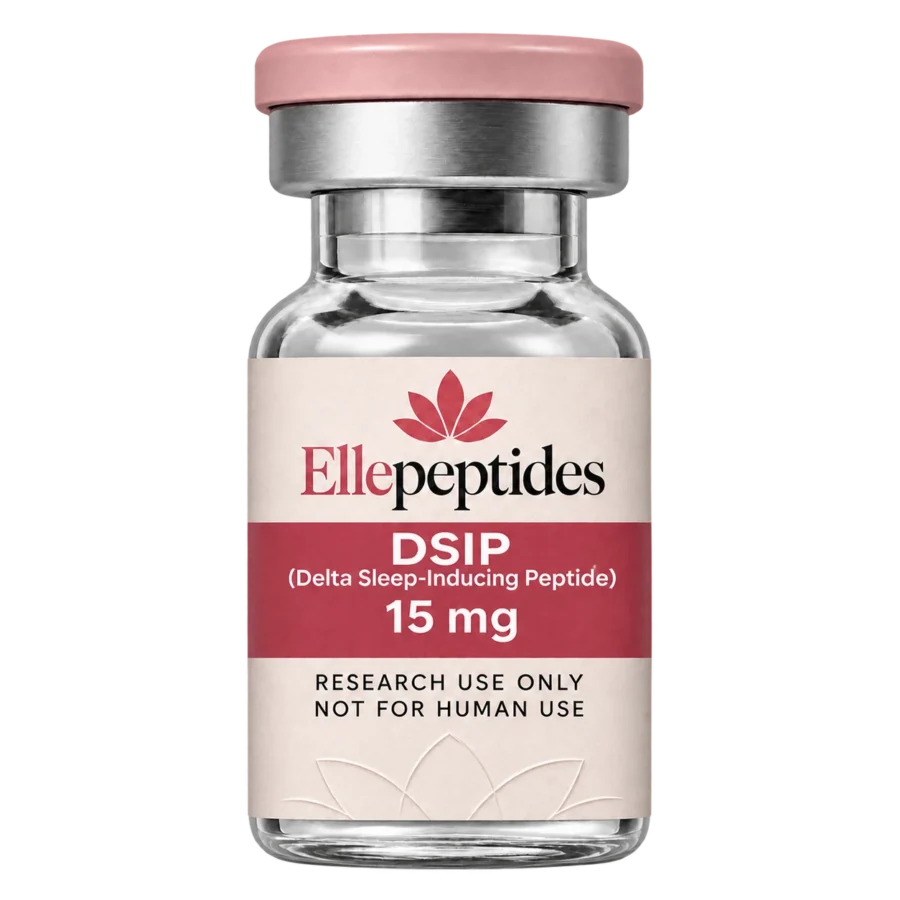
DSIP (delta sleep-inducing peptide) is a nine-amino-acid neuropeptide first characterized in 1977 in rabbit sleep experiments. Despite the name, later human studies were mixed, and no receptor or gene for it has been identified. Ellepeptides supplies DSIP as freeze-dried research material in a 15 mg vial, listed in our focus, mood and sleep research collection.
- Molecule type: nine-residue neuropeptide (WAGGDASGE)
- Vial size: 15 mg
- Listed price: $64.99 USD
- Form: freeze-dried (lyophilized) powder
- Ships within the United States; free shipping when the merchandise subtotal is over $200
- For laboratory research only
DSIP vial sizes and price per mg
| Vial size | Listed price (USD) | Price per mg |
|---|---|---|
| 15 mg | $64.99 | $4.33 |
Prices are listed in USD at the time of writing; the size selector above shows the current price. Bulk or combination savings through the cart or coupons are not promised.
DSIP compound profile
| Research name | DSIP (delta sleep-inducing peptide) |
|---|---|
| Reference sequence | H-Trp-Ala-Gly-Gly-Asp-Ala-Ser-Gly-Glu-OH (WAGGDASGE) |
| Peptide length | 9 amino acids |
| Reference molecular formula | C35H48N10O15 |
| Reference molar mass | 848.8 g/mol |
| CAS number | 62568-57-4 |
| PubChem record | CID 68816 |
The table gives the reference DSIP structure, not the analytical make-up of a particular lot. Counterions and water content vary between materials, so confirm what you received against the vial label and any documentation supplied.
How DSIP works in research
The honest answer is that nobody knows. DSIP was isolated from the cerebral venous blood of rabbits and characterized as a nine-residue peptide; the original work compared it with synthetic analogues by measuring brain-wave patterns in rabbits. Schoenenberger and Monnier (1977)
Three decades later, a review called DSIP “a still unresolved riddle.” Its link to sleep was poorly documented, and its gene, precursor protein and possible receptor had not been isolated. Certain DSIP analogues, but not DSIP itself, promoted slow-wave sleep in rabbits and rats, which led the authors to propose that a related, still-unidentified DSIP-like peptide might be the real actor. Kovalzon and Strekalova (2006)
Human studies therefore measured outcomes, such as sleep recordings and hormone levels, rather than testing a defined receptor pathway. That limits how any result can be interpreted, and it means confident descriptions of how DSIP works go beyond the published evidence.
Key DSIP studies
| Year | Study & model | What was measured | Main finding | Source |
|---|---|---|---|---|
| 1977 | Rabbits; original characterization | Structure; brain-wave patterns vs synthetic analogues | Nine-residue peptide characterized | Schoenenberger and Monnier |
| 1987 | 14 middle-aged adults with chronic insomnia; double-blind, placebo-controlled, 7 nights | Sleep recordings, daytime performance | Author reported better night sleep and daytime alertness | Schneider-Helmert |
| 1992 | 16 people with chronic insomnia; double-blind | Objective and subjective sleep | Weak objective effects; subjective sleep quality not improved | Bes et al. |
| 1993 | 8 healthy women | Growth-hormone and prolactin secretion | No change under test conditions | Giusti et al. |
| 2006 | Review of three decades of research | State of the evidence | Sleep link poorly documented; no gene, precursor or receptor isolated | Kovalzon and Strekalova |
One positive trial. In 1987, 14 middle-aged adults with chronic insomnia were studied under placebo-controlled, double-blind conditions over seven nights, with sleep recordings and daytime testing. The author reported improved night sleep that persisted into the first placebo night, and better daytime alertness. It was small and from a single laboratory. Schneider-Helmert (1987)
One largely negative trial. In a 1992 double-blind study of 16 people with chronic insomnia, objective sleep effects were weak and subjective sleep quality did not improve; the authors found no major short-term therapeutic benefit. Bes et al. (1992)
Reading them together. Two small trials with conflicting results, no identified receptor and a review describing the field as unresolved add up to weak evidence, not a sleep effect. Our research page explains why we report null results alongside positive ones.
DSIP research involving women
One study on this page enrolled only women: Giusti and colleagues tested DSIP in eight healthy women in 1993 and found no change in growth-hormone or prolactin secretion under their conditions. It is a small endocrine experiment, and it demonstrates neither a sleep effect nor a hormonal effect in women. Giusti et al. (1993)
The insomnia trials do not report women-specific results in the sources cited here. There is no study of DSIP in relation to menopause, menstrual-cycle sleep changes or pregnancy among these sources. See our peptides for women hub for compounds with fuller women-focused notes.
DSIP vs Pinealon, Epitalon and Selank
| Compound | Type | Main research focus | Sizes on Ellepeptides |
|---|---|---|---|
| DSIP (this page) | Nine-residue neuropeptide | Sleep physiology, with mixed human results | 15 mg |
| Pinealon | Synthetic tripeptide (EDR) | Oxidative stress in nerve-cell models | 10 mg |
| Epitalon | Synthetic tetrapeptide (AEDG) | Telomerase and aging biomarkers | 10 mg |
| Selank | Synthetic heptapeptide | Anxiety and stress-response research | 5 mg, 10 mg |
DSIP is the only one of the four with a sleep-trial literature, and that literature is mixed. The other three are studied for different questions, so none is a substitute for DSIP in a sleep-related protocol, or vice versa.
DSIP handling, storage and reconstitution math
DSIP comes as a freeze-dried solid. The label states the amount and the storage conditions to follow; leave the vial sealed until your protocol requires it and keep a record of the lot used in each experiment.
Divide vial mass by solvent volume to get concentration. With a 15 mg vial, 3 mL gives 5 mg/mL and 2 mL gives 7.5 mg/mL. In molar terms, 15 mg of an 848.8 g/mol peptide is about 17.7 µmol. The peptide calculator does the mass conversions, and bacteriostatic water is a frequent choice when a vial is drawn from more than once. Your method determines the solvent.
Ordering DSIP in the US
DSIP orders ship to addresses within the United States. Shipping is free when your merchandise subtotal is over $200 after coupon discounts (before taxes and shipping); below that, standard shipping is $15.99 per order. The available payment methods and delivery options are shown at checkout, so check the shipping policy for current details.
DSIP peptide FAQ
What is DSIP peptide?
DSIP is a nine-amino-acid neuropeptide, sequence Trp-Ala-Gly-Gly-Asp-Ala-Ser-Gly-Glu, first characterized in 1977 from rabbit sleep experiments. Its mechanism remains unresolved and no receptor has been isolated. Ellepeptides sells DSIP as freeze-dried research material in a 15 mg vial, for laboratory research only.
What does DSIP stand for?
DSIP stands for delta sleep-inducing peptide. The name refers to delta waves, the slow brain waves of deep sleep, which early rabbit experiments linked to the peptide. The name is historical: later reviews found the connection to sleep poorly documented, so it should not be read as a description of a proven effect.
Does DSIP improve sleep in studies?
The results conflict. A 1987 double-blind trial in 14 adults with chronic insomnia reported better night sleep and daytime alertness, but a 1992 double-blind trial in 16 people found only weak objective effects and no improvement in subjective sleep quality. Both were small, and neither settles the question.
How much does DSIP cost in the US?
At the time of writing, Ellepeptides lists DSIP at $64.99 USD for a 15 mg vial, which is $4.33 per mg. The product page shows the current price. Shipping is free when the merchandise subtotal is over $200 after coupons; otherwise standard shipping is $15.99.
Where can I buy DSIP peptide in the US?
Ellepeptides lists DSIP research vials and ships them to US addresses, with prices in USD and payment methods shown at checkout. It is sold for laboratory research only. Current rates and the free-shipping threshold are set out in the shipping policy.
What side effects of DSIP were reported in studies?
The small human studies cited here focused on sleep and hormone outcomes and do not provide a systematic safety profile, so no reliable side-effect list can be drawn from them. Old trials with a few dozen participants are too limited to describe safety, and a research vial is not for human or veterinary use.
Does DSIP have a known receptor?
No. A 2006 review reported that the gene, precursor protein and possible receptor for DSIP had not been isolated. The same review noted that some DSIP analogues, but not DSIP itself, promoted slow-wave sleep in rabbits and rats. Its mechanism is still described as unresolved.
Is DSIP available as a nasal spray?
Ellepeptides sells DSIP only as freeze-dried powder in a sealed vial; there is no nasal spray, capsule or ready-mixed liquid on this listing. The human studies summarized here did not test a consumer nasal spray, so their findings cannot be assumed to describe one.
DSIP vs Selank: what is the difference?
They are different peptides with separate literatures. DSIP is a nine-residue neuropeptide studied for sleep physiology, with mixed results. Selank is a synthetic heptapeptide studied mainly in anxiety and stress-response research. Neither can stand in for the other in a protocol.
Which peptides are studied for sleep?
DSIP is the peptide most directly associated with sleep research, and its human evidence is mixed. Among related catalog items, Pinealon and Epitalon are studied for other questions, oxidative stress and telomere biology, and have no comparable sleep-trial literature in the sources on our pages.
How should DSIP vials be stored?
Follow the storage conditions printed on the vial label and in any documentation supplied with the order. Published studies do not set the shelf life of a research lot. If something you need is not on the label, email [email protected] before you begin.
DSIP references
- National Library of Medicine, PubChem. Delta sleep-inducing peptide, CID 68816.
- Schoenenberger GA, Monnier M (1977). Characterization of DSIP. PubMed 265572.
- Schneider-Helmert D (1987). DSIP and 24-hour sleep-wake behavior in severe chronic insomnia. Eur Neurol 27(2):120–129. PubMed 3622582.
- Bes F, et al. (1992). Controlled DSIP study in chronic insomnia. PubMed 1299794.
- Giusti M, et al. (1993). DSIP and hormone responses in healthy women. PubMed 8475226.
- Kovalzon VM, Strekalova TV (2006). DSIP: a still unresolved riddle. J Neurochem 97(2):303–309. PubMed 16539679.
Related research materials: Focus, Mood & Sleep, all research peptides, Pinealon, Epitalon, Selank and Semax. For laboratory research only. Not for human or veterinary use.

Reviews
There are no reviews yet.