
Description
KPV peptide at a glance
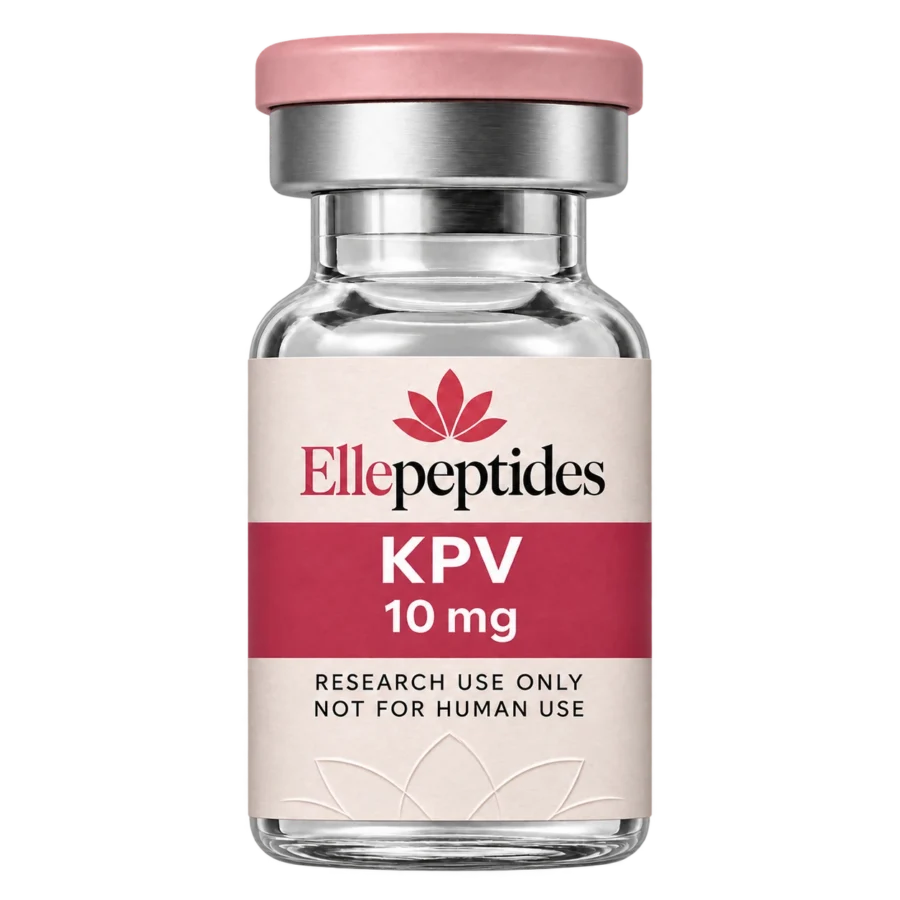
KPV is a three-amino-acid peptide, lysine–proline–valine, that matches the final residues of alpha-melanocyte-stimulating hormone (alpha-MSH). Researchers study it mainly in intestinal cell and mouse colitis models, where it has reduced inflammatory signaling. Ellepeptides lists KPV as a single 10 mg freeze-dried research vial.
- Molecule type: synthetic tripeptide, H-Lys-Pro-Val-OH
- Vial size: 10 mg (one size)
- Listed price: from $60.00 USD
- Form: freeze-dried (lyophilized) powder in a sealed vial; no capsules, creams or nasal sprays
- Shipping: ships within the US, with free shipping on merchandise over $200 after coupons
- Scope: for laboratory research only
KPV vial sizes and price per mg
| Vial size | Listed price (USD) | Price per mg |
|---|---|---|
| 10 mg | $60.00 | $6.00 |
Prices are listed in U.S. dollars at the time of writing, and the price shown beside Add to cart is always the current one. Bulk or combination savings through cart rules or coupons are not promised.
KPV compound profile
| Catalog name | KPV |
|---|---|
| Nominal amount per vial | 10 mg |
| Research reference identity | Tripeptide; Lys–Pro–Val |
| Reference sequence | H-Lys-Pro-Val-OH (KPV) |
| Reference molecular formula | C16H30N4O4 |
| Reference molar mass | 342.43 g/mol |
| CAS reference | 67727-97-3 |
| Molecular reference source | PubChem CID 125672 |
| Intended scope | Laboratory research |
The table describes the reference molecule recorded in PubChem: its sequence, formula and mass. It does not describe the analytical make-up of any lot; counterions, water content and actual vial composition are separate questions. KPV is also distinct from the full 13-residue alpha-MSH hormone.
How KPV works in research
Alpha-MSH is a 13-amino-acid hormone derived from the precursor proopiomelanocortin. A 2008 review by Brzoska and colleagues described how it calms inflammation through melanocortin receptors on immune and non-immune cells and through NF-κB, a transcription factor behind many inflammatory genes. The same review noted that the C-terminal tripeptide, KPV, keeps anti-inflammatory activity without the pigmentary effect of the parent hormone (Brzoska et al., 2008).
KPV may not rely on those receptors alone. Dalmasso’s group showed that the peptide transporter PepT1 carries KPV into intestinal epithelial and immune cells, where it lowered NF-κB and MAPK signaling and inflammatory cytokine output (Dalmasso et al., 2008). Kannengiesser and colleagues then studied mice lacking a functional melanocortin-1 receptor (MC1R) and still saw protection during chemically induced colitis, which suggests at least part of the effect is independent of MC1R (Kannengiesser et al., 2008).
Later work packaged KPV in nanoparticles designed for colon delivery (Laroui et al., 2010; Xiao et al., 2017). No human pharmacology data were identified in the sources reviewed.
Key KPV studies
| Year | Study & model | What was measured | Main finding | Source |
|---|---|---|---|---|
| 2008 | Dalmasso et al.; intestinal and immune cells, mouse colitis | PepT1 transport, NF-κB/MAPK signaling, inflammation indices | PepT1 carried KPV into cells; signaling and inflammation were reduced | Gastroenterology |
| 2008 | Kannengiesser et al.; two mouse colitis models, incl. MC1R-deficient mice | Weight loss, colon histology, MPO activity | Earlier recovery and lower MPO; all KPV-treated MC1R-deficient mice survived DSS colitis | Inflamm Bowel Dis |
| 2008 | Brzoska et al.; narrative review of alpha-MSH and related tripeptides | Published cell and animal evidence | KPV keeps anti-inflammatory activity without pigmentary effect | Endocr Rev |
| 2010 | Laroui et al.; KPV nanoparticles in hydrogel, Caco2-BBE cells and DSS mice | Cell viability, barrier function, inflammatory and histologic damage | No effect on viability; protection against colitis damage | Gastroenterology |
| 2017 | Xiao et al.; hyaluronic-acid-functionalized KPV nanoparticles in DSS mice | Targeting, mucosal healing, TNF-α | Faster mucosal healing and lower TNF-α than KPV particles without hyaluronic acid | Mol Ther |
Kannengiesser’s study is the most informative because it used two mouse models: colitis induced by dextran sodium sulfate (DSS) and the CD45RBhi T-cell transfer model. KPV-treated mice regained weight sooner and showed fewer inflammatory infiltrates and lower colonic myeloperoxidase (MPO) activity. The abstract does not give group sizes or the sex of the animals (source).
The nanoparticle studies test delivery systems, not KPV in plain solution. Laroui reported that its roughly 400 nm particles left cell viability and barrier function unchanged and achieved similar efficacy in mice at a far lower KPV concentration than free peptide (source). Xiao’s hyaluronic-acid particles reached colonic epithelial cells and macrophages (source). Neither result describes a freeze-dried vial.
KPV research involving women
None of the primary KPV studies reviewed here enrolled people, so there are no results in women, or in men, to report. The mouse abstracts do not state animal sex, and the cell work uses established laboratory cell lines. Gut and skin questions are common among Ellepeptides readers, but KPV evidence currently stops at cell and mouse models. The 2008 review lists inflammatory skin and bowel disease as areas for future study; that is a research direction, not an outcome demonstrated in women (Brzoska et al.).
KPV vs BPC-157, GHK-Cu and KLOW
| Compound | Type | Main research focus | Sizes on Ellepeptides |
|---|---|---|---|
| KPV | Tripeptide (Lys-Pro-Val), alpha-MSH fragment | Inflammatory signaling in gut cell and colitis models | 10 mg |
| BPC-157 | 15-amino-acid synthetic peptide | Rat tendon-cell migration | 5 mg, 10 mg |
| GHK-Cu | Copper complex of the tripeptide Gly-His-Lys | Fibroblast collagen and matrix research | 50 mg, 100 mg |
| KLOW Research Blend | Four-component blend that includes 10 mg KPV | Constituent evidence only; no study of the mixture | 80 mg |
BPC-157 is a 15-residue peptide whose cited work comes from rat tendon cells (Chang et al., 2011), so it shares little with KPV, a three-residue hormone fragment studied for inflammatory signaling. GHK-Cu is also a tripeptide, but it is bound to copper and studied in fibroblast matrix research (Maquart et al., 1988). KLOW combines KPV with GHK-Cu, BPC-157 and TB-500 in one vial; a fixed mixture is not equivalent to standalone KPV.
Handling, storage and reconstitution math
KPV arrives as a freeze-dried solid in a sealed vial. Storage conditions for the unopened vial and any prepared solution belong to the label, so check it first. Common laboratory habits include letting a chilled vial reach room temperature before opening, working with clean technique and labeling any prepared vial with solvent and date.
The arithmetic is straightforward: concentration equals vial mass divided by solvent volume. A 10 mg vial brought up in 5.0 mL gives 2 mg/mL; in 2.0 mL it gives 5 mg/mL. The peptide calculator repeats the conversion for any mass and volume, and laboratories needing a preserved diluent can review bacteriostatic water (30 mL).
Ordering KPV in the US
Ellepeptides ships KPV to addresses within the United States. Shipping is free when the merchandise subtotal exceeds $200 after coupon discounts (before taxes and shipping). Below that threshold, standard shipping is $15.99 per order. Delivery options and the available payment methods are shown at checkout, so please review the shipping policy for current details.
KPV FAQ
What is KPV peptide?
KPV is a synthetic tripeptide made of lysine, proline and valine, the last three amino acids of alpha-MSH. Researchers use it to study how a very short melanocortin fragment affects inflammatory signaling, especially in intestinal cell and mouse colitis models. Ellepeptides lists it as a 10 mg freeze-dried research vial.
How much does KPV peptide cost?
KPV is listed at $60.00 USD for a 10 mg vial at the time of writing, about $6.00 per mg. The current price always appears beside the Add to cart button. Orders with a merchandise subtotal above $200 after coupons qualify for free shipping, and taxes are calculated at checkout.
Where can I buy KPV peptide in the US?
You can order KPV from Ellepeptides on this page. Vials ship to US addresses, the available payment methods are shown at checkout, and free shipping applies over $200 after coupons. Related compounds sit in the Healing & Recovery category and the wider research peptides catalog.
What are the benefits of KPV in research?
In published models, KPV reduced inflammatory signaling. Cell studies showed lower NF-κB and MAPK activity after uptake through PepT1, and mouse colitis studies reported faster weight recovery and less tissue inflammation. These are findings in cells and animals; no human trial establishing a health benefit was identified.
What is the difference between KPV and BPC-157?
They are unrelated molecules. KPV has three amino acids taken from the alpha-MSH sequence, while BPC-157 is a 15-amino-acid synthetic peptide studied in tendon and tissue-repair models. KPV research centers on inflammatory signaling in the gut. The BPC-157 page summarises its own sources.
Is KPV the same as alpha-MSH?
No. Alpha-MSH is a 13-amino-acid hormone with both pigmentary and anti-inflammatory effects, and KPV is only its final three residues. Review authors describe KPV as keeping anti-inflammatory activity without the pigmentary effect, so results for one molecule cannot be assumed for the other.
What side effects of KPV have been reported in studies?
No human trial was found, so there is no clinical side-effect profile to report. In laboratory work, Laroui’s team found its KPV nanoparticles did not affect cell viability or barrier function, and Xiao’s group described its formulation as non-toxic to intestinal cells. Those observations apply only to specific formulations in models.
What is the half-life of KPV?
A human half-life for KPV has not been established in the literature reviewed here, because no pharmacokinetic study in people was identified; the animal work measured inflammation rather than clearance. Treat uncited half-life figures with caution; our research page explains how sources are reviewed.
Does Ellepeptides sell KPV capsules, cream or nasal spray?
No. Ellepeptides lists KPV only as freeze-dried powder in a 10 mg vial. Capsules, creams and nasal sprays are separate formulations with their own specifications. Published oral-delivery work used purpose-built nanoparticles inside a hydrogel, which is a different material from a plain research vial.
Has KPV been studied for skin?
Mostly indirectly. The 2008 Endocrine Reviews article discusses alpha-MSH in contact dermatitis models and proposes KPV as a candidate for inflammatory skin research, but the primary KPV studies cited on this page are all intestinal, and skin-specific data remain limited in peer-reviewed work.
How long does KPV shipping take?
Delivery options are shown at checkout. Standard shipping is $15.99 per order, and shipping is free over $200 after coupons. See the shipping policy for details.
KPV references
- PubChem (NCBI). KPV, CID 125672. PubChem
- Brzoska T, et al. (2008). Alpha-MSH and related tripeptides. Endocrine Reviews. PubMed 18612139
- Dalmasso G, et al. (2008). PepT1-mediated tripeptide KPV uptake reduces intestinal inflammation. Gastroenterology. PubMed 18061177
- Kannengiesser K, et al. (2008). KPV in murine models of inflammatory bowel disease. Inflamm Bowel Dis. PubMed 18092346
- Laroui H, et al. (2010). Colon-targeted KPV nanoparticles in hydrogel reduce colitis in mice. Gastroenterology. DOI
- Xiao B, et al. (2017). Hyaluronic acid-functionalized KPV nanoparticles. Molecular Therapy. PMC5498804
- Chang CH, et al. (2011). BPC-157 and rat tendon fibroblasts. PubMed 21030672
- Maquart FX, et al. (1988). GHK-Cu and collagen synthesis in fibroblast cultures. PubMed 3169264
Related research materials: Healing & Recovery peptides, BPC-157, KLOW Research Blend (80 mg), GHK-Cu Copper Peptide, TB-500 and the full research peptides catalog. For laboratory research only. Not for human or veterinary use.

Reviews
There are no reviews yet.