
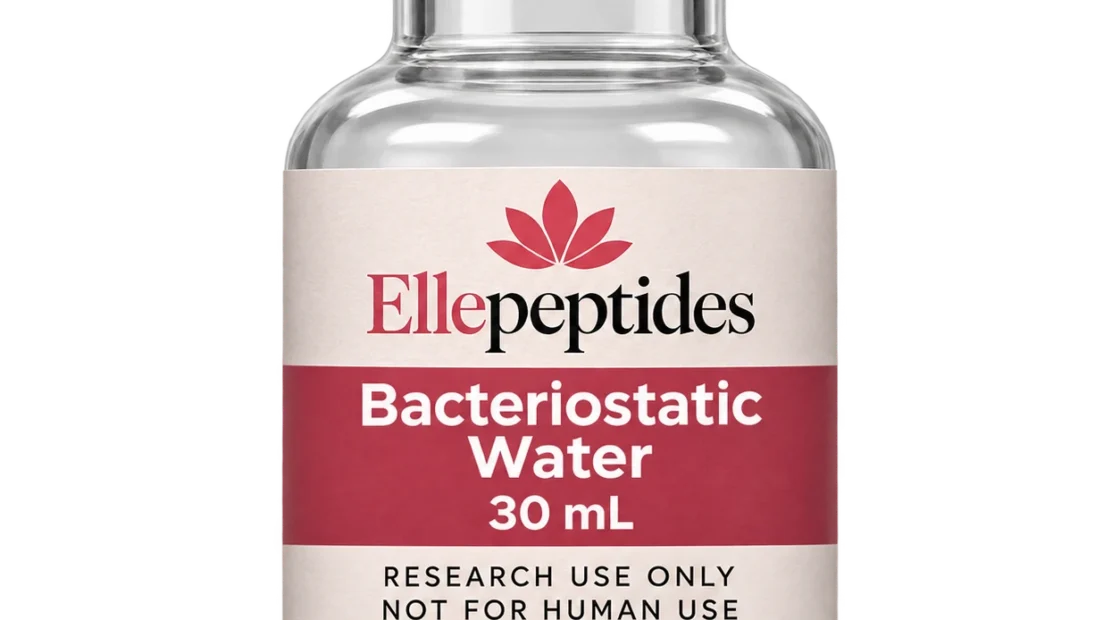
Here is how to reconstitute peptides in the lab: add a measured volume of a suitable sterile liquid, usually bacteriostatic water, to the freeze-dried vial, let it run down the inside wall, and swirl gently until the powder dissolves. Concentration is then simple division: milligrams in the vial ÷ milliliters added.
At a glance
- Reconstituting turns a freeze-dried (lyophilized) peptide back into a liquid.
- Bacteriostatic water, commonly preserved with 0.9% benzyl alcohol, suits vials entered more than once; sterile water has no preservative and is single-use.
- Swab the stopper, let the liquid run down the vial wall, then swirl gently. Never shake.
- Concentration = vial mass ÷ liquid volume: 10 mg in 2 mL gives 5 mg/mL.
- Keep dry vials at –20 °C or colder; freeze solutions in single-use portions.
Featured in this guide
- Bacteriostatic Water (30 mL vial): View research vials
- Alcohol Prep Pads (200 pack): View prep pads
- BPC-157 (5 mg, 10 mg): View research vials
- GHK-Cu (50 mg, 100 mg): View research vials
- Retatrutide (5, 10, 30, 50, 60 mg): View research vials
Table of contents
- What is a lyophilized peptide?
- Which liquid should you use to reconstitute peptides?
- How to reconstitute peptides, step by step
- How do you calculate peptide concentration?
- How should you store lyophilized peptides?
- How can you tell a peptide has degraded?
- Reconstitution research in women
- Supplies checklist
- Frequently Asked Questions
- References
What is a lyophilized peptide?
A peptide is a short chain of amino acids, typically 2 to 50 (NHGRI: peptide definition). For how peptides differ from steroids, see Are peptides steroids?
Lyophilization (freeze-drying) removes water from a product after it is frozen, through freezing, primary drying by sublimation (ice turning straight into vapour) and secondary drying. The FDA notes that products are made this way because they are unstable in solution, and that a dry powder offers enhanced stability (FDA, 1993: lyophilization guide).
That is why every vial in the research peptides catalogue arrives as a dry powder or compact “cake.” Adding liquid changes the concentration, never the amount of material in the vial.
Which liquid should you use to reconstitute peptides?
The right liquid (diluent) comes from the compound’s own documentation. One bacteriostatic water label says to consult the solute maker’s instructions for the choice of vehicle (Hospira label, 2019: bacteriostatic water).
Bacteriostatic water is sterilized water containing one or more suitable antimicrobial agents (USP 35: bacteriostatic water monograph); the Hospira product lists 0.9% (9 mg/mL) benzyl alcohol and a pH of 5.7. Sterile water has no antimicrobial agent or other added substance and comes in single-use containers (USP 35: sterile water monograph).
For sequences that resist water, a Sigma-Aldrich protocol suggests a small amount of 25% acetic acid for basic (positively charged) peptides, 0.1 M ammonium bicarbonate for acidic ones, and organic solvents such as DMSO for very hydrophobic sequences (Sigma-Aldrich: peptide solubility protocol).
| Liquid | What it contains | Typical bench use | Watch for | On Ellepeptides |
|---|---|---|---|---|
| Bacteriostatic water | Water plus 0.9% benzyl alcohol (common) | Vials entered more than once | Benzyl alcohol is chemically active | 30 mL vial |
| Sterile water | Water with nothing added | Single-entry preparation | Single-use once opened | Not listed |
| Dilute acetic acid | Water with a little acetic acid | Basic sequences | Lowers pH; test a small portion first | Not listed |
| 0.1 M ammonium bicarbonate | Mild basic buffer | Acidic sequences | Aim for about pH 7 | Not listed |
| DMSO or acetonitrile | Organic solvents | Very hydrophobic sequences | Cysteine and methionine are unstable in DMSO | Not listed |
Benzyl alcohol is not inert: in 1982, CDC linked diluents preserved with it to 16 deaths in preterm infants (CDC, 1982: benzyl alcohol in newborns). For cell work, include a comparison group given the liquid alone.
How to reconstitute peptides, step by step
Work on a clean surface with clean gloves, and lay out everything before you open a vial.
- Check the documentation. Confirm the liquid and target concentration first.
- Let the vial warm up. Bring a cold vial to room temperature before opening it to limit moisture uptake (Sigma-Aldrich: peptide handling and storage).
- Let the powder settle. Tap the vial gently so loose powder collects at the bottom. Protein suppliers briefly centrifuge vials for the same reason (Sartorius, 2023: reconstitution datasheet).
- Swab the stoppers. Scrub each rubber stopper, on the peptide vial and the water, with a fresh 70% alcohol prep pad using friction, then let it air-dry (Public Health Ontario, 2020: multi-use vials). Alcohol works best at 60 to 90% and does not kill bacterial spores (CDC, 2023: chemical disinfectants).
- Measure the liquid. Withdraw the planned volume with a sterile, graduated transfer device, using aseptic technique for every entry.
- Run it down the wall. Add the liquid slowly down the inside of the vial, not straight onto the powder, to limit foam.
- Swirl, never shake. Swirl or roll the vial gently, then let it stand for a minute. Sartorius and Thermo Fisher both say not to vortex (Thermo Fisher: protein reconstitution protocol).
- Inspect and log. The solution should be clear, with no floating particles. Record the compound, lot, liquid, volume, concentration and date.
Why so gentle? Air-liquid interfaces stress large molecules: one review reports that vortexing a growth hormone solution for just 1 minute precipitated as much as 67% of the protein (Li et al., 2019: interfacial stress). Most research peptides are far smaller, but gentle mixing costs nothing.
How do you calculate peptide concentration?
Concentration is milligrams in the vial ÷ milliliters of liquid added = mg/mL. Multiply by 1,000 for micrograms (mcg) per mL.
Worked example: a 10 mg vial of BPC-157 with 2 mL of bacteriostatic water gives 10 ÷ 2 = 5 mg/mL, or 5,000 mcg/mL. With 1 mL, the same vial gives 10 mg/mL. The amount of peptide is unchanged.
| Vial (nominal mass) | Liquid added | Concentration | In mcg/mL |
|---|---|---|---|
| BPC-157, 5 mg | 2 mL | 2.5 mg/mL | 2,500 |
| BPC-157, 10 mg | 2 mL | 5 mg/mL | 5,000 |
| Tirzepatide, 30 mg | 3 mL | 10 mg/mL | 10,000 |
| GHK-Cu, 50 mg | 5 mL | 10 mg/mL | 10,000 |
| MOTS-c, 40 mg | 4 mL | 10 mg/mL | 10,000 |
The same math plans frozen portions (aliquots): four 0.5 mL aliquots from that 10 mg vial each hold 2.5 mg. The Ellepeptides peptide calculator runs this arithmetic and the mg-to-mcg conversion for any vial size.
One caution: the label states nominal mass, not necessarily pure peptide. Synthetic peptides are usually made as trifluoroacetate (TFA) salts, and in one 2025 study TFA reached up to 35% of the total weight of the salts tested (Erckes et al., 2025: TFA counter-ions). European guidance expresses peptide content on a counter-ion-free, water-free basis (EMA, 2025: synthetic peptides guideline); our research page explains more.
How should you store lyophilized peptides?
The label and the compound’s documentation come first. Where they are silent, published guides agree on these principles.
| Stage | General guidance | Source |
|---|---|---|
| Dry vial | –20 °C for 1 to 2 weeks; –80 °C preferred for longer storage; away from bright light | Sigma-Aldrich |
| Before opening | Let the vial reach room temperature; moisture greatly decreases long-term stability | Sigma-Aldrich |
| Reconstituted solution | Limited shelf life; freeze single-use aliquots, sterile buffers at pH 5 to 6 where suitable, no repeated freeze-thaw | Sigma-Aldrich |
| Reconstituted solution | Do not store unless the solute maker directs it | Hospira label |
| Bacteriostatic water, unopened | Per its label; one manufacturer specifies 20 to 25 °C | Hospira label |
| Bacteriostatic water, opened | Discard per the manufacturer or within 28 days, whichever is shorter | Public Health Ontario |
For scale, Thermo Fisher’s protocol for its recombinant proteins allows reconstituted solutions at 2 to 8 °C for up to one week, or frozen aliquots at –20 to –80 °C for 3 to 12 months (Thermo Fisher: protein reconstitution protocol). These are one supplier’s protein figures, not a peptide rule.
How can you tell a peptide has degraded?
In a dry vial, a collapsed or melted-looking cake is a warning sign: the FDA describes this “meltback” as cake collapse that may cause greater instability and increased degradation (FDA, 1993: lyophilization guide). In solution, watch for cloudiness, specks or a film. Interfacial stress can produce visible or subvisible particles and soluble aggregates (Li et al., 2019: interfacial stress), and only some show up by eye.
Many changes are invisible without lab testing such as mass spectrometry. A Sigma-Aldrich guide lists the main chemical pathways (Sigma-Aldrich: peptide degradation pathways).
| Pathway | What happens | Sequences most at risk |
|---|---|---|
| Oxidation | Side chains react with oxygen; methionine oxidation is almost impossible to reverse | Cysteine (C), methionine (M), tryptophan (W) |
| Deamidation | An amide side chain converts, favored by basic conditions | Asn-Gly (N-G), Gln-Gly (Q-G) |
| Hydrolysis | The chain is cut | Asp-Pro (D-P) |
| Pyroglutamate formation | The first residue closes into a ring | Glutamine (Q) at the N-terminus |
| Aggregation | Molecules clump, sometimes into visible particles | Any sequence; agitation raises the risk |
If a solution looks different from when you made it, or has passed the window your documentation allows, discard it and note why.
Reconstitution research in women
Reconstitution studies test molecules, not people, so no reconstitution data “in women” exists, and the chemistry is the same whatever the sex of the study subjects. Sex matters in experimental design.
In 2014, the US National Institutes of Health announced steps to correct an over-reliance on male animals and cells in preclinical research (NIH, 2014: sex differences in preclinical research). The Canadian Institutes of Health Research (CIHR) expects applicants to integrate sex and gender into research designs where appropriate (CIHR: sex and gender in health research).
Preparing material identically for female and male study groups, with the same liquid, concentration and lot, makes differences easier to attribute to biology rather than handling. Our peptides for women collection notes who was studied for each compound.
Supplies checklist
Ellepeptides lists the first two items in its lab supplies category; the rest come from standard lab stock.
- Bacteriostatic water, 30 mL: read the label for preservative and storage
- Alcohol prep pads, 200 pack: one fresh pad per stopper, every entry
- The sealed freeze-dried research vial
- Sterile, graduated transfer devices sized for your volumes (not listed)
- Sterile water or dilute acetic acid, if your documentation calls for it (not listed)
- Clean gloves, a clean surface and a suitable waste container
- Freezer-safe tubes, labels, a marker and a notebook
Planning a metabolic study? Our peptides for weight loss research guide summarizes the main trials.
Frequently Asked Questions
How much bacteriostatic water should I add to a 10 mg peptide vial?
It depends on your target concentration, because volume only sets concentration. Adding 1 mL to a 10 mg vial gives 10 mg/mL, 2 mL gives 5 mg/mL and 5 mL gives 2 mg/mL. The peptide calculator checks these figures; pick a concentration your equipment can measure accurately.
Can I use sterile water instead of bacteriostatic water?
Yes, if your compound’s documentation allows it. Sterile water has no preservative and is meant for single use, while bacteriostatic water commonly carries 0.9% benzyl alcohol so a vial can be entered more than once. With sterile water, prepare only what you need or freeze portions straight away.
Why shouldn’t I shake my peptide vial?
Shaking whips air into the liquid, and air-liquid interfaces can make large molecules clump together. A 2019 review reported that vortexing a growth hormone solution for just 1 minute precipitated as much as 67% of the protein. Swirl gently, and give stubborn powder more time, not more force.
How should I store lyophilized peptides before I mix them?
Keep sealed vials cold, dark and dry unless the label says otherwise. Sigma-Aldrich recommends –20 °C for 1 to 2 weeks and –80 °C for longer storage, away from bright light. Let a cold vial reach room temperature before opening it, because moisture greatly decreases long-term stability.
How long does a reconstituted peptide last in the fridge?
There is no single number; it depends on the compound’s documentation. One bacteriostatic water label advises against storing reconstituted solutions unless the solute maker directs it, and Thermo Fisher allows its own proteins 2 to 8 °C for up to one week. For longer storage, freeze single-use aliquots.
Why won’t my peptide dissolve in bacteriostatic water?
Some sequences are too hydrophobic, or carry a charge that resists near-neutral water. Sigma-Aldrich suggests brief sonication first, then a small amount of 25% acetic acid for basic peptides or 0.1 M ammonium bicarbonate for acidic ones. Always test a small portion before committing the whole vial.
What does the 0.9% benzyl alcohol in bacteriostatic water do?
It is the preservative. At 0.9%, or 9 mg per mL, benzyl alcohol inhibits microbial growth in the vial between entries. It does not sterilize a contaminated vial or replace swabbing the stopper. Because the USP definition allows other agents, check your label for the exact preservative.
My reconstituted peptide looks cloudy. Can I still use it for research?
Treat a cloudy solution as compromised and discard it. The Hospira label for its 30 mL bacteriostatic water says not to use the liquid unless it is clear, and a 2019 review notes that aggregation can show up as visible particles. Remake it with gentler mixing, or check whether the sequence needs another solvent.
How long can I keep an opened vial of bacteriostatic water?
Follow the manufacturer’s label first. Public Health Ontario guidance advises discarding opened multi-use vials per the manufacturer or within 28 days, whichever is shorter, and dating the vial at first entry. Ellepeptides sells bacteriostatic water in a 30 mL vial, so plan how many preparations it will cover.
Does Ellepeptides ship reconstitution supplies across the US?
Yes. Bacteriostatic water and alcohol prep pads ship to addresses within the United States. Shipping is free when the merchandise subtotal exceeds $200 after coupon discounts; otherwise standard shipping is $15.99 per order. Delivery options are shown at checkout; see the shipping policy.
References
- NHGRI. Talking Glossary: peptide. genome.gov
- FDA. 1993 (updated 2014). Lyophilization of parenteral (7/93): inspection guide. fda.gov
- USP 35–NF 30 (2012). Monograph: bacteriostatic water. Reproduced text
- USP 35–NF 30 (2012). Monograph: sterile water. Reproduced text
- Hospira, Inc. (Pfizer). Revised 2019. Bacteriostatic Water, USP: product label (DailyMed). dailymed.nlm.nih.gov
- Sigma-Aldrich. Synthetic peptide handling and storage protocol: peptide solubility. sigmaaldrich.com
- Sigma-Aldrich. Handling and storage guidelines for peptides and proteins. sigmaaldrich.com
- Sigma-Aldrich. Peptide stability and potential degradation pathways. sigmaaldrich.com
- CDC. 1982. Neonatal deaths associated with use of benzyl alcohol. MMWR 31(22):290. cdc.gov
- Public Health Ontario. 2020. Updated guidance on the use of multi-use vials. publichealthontario.ca
- CDC. 2023. Disinfection and sterilization guideline: chemical disinfectants. cdc.gov
- Sartorius. 2023. RUO growth factors and cytokines: reconstitution datasheet. sartorius.hr
- Thermo Fisher Scientific. Reconstitution and storage of Gibco PeproTech recombinant proteins. thermofisher.com
- Li J, et al. 2019. Interfacial stress in the development of biologics. AAPS J 21:44. link.springer.com
- Erckes V, Streuli A, et al. 2025. Towards a consensus for the analysis and exchange of TFA as a counterion in synthetic peptides and its influence on membrane permeation. Pharmaceuticals 18(8):1163. mdpi.com
- EMA. 2025. Guideline on the development and manufacture of synthetic peptides. ema.europa.eu
- NIH. 2014. NIH takes steps to address sex differences in preclinical research. nih.gov
- CIHR. Sex and gender in health research. cihr-irsc.gc.ca
Explore the research catalog: find bacteriostatic water and prep pads in Lab Supplies, then browse Research Peptides such as BPC-157, GHK-Cu, retatrutide and TB-500. For laboratory research only. Not for human or veterinary use.