
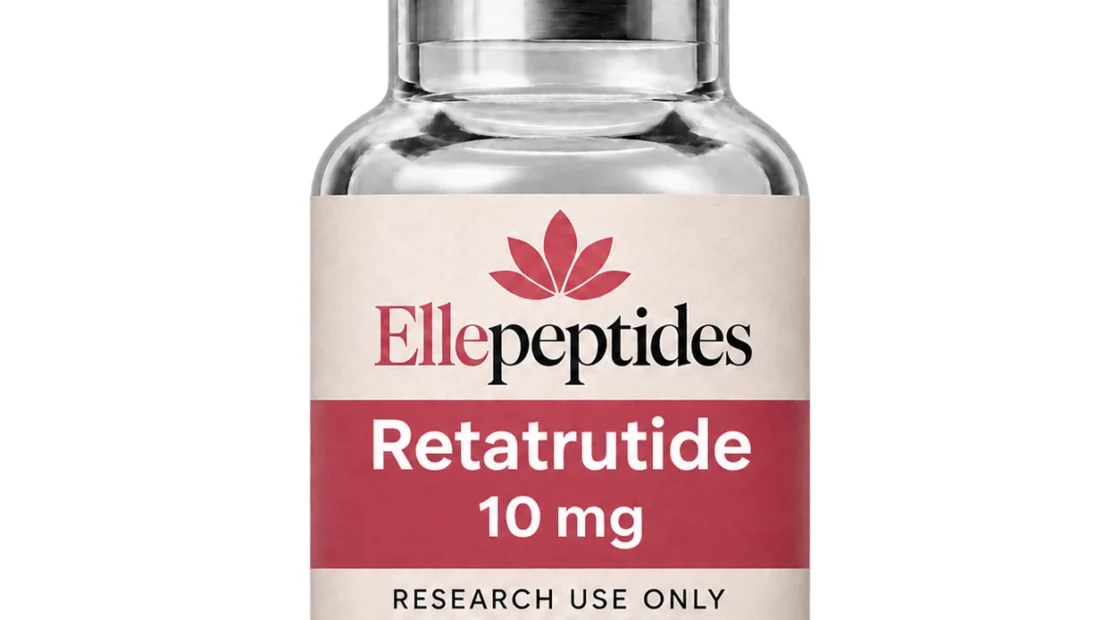
The most common retatrutide side effects reported in clinical trials were digestive: nausea, diarrhea, vomiting and constipation, mostly mild to moderate and most frequent early in treatment. Trials also recorded a rise in heart rate in phase 2 that eased after week 24, plus an unusual skin sensation called dysesthesia in phase 3. Roughly 4% to 18% of retatrutide participants stopped because of adverse events, depending on the trial and study group.
At a glance
- Digestive effects led every trial: in TRIUMPH-1, nausea affected 28.6% to 42.4% of retatrutide study groups versus 14.8% on an inactive treatment (placebo).
- Dysesthesia, a burning, tingling or numb skin sensation, affected 4.5% to 20.9% of retatrutide study groups in phase 3.
- Heart rate rose in the phase 2 obesity trial, peaked at week 24 and then declined.
- Head to head, nausea was almost identical with retatrutide and semaglutide (21.2% to 23.8% versus 21.3%).
Featured research vials
- Retatrutide: freeze-dried vials of 5, 10, 30, 50 and 60 mg. View research vials
- Tirzepatide: freeze-dried vials of 10, 15, 20, 30 and 60 mg. View research vials
- Semaglutide: freeze-dried vials of 5, 10, 20 and 30 mg. View research vials
Table of contents
- Which retatrutide side effects were most common?
- What did the phase 2 obesity trial report?
- What did the phase 2 type 2 diabetes trial report?
- What have the phase 3 TRIUMPH trials reported?
- What is dysesthesia, and how often did it appear?
- What happened to heart rate and blood pressure?
- How many participants stopped because of side effects?
- How do these compare with tirzepatide and semaglutide trials?
- What do the trials show in women?
- Frequently Asked Questions
- References
Which retatrutide side effects were most common?
In every trial, the same four digestive complaints led the list: nausea, diarrhea, vomiting and constipation. The phase 2 obesity paper called them the most common adverse events, more frequent in the higher study groups and mostly mild to moderate (Jastreboff et al., 2023: phase 2 obesity trial).
Phase 3 tells the same story at scale. In TRIUMPH-1, which enrolled 2,339 adults with obesity and without diabetes, nausea affected 28.6% to 42.4% of the retatrutide groups and diarrhea 25.2% to 34.1%, compared with 14.8% and 13.5% on placebo (Eli Lilly, 2026: TRIUMPH-1 topline results).
Dysesthesia and a phase 2 rise in heart rate have their own sections below. All figures describe adults in clinical trials of retatrutide; for how its three receptors work, see What is GLP-3?
What did the phase 2 obesity trial report?
The 48-week trial in the New England Journal of Medicine randomized 338 adults with obesity to several retatrutide study groups or placebo; 51.8% were men (Jastreboff et al., 2023: phase 2 obesity trial). Adverse events of any kind were reported by 73% to 94% of participants in the retatrutide groups and by 70% on placebo (PACE-CME, 2023: phase 2 trial summary).
Digestive events drove most of that difference, and investigators said most occurred in the early weeks of treatment. Vomiting reached 20% in two of the retatrutide groups, and constipation 26% in one of them (TCTMD, 2023: phase 2 safety report).
Serious adverse events occurred in 0% to 6% of the retatrutide groups versus 4% on placebo. Between 6% and 16% of retatrutide participants stopped because of adverse events, compared with none on placebo (PACE-CME, 2023).
What did the phase 2 type 2 diabetes trial report?
The phase 2 trial in The Lancet enrolled 281 adults with type 2 diabetes at 42 US centers and compared retatrutide with placebo and with dulaglutide, an established GLP-1 drug, over 36 weeks (Rosenstock et al., 2023: phase 2 type 2 diabetes trial).
Mild to moderate digestive events were reported by 35% of retatrutide participants (67 of 190), exactly matching the 35% seen with dulaglutide (16 of 46), against 13% on placebo (6 of 45). Rates rose from 13% to 50% across the retatrutide groups. There were no reports of severe low blood sugar (hypoglycemia) and no deaths during the study.
That close match with a GLP-1 comparator returned in the phase 3 head-to-head trial against semaglutide.
What have the phase 3 TRIUMPH trials reported?
Four TRIUMPH trials have reported safety figures through sponsor releases, and TRIUMPH-1 and TRIUMPH-2 have also appeared in journals (Jastreboff et al., 2026: TRIUMPH-1 in NEJM; TRIUMPH-2 investigators, 2026: TRIUMPH-2). Ranges cover the retatrutide study groups; placebo is in brackets.
| Trial and population | Nausea | Diarrhea | Vomiting | Constipation | Source |
|---|---|---|---|---|---|
| TRIUMPH-1: 2,339 adults with obesity, no diabetes; 80 weeks | 28.6–42.4% (14.8%) | 25.2–34.1% (13.5%) | 10.6–25.3% (4.8%) | 23.8–26.1% (10.9%) | Eli Lilly, 2026: TRIUMPH-1 |
| TRIUMPH-2: 1,152 adults with type 2 diabetes and obesity or overweight; 80 weeks | 13.7–28.0% (8.0%) | 27.4–33.6% (13.2%) | 5.5–15.7% (4.2%) | 14.0–16.8% (9.4%) | Eli Lilly, 2026: TRIUMPH-2 and -3 |
| TRIUMPH-3: 1,949 adults with severe obesity and cardiovascular disease; 80 weeks | 21.7–22.4% (5.8%) | 24.4–30.1% (8.7%) | Not listed | 15.7–18.0% (7.1%) | Eli Lilly, 2026: TRIUMPH-2 and -3 |
| TRIUMPH-4: 445 adults with obesity or overweight and knee osteoarthritis; 68 weeks | 38.1–43.2% (10.7%) | 33.1–34.7% (13.4%) | 20.4–20.9% (0.0%) | 21.8–25.0% (8.7%) | Eli Lilly, 2025: TRIUMPH-4 |
Lilly describes most of these events as mild to moderate. The TRIUMPH-2 report added low blood pressure (hypotension) in 1% to 6% of retatrutide participants versus under 1% on placebo (TRIUMPH-2 investigators, 2026).
What is dysesthesia, and how often did it appear?
Dysesthesia means a distorted sense of touch: an abnormal, unpleasant sensation usually described as burning, tingling or numbness (NCI Thesaurus: dysesthesia definition). It appeared in every phase 3 trial listed here, and it is one of the few events where retatrutide ran higher than semaglutide in a direct comparison.
| Trial | Retatrutide study groups | Comparator | Source |
|---|---|---|---|
| TRIUMPH-1 | 5.1–12.5% | 0.9% (placebo) | Eli Lilly, 2026 |
| TRIUMPH-2 | 4.5–7.3% | 0.7% (placebo) | Eli Lilly, 2026 |
| TRIUMPH-3 | 6.4% | 1.3% (placebo) | Eli Lilly, 2026 |
| TRIUMPH-4 | 8.8–20.9% | 0.7% (placebo) | Eli Lilly, 2025 |
| TRANSCEND-T2D-2 | 4.8–6.5% | 2.7% (semaglutide) | Eli Lilly, 2026 |
Lilly reported that these events were generally mild to moderate and that most resolved during treatment in TRIUMPH-2 and TRIUMPH-3; in TRIUMPH-4 they rarely led anyone to stop. The sources cited here do not describe a mechanism.
What happened to heart rate and blood pressure?
In the phase 2 obesity trial, heart rate went up more in the higher study groups, peaked at 24 weeks and declined after that (Jastreboff et al., 2023). The phase 3 sponsor releases cited here give no heart-rate figures.
Blood pressure moved the other way. Systolic pressure (the top number) fell an average of 5 to 8 mm Hg in all but the lowest phase 2 retatrutide group (TCTMD, 2023: phase 2 safety report), and TRIUMPH-2 recorded hypotension in 1% to 6% of retatrutide participants versus under 1% on placebo.
How many participants stopped because of side effects?
Stopping rates are one of the clearest ways to compare tolerability between trials.
| Trial | Retatrutide study groups | Comparator | Source |
|---|---|---|---|
| Phase 2 obesity, 48 weeks | 6–16% | 0% (placebo) | PACE-CME, 2023 |
| TRIUMPH-1, 80 weeks | 4.1–11.3% | 4.9% (placebo) | Eli Lilly, 2026 |
| TRIUMPH-2, 80 weeks | 3.8–11.6% | 4.9% (placebo) | Eli Lilly, 2026 |
| TRIUMPH-3, 80 weeks | 9.8–13.5% | 4.8% (placebo) | Eli Lilly, 2026 |
| TRIUMPH-4, 68 weeks | 12.2–18.2% | 4.0% (placebo) | Eli Lilly, 2025 |
| TRANSCEND-T2D-2, 80 weeks | 4.8–7.9% | 2.7% (semaglutide) | Eli Lilly, 2026 |
TRIUMPH-4 had the highest rates. Lilly reported that they tracked closely with starting body mass index (BMI) and included people who stopped for perceived excessive weight loss; among participants with a BMI of 35 or more, the rates were 8.8% and 12.1% versus 4.8% on placebo (Eli Lilly, 2025: TRIUMPH-4). The published NEJM version of TRIUMPH-1 lists 4.1% to 11.1% versus 4.6% on placebo, close to the topline release (Healio, 2026: TRIUMPH-1 publication).
How do these compare with tirzepatide and semaglutide trials?
Each drug’s flagship obesity trial enrolled adults without diabetes and counted the same digestive events. Lengths and populations differ, so read the table as context rather than a ranking.
| Trial | Compound | Nausea | Vomiting | Diarrhea | Stopped for adverse events | Source |
|---|---|---|---|---|---|---|
| STEP 1: 1,961 adults; 68 weeks | Semaglutide | 44.2% (17.4%) | 24.8% (6.6%) | 31.5% (15.9%) | 7.0% (3.1%) | Wilding et al., 2021: STEP 1 |
| SURMOUNT-1: 2,539 adults; 72 weeks | Tirzepatide | 24.6–33.3% (9.5%) | 8.3–12.2% (1.7%) | 18.7–23.0% (7.3%) | 4.3–7.1% (2.6%) | Eli Lilly, 2022: SURMOUNT-1 |
| TRIUMPH-1: 2,339 adults; 80 weeks | Retatrutide | 28.6–42.4% (14.8%) | 10.6–25.3% (4.8%) | 25.2–34.1% (13.5%) | 4.1–11.3% (4.9%) | Eli Lilly, 2026: TRIUMPH-1 |
The clearest comparison is the only direct one. In TRANSCEND-T2D-2, an open-label trial in 1,298 adults with type 2 diabetes, nausea affected 21.2% and 23.8% of the two retatrutide groups versus 21.3% with semaglutide. Diarrhea was 28.3% and 32.7% versus 26.4%, constipation was lower with retatrutide (14.2% and 13.1% versus 19.8%), and stopping for adverse events was 4.8% and 7.9% versus 2.7% (Eli Lilly, 2026: TRANSCEND-T2D-2).
No head-to-head result against tirzepatide exists yet. Lilly lists TRIUMPH-5, a phase 3 comparison with tirzepatide, as ongoing (same release). For the wider field, see our peptides for weight loss research guide.
What do the trials show in women?
Women made up a large share of retatrutide participants. The phase 2 obesity trial enrolled 163 women among 338 people, and its prespecified subgroup analysis found greater percentage weight reduction in women than in men (Jastreboff et al., 2023: NEJM full report). TRIUMPH-2 included 554 women, 48% of 1,152 participants (TRIUMPH-2 investigators, 2026), and TRANSCEND-T2D-1 randomized 296 women among 537 adults (Bajaj et al., 2026: TRANSCEND-T2D-1).
None of the sources cited here report adverse events separately for women and men, so that comparison cannot be made yet. The comparator data lean heavily on women by design: women were 74.1% of STEP 1 (Wilding et al., 2021: STEP 1 participants) and 67.5% of SURMOUNT-1 (Jastreboff et al., 2022: SURMOUNT-1).
One women-relevant finding comes from the related dual agonist tirzepatide. Its label reports that peak levels of the hormones in a combined oral contraceptive fell by 55% to 66% after a single administration, an effect tied to slower stomach emptying (Zepbound prescribing information). Whether retatrutide does the same is not established, and no retatrutide trial cited here studied menopause, fertility or pregnancy. Related compounds are grouped in our peptides for women collection.
Frequently Asked Questions
What side effects did people report most often in the retatrutide trials?
Digestive effects: nausea, diarrhea, vomiting and constipation. In TRIUMPH-1, nausea affected 28.6% to 42.4% of retatrutide study groups and diarrhea 25.2% to 34.1%, versus 14.8% and 13.5% on placebo. Most events were mild to moderate and came early in treatment. Always check which trial a quoted number comes from.
How common was nausea with retatrutide compared with semaglutide?
About the same in the only direct trial. In TRANSCEND-T2D-2, nausea affected 21.2% and 23.8% of the retatrutide groups versus 21.3% with semaglutide in adults with type 2 diabetes. In separate trials the numbers look different, for example 44.2% with semaglutide in STEP 1, which shows how much trial design shapes the result. Compare like with like whenever you can.
What is the tingling skin side effect I keep reading about?
That is dysesthesia, an abnormal sensation usually described as burning, tingling or numbness. It appeared in 4.5% to 20.9% of retatrutide study groups across the phase 3 trials, versus 0.7% to 1.3% on placebo. Lilly described the events as generally mild to moderate, with most resolving during treatment. Watch for it in the full phase 3 papers.
Does retatrutide raise heart rate?
It did in phase 2. In the 338-person obesity trial, heart rate went up more in the higher study groups, peaked at 24 weeks and then declined. The phase 3 sponsor releases cited here do not report heart-rate numbers. The full journal papers are the best place to check that detail.
How many trial participants stopped retatrutide because of side effects?
Between 3.8% and 18.2% of retatrutide study groups in phase 3, compared with 4.0% to 4.9% on placebo. The top figure came from TRIUMPH-4, where Lilly linked stopping to a higher starting BMI and included people who stopped for perceived excessive weight loss. In phase 2, the range was 6% to 16%, versus none on placebo.
Are retatrutide side effects worse than tirzepatide side effects?
No direct trial has answered that yet, because the head-to-head TRIUMPH-5 study is still ongoing. Across separate trials, nausea reached 28.6% to 42.4% in TRIUMPH-1 and 24.6% to 33.3% in tirzepatide’s SURMOUNT-1, but those trials differed in length and population. TRIUMPH-5 will give the firm comparison.
Did women in the retatrutide trials report different side effects?
That breakdown has not been published in the sources cited here. Women made up 163 of 338 participants in phase 2 and 48% of TRIUMPH-2, but adverse events were reported for everyone together. Comparator trials were even more female, with women making up 74.1% of STEP 1. A sex-specific safety analysis would fill a real gap in the evidence.
What retatrutide vial sizes does Ellepeptides list for research?
Ellepeptides lists retatrutide as freeze-dried powder in 5, 10, 30, 50 and 60 mg vials, starting at $33.50 for the 5 mg size. The 50 mg vial has the lowest cost per mg, at $5.56. Prices change, so check the retatrutide page for the current figure before you order.
How does Ellepeptides shipping work within the US?
Orders ship to addresses within the United States, and the delivery options are shown at checkout. Free shipping applies when the merchandise subtotal exceeds $200 after coupons; otherwise standard shipping is $15.99 per order. Read the shipping policy for details.
How should I store retatrutide vials for lab work?
Follow the label on the vial you receive, because storage temperature and light protection belong to that label. Freeze-dried peptides are generally kept sealed and dry, and a chilled vial is brought to room temperature before opening so condensation does not form. For concentration math, 2 mL of solvent in a 10 mg vial gives 5 mg/mL; our peptide calculator and reconstitution guide cover the rest.
References
- Jastreboff AM, et al. 2023. Retatrutide phase 2 obesity trial. PubMed 37366315; NEJM full text
- PACE-CME. 2023. Phase 2 obesity trial summary. PACE-CME summary
- TCTMD. 2023. Phase 2 retatrutide report. TCTMD report
- Rosenstock J, et al. 2023. Retatrutide phase 2 type 2 diabetes trial. Lancet. PubMed 37385280
- Eli Lilly and Company. May 21, 2026. TRIUMPH-1 topline results. Lilly investor release
- Jastreboff AM, et al. 2026. TRIUMPH-1. NEJM; Healio summary of the publication. Healio
- TRIUMPH-2 investigators. 2026. TRIUMPH-2 results. PubMed 42810372
- Eli Lilly and Company. July 23, 2026. TRIUMPH-2 and TRIUMPH-3 results. Lilly investor release
- Eli Lilly and Company. December 11, 2025. TRIUMPH-4 results. Lilly investor release
- Bajaj M, et al. 2026. TRANSCEND-T2D-1. PubMed 42250575
- Eli Lilly and Company. October 28, 2026. TRANSCEND-T2D-2 results. Lilly announcement (PDF)
- Wilding JPH, et al. 2021. STEP 1. PubMed 33567185; participant characteristics. PMC8089593
- Eli Lilly and Company. April 28, 2022. SURMOUNT-1 topline results. Lilly investor release
- Jastreboff AM, et al. 2022. SURMOUNT-1. PubMed 35658024; NEJM full text
- US National Library of Medicine. Zepbound (tirzepatide) prescribing information. DailyMed
- NCI Thesaurus, via CISMeF. Dysesthesia (C28246). CISMeF record
Explore the research catalog: browse all weight management research peptides, including retatrutide, tirzepatide, semaglutide, cagrilintide and AOD-9604, plus bacteriostatic water for lab preparation and how we cite research. For laboratory research only. Not for human or veterinary use.