
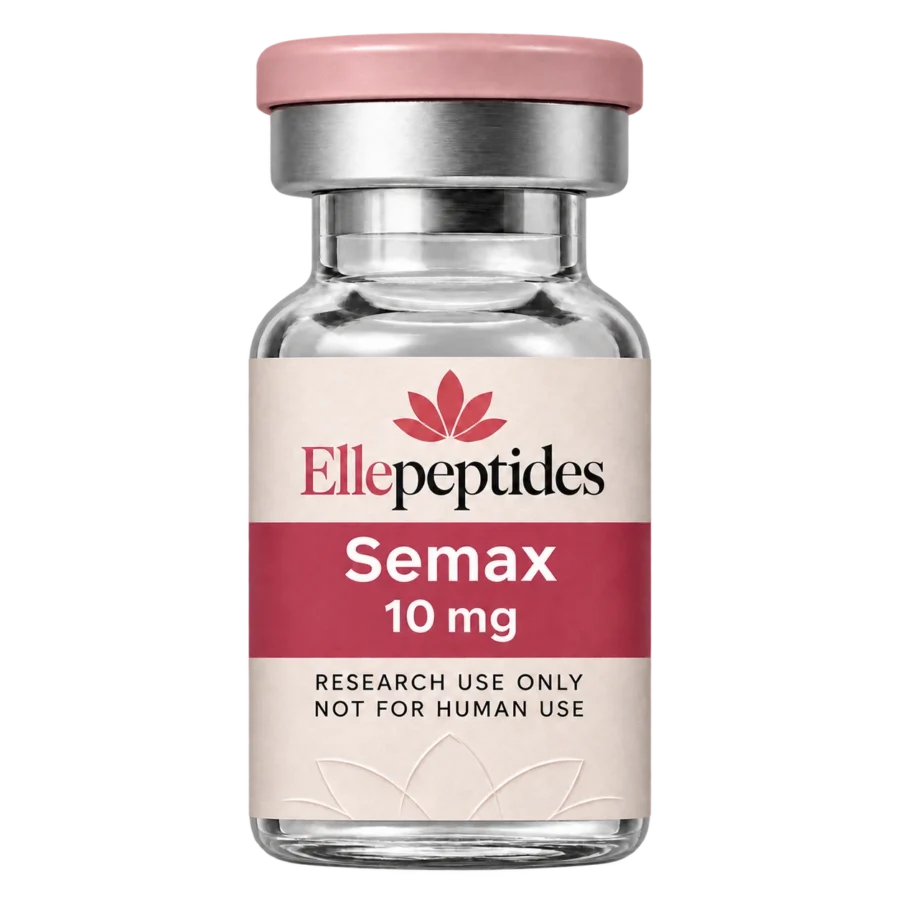
Description
Semax at a glance
Semax is a synthetic seven-amino-acid peptide, Met-Glu-His-Phe-Pro-Gly-Pro, built from the ACTH(4–7) fragment plus a Pro-Gly-Pro extension. It is studied for brain signaling, including BDNF, peptide-degrading enzymes and brain-network imaging, in rats and small human studies. Ellepeptides lists Semax in 5 mg and 10 mg freeze-dried vials; it does not sell a Semax nasal spray.
- Molecule type: synthetic heptapeptide, ACTH(4–7)-Pro-Gly-Pro
- Vial sizes: 5 mg and 10 mg
- Listed price: from $30.56 USD
- Form: freeze-dried (lyophilized) powder in a sealed vial; no nasal spray, drops or capsules
- Shipping: ships within the US, with free shipping on merchandise over $200 after coupons
- Scope: for laboratory research only
Semax vial sizes and price per mg
| Vial size | Listed price (USD) | Price per mg |
|---|---|---|
| 5 mg | $30.56 | $6.11 |
| 10 mg | $65.00 | $6.50 |
The 5 mg vial works out to about 6% less per mg than the 10 mg vial. Prices are listed in U.S. dollars at the time of writing; the size selector shows the current price, and bulk or combination savings through the cart or coupons are not promised.
Semax compound profile
| Catalog name | Semax |
|---|---|
| Nominal amount per vial | 5 mg, 10 mg |
| Research reference identity | Synthetic heptapeptide |
| Reference sequence | H-Met-Glu-His-Phe-Pro-Gly-Pro-OH (MEHFPGP) |
| Reference molecular formula | C37H51N9O10S |
| Reference molar mass | 813.9 g/mol |
| CAS reference | 80714-61-0 |
| Molecular reference source | PubChem CID 9811102 |
| Intended scope | Laboratory research |
These values describe the reference Semax molecule in PubChem, not the analytical make-up of a particular lot; counterions, hydration and actual vial composition are separate matters. In the literature, Semax is a seven-residue analogue related to an ACTH fragment (Dolotov et al., 2006).
How Semax works in research
Semax joins ACTH(4–7), a short stretch of adrenocorticotropic hormone, to a Pro-Gly-Pro tail. Mechanism research follows three threads.
The first is neurotrophic signaling. Dolotov’s group found that Semax binds specifically to rat basal-forebrain membranes and raises brain-derived neurotrophic factor (BDNF), a protein involved in neuron survival and plasticity, in that region (Dolotov et al., 2006). The second involves peptide-degrading enzymes: in human serum tested in vitro, Semax inhibited enkephalin-degrading enzymes with an IC50 of about 10 µM, versus about 20 µM for Selank. The authors proposed this as a partial explanation for its activity (Kost et al., 2001).
The third concerns injury-response proteins. After experimental ischemia–reperfusion in male rats, Semax lowered active JNK, reduced MMP-9 and c-Fos in tissue next to the damaged area and raised active CREB in the subcortex (Sudarkina et al., 2021). Human imaging adds a network-level view of activity patterns, and no single receptor explains the findings.
Key Semax studies
| Year | Study & model | What was measured | Main finding | Source |
|---|---|---|---|---|
| 2001 | Kost et al.; human serum, in vitro | Inhibition of enkephalin-degrading enzymes | Semax and Selank both inhibited the enzymes (IC50 ≈ 10 µM and 20 µM) | Bioorg Khim |
| 2006 | Dolotov et al.; rat basal forebrain | Specific binding, BDNF protein | Specific binding sites and higher BDNF levels | J Neurochem |
| 2018 | Gusev et al.; 110 adults after ischemic stroke (67 women) | Plasma BDNF, functional scores | Changes reported with Semax alongside rehabilitation | PubMed |
| 2018 | Lebedeva et al.; 24 healthy adults (13 women), Semax n=14 vs placebo n=10 | Resting-state fMRI, default mode network | Larger rostral default-mode subcomponent in the Semax group | Bull Exp Biol Med |
| 2020 | Panikratova et al.; 52 healthy adults, Semax, Selank or placebo | Amygdala and prefrontal connectivity (fMRI) | Group differences in right amygdala–temporal cortex connectivity | Dokl Biol Sci |
| 2021 | Sudarkina et al.; male Wistar rats, ischemia–reperfusion | MMP-9, c-Fos, JNK, CREB proteins | Lower JNK, MMP-9 and c-Fos; higher active CREB | Int J Mol Sci |
Gusev’s rehabilitation study is the largest clinical dataset here. Investigators reported changes in plasma BDNF and functional scores with Semax plus rehabilitation, but the abstract does not establish randomization or give separate results by sex (source).
The two imaging studies used healthy volunteers. Lebedeva’s team scanned 24 adults (mean age about 44) before and 5 and 20 minutes after an intranasal 1% Semax preparation or placebo, finding a larger rostral component of the default mode network (source). Panikratova’s 52-person study compared Semax, Selank and placebo in separate groups (source). Both are small and short; neither measured everyday memory or focus.
Semax research involving women
Women have taken part in human Semax research, often as a majority. In Gusev’s stroke cohort, 67 of 110 participants were women; in Lebedeva’s imaging study, 13 of 24 were women. Neither abstract reports outcomes separately for women, so no women-specific effect can be stated. Panikratova’s abstract does not give a sex breakdown, and the ischemia protein study used only male rats (Sudarkina et al.). Post-stroke results also cannot be carried over to healthy women: participation, yes; sex-specific analysis, not yet.
Semax vs Selank and related focus peptides
| Compound | Type | Main research focus | Sizes on Ellepeptides |
|---|---|---|---|
| Semax | Heptapeptide; ACTH(4–7) + Pro-Gly-Pro (MEHFPGP) | BDNF signaling, ischemia models, brain-network imaging | 5 mg, 10 mg |
| Selank | Heptapeptide; tuftsin analogue (TKPRPGP) | Anxiety-scale comparison, GABA-related gene expression | 5 mg, 10 mg |
| Selank + Semax Blend | Two peptides in one vial, 10 mg + 10 mg | No study of the combined vial; evidence is per component | 20 mg total |
| Pinealon | Tripeptide Glu-Asp-Arg (EDR) | Oxidative-stress responses in cell models | 10 mg |
Both are seven residues long and end in Pro-Gly-Pro, but their parent peptides differ: Semax comes from ACTH, while Selank is a tuftsin analogue studied in anxiety research (Volkova et al., 2016; Zozulia et al., 2008). In the same in vitro assay, Semax inhibited enkephalin-degrading enzymes at roughly half the concentration Selank needed. The Selank + Semax Blend puts both in one vial, while Pinealon is a much shorter tripeptide studied in cell oxidative-stress work (Khavinson et al., 2011).
Handling, storage and reconstitution math
Semax is supplied as a dry, freeze-dried solid. Storage time and temperature for the sealed vial and any prepared solution are label questions, so read the label rather than general advice online. Good practice is to avoid moisture and record the solvent added and the date.
Concentration is vial mass divided by solvent volume. A 5 mg vial in 2.5 mL gives 2 mg/mL; a 10 mg vial in the same 2.5 mL gives 4 mg/mL. The peptide calculator handles other combinations, and bacteriostatic water (30 mL) is listed for laboratories that use a preserved diluent. Ellepeptides does not supply spray bottles or nasal formulations.
Ordering Semax in the US
Ellepeptides ships Semax to addresses within the United States. Shipping is free when the merchandise subtotal exceeds $200 after coupon discounts (before taxes and shipping); below that, standard shipping is $15.99 per order. Available payment methods and delivery options are shown at checkout. Current details are in the shipping policy.
Semax FAQ
What is Semax?
Semax is a synthetic seven-amino-acid peptide, Met-Glu-His-Phe-Pro-Gly-Pro, built from the ACTH(4–7) fragment of adrenocorticotropic hormone with a Pro-Gly-Pro tail. Researchers study it for BDNF signaling, enzyme inhibition and brain-network activity. Ellepeptides lists it as freeze-dried powder in 5 mg and 10 mg vials for laboratory research.
Does Ellepeptides sell Semax nasal spray in the US?
No. Ellepeptides sells Semax only as freeze-dried powder in sealed 5 mg and 10 mg vials, with no nasal spray, drops or spray bottles. Human studies used formulated preparations; Lebedeva’s imaging study, for example, used an intranasal 1% preparation. A research vial is a different material from a finished nasal product.
How much does Semax cost?
At the time of writing, Semax is listed at $30.56 USD for 5 mg and $65.00 USD for 10 mg, which is about $6.11 and $6.50 per mg. The size selector always shows the current price. Free shipping applies when the merchandise subtotal exceeds $200 after coupons.
Where can I buy Semax in the US?
You can order Semax from Ellepeptides on this page. Vials ship to US addresses. Related compounds are grouped in the Focus, Mood & Sleep category, and the research peptides catalog lists the full range.
What are the benefits of Semax in research?
Published work reports higher BDNF in rat basal forebrain, inhibition of enkephalin-degrading enzymes in human serum, lower injury-related proteins in rat ischemia models and altered brain-network activity in small healthy-volunteer imaging studies. These are research measurements; they do not demonstrate improved focus or memory in healthy people.
Semax vs Selank: what is the difference?
Both are seven-residue peptides ending in Pro-Gly-Pro, but Semax is built on an ACTH fragment and Selank on tuftsin. Semax research emphasises BDNF and ischemia models, while Selank research emphasises anxiety scales and GABA-related gene expression. See the Selank page for its sources.
Have Semax and Selank been studied together?
Only side by side. Panikratova’s 2020 imaging study gave Semax, Selank or placebo to separate groups of healthy adults, and Kost’s 2001 enzyme assay tested each peptide separately. No study of a combined vial was identified. The Selank + Semax Blend page explains what that means for blend research.
What side effects of Semax have been reported in studies?
The study abstracts reviewed for this page do not report detailed adverse-event data, so no reliable side-effect profile can be summarised here. The human studies were small or did not establish randomization, which limits safety conclusions. Researchers needing safety data should consult full-text clinical reports directly.
Is Semax studied for focus and memory?
Indirectly. The healthy-volunteer studies measured brain-network activity on fMRI, not performance on memory or attention tests, and the stroke study measured functional recovery scores. Rat work looked at BDNF and protein markers. A direct link to focus in healthy people has not been demonstrated in these sources.
What is the half-life of Semax?
A plasma half-life for Semax is not established in the sources reviewed for this page. Imaging studies scanned participants 5 and 20 minutes after administration, but those time points reflect study design, not a measured half-life. Treat uncited half-life figures with caution.
Semax references
- PubChem (NCBI). Semax, CID 9811102. PubChem
- Kost NV, et al. (2001). Semax and Selank inhibit serum enkephalin-degrading enzymes. Bioorg Khim. PubMed 11443939
- Dolotov OV, et al. (2006). Semax binding and BDNF in rat basal forebrain. J Neurochem. PubMed 16635254
- Gusev EI, et al. (2018). Semax, BDNF and rehabilitation after ischemic stroke. PubMed 29798983
- Lebedeva IS, et al. (2018). Effects of Semax on the default mode network of the brain. Bull Exp Biol Med. DOI
- Panikratova YR, et al. (2020). Functional connectomics of Selank and Semax. Dokl Biol Sci. PubMed 32342318
- Sudarkina OY, et al. (2021). Semax in rat ischemia–reperfusion. Int J Mol Sci. PMC8226508
- Volkova A, et al. (2016). Selank and GABA-related gene expression in rat frontal cortex. PMC4757669
- Zozulia AA, et al. (2008). Selank compared with medazepam in anxiety disorders. PubMed 18454096
- Khavinson V, et al. (2011). Pinealon and oxidative stress in cell models. PubMed 21978084
Related research materials: Focus, Mood & Sleep peptides, Selank, Selank + Semax Blend, Pinealon, DSIP and our research and sourcing notes. For laboratory research only. Not for human or veterinary use.

Reviews
There are no reviews yet.