
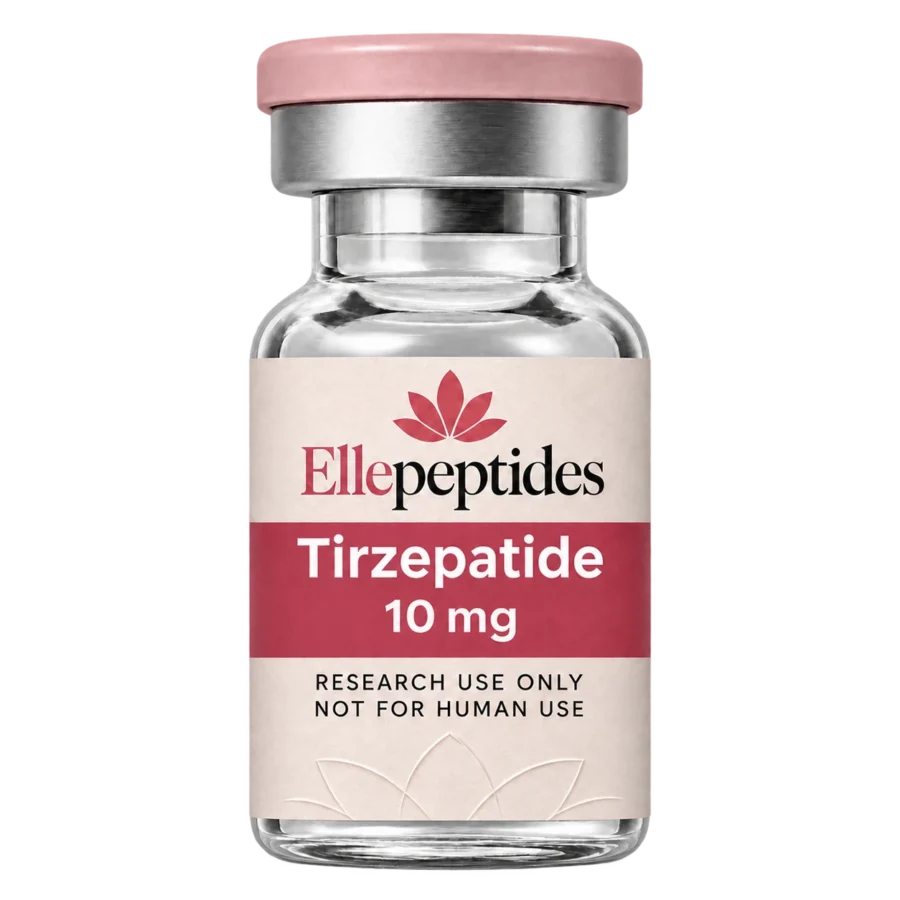
Description
Tirzepatide at a glance
Tirzepatide (LY3298176) is a single lipidated peptide that activates both the GIP and GLP-1 receptors, which makes it a dual incretin agonist. Its trial programs, SURPASS and SURMOUNT, measured blood glucose, body weight and sleep apnea outcomes in adults. Ellepeptides offers it as freeze-dried research material in five vial sizes, listed with our other weight management peptides.
- Molecule: 39-amino-acid peptide with a C20 fatty diacid; dual GIP/GLP-1 receptor agonist
- Vial sizes: 10 mg, 15 mg, 20 mg, 30 mg and 60 mg
- Listed price: from $100.00 USD (10 mg); $6.50 per mg in the 60 mg vial
- Form: lyophilized (freeze-dried) powder
- Shipping: within the US, with free shipping on subtotals above $200 after coupons
- Use: laboratory research only; browse all research peptides
Tirzepatide vial sizes and price per mg
| Vial size | Listed price (USD) | Price per mg |
|---|---|---|
| 10 mg | $100.00 | $10.00/mg |
| 15 mg | $105.00 | $7.00/mg |
| 20 mg | $170.00 | $8.50/mg |
| 30 mg | $240.00 | $8.00/mg |
| 60 mg | $390.00 | $6.50/mg |
These are U.S.-dollar prices at the time of writing; the size selector shows the current figure. Note that the 15 mg vial costs less per mg than the 20 mg and 30 mg vials, while 60 mg is the lowest. Bulk or combination savings are not promised — anything extra would come only from the cart or a valid coupon.
Tirzepatide compound profile
| Reference names | Tirzepatide; LY3298176 |
|---|---|
| Molecule class | Dual GIP and GLP-1 receptor agonist |
| Peptide length | 39 amino acids |
| Reference CAS | 2023788-19-2 |
| Reference formula | C225H348N48O68 |
| Reference molecular mass | 4813.53 Da (US prescribing information) |
| Backbone shorthand | YXEGTFTSDY SIXLDKIAQK AFVQWLIAGG PSSGAPPPS |
X stands for Aib at positions 2 and 13; the reference molecule has a C-terminal amide and a C20 fatty diacid attached to Lys20. Values come from the Zepbound prescribing information and the KEGG D11360 sequence record. They define the reference structure only; they do not describe the salt form or analytical results of any Ellepeptides lot, and a research vial is not the labeled medicine.
How Tirzepatide works in research
GIP and GLP-1 are the two main incretins — gut hormones released after a meal that amplify insulin secretion when glucose is high. GLP-1 receptor agonists were already established in metabolic research; tirzepatide asked whether adding GIP receptor activity in the same molecule would change the result. The 2018 discovery work by Coskun et al. reported potent activity at both human receptors, improved glucose tolerance and lower body weight in mice, and early clinical data. An accompanying commentary noted the in-vitro profile was imbalanced in favor of GIP, roughly four- to five-fold relative to the native hormones (DiMarchi, 2018).
At the GLP-1 receptor, tirzepatide behaves differently from the natural hormone. Cell experiments by Willard et al. (2020) found it favors cAMP signaling over β-arrestin recruitment and causes less receptor internalization — a pattern called biased agonism that may help explain its profile. In people, the prescribing information reports delayed gastric emptying and an elimination half-life of about 5–6 days, the basis for weekly trial schedules (Zepbound label). These are findings about the clinical molecule, not tests of a catalog vial.
Key Tirzepatide studies
| Year | Study & model | What was measured | Main finding | Source |
|---|---|---|---|---|
| 2018 | Coskun et al.; receptor assays, mice, early clinical studies | Receptor potency, glucose tolerance, body weight | Potent dual GIP/GLP-1 agonist; improved glucose tolerance and lowered weight in mice | PubMed |
| 2020 | Willard et al.; cell signaling assays | cAMP vs β-arrestin signaling at the GLP-1 receptor | Favored cAMP signaling with reduced receptor internalization | JCI Insight |
| 2021 | SURPASS-2; 1,879 adults with type 2 diabetes, open-label vs semaglutide | HbA1c at 40 weeks | −2.01 to −2.30 points vs −1.86 with semaglutide | PubMed |
| 2022 | SURMOUNT-1; 2,539 adults with obesity, no diabetes | Weight change at 72 weeks | −15.0%, −19.5% and −20.9% vs −3.1% placebo | PubMed |
| 2024 | SURMOUNT-OSA; two trials in adults with obesity and sleep apnea | Apnea–hypopnea index at 52 weeks | −25.3 vs −5.3 and −29.3 vs −5.5 events/hour | PubMed |
| 2025 | SURMOUNT-5; 751 adults with obesity, open-label vs semaglutide | Weight and waist at 72 weeks | Weight −20.2% vs −13.7%; waist −18.4 cm vs −13.0 cm | PubMed |
| Label | Prescribing information; pooled obesity trials | Stopping due to adverse reactions | 4.8% to 6.7% across study arms vs 3.4% placebo | DailyMed |
SURMOUNT-1 is the anchor trial. Its 2,539 participants without diabetes received tirzepatide or placebo alongside lifestyle measures for 72 weeks; gastrointestinal adverse events were the most common, mostly mild to moderate and reported mainly during the step-up period; adverse events led 4.3–7.1% of tirzepatide participants to stop versus 2.6% on placebo (Jastreboff et al., 2022).
Head-to-head data come from two open-label trials against semaglutide. SURPASS-2 compared HbA1c in type 2 diabetes (Frías et al., 2021); SURMOUNT-5 compared weight in obesity without diabetes (Aronne et al., 2025). Both favored tirzepatide, but open-label designs and specific regimens limit how far the comparison generalizes.
SURMOUNT-OSA extended the program beyond weight. Its endpoint, the apnea–hypopnea index, counts breathing interruptions per hour of sleep; it is not a measure of sleep quality in general (Malhotra et al., 2024).
Tirzepatide research involving women
Women made up 67.5% of SURMOUNT-1 participants, so the headline obesity data rest largely on female participants (SURMOUNT-1 baseline characteristics). That representation does not make the results women-specific: they are pooled estimates, not a separate analysis by sex.
Two label findings bear directly on women’s research. In a clinical pharmacology study, peak levels of the hormones in a combined oral contraceptive fell by 55–66% and overall exposure by 20–23% after a single administration of tirzepatide, an effect attributed to delayed gastric emptying that was largest at the start and diminished over time. Separately, animal reproduction studies found fetal growth reductions and malformations in rats and reduced fetal growth in rabbits (Zepbound prescribing information). No trial cited here studied menopause, polycystic ovary syndrome or fertility as an outcome. The compound appears in our peptides for women collection as a navigation choice, not a health claim.
Tirzepatide vs semaglutide, retatrutide and 5-Amino-1MQ
| Compound | Type | Mechanism | Main research focus | Sizes on Ellepeptides |
|---|---|---|---|---|
| Tirzepatide (this page) | Lipidated peptide | GIP and GLP-1 receptor agonist | Glucose control, obesity, sleep apnea | 10, 15, 20, 30, 60 mg |
| Semaglutide | Lipidated peptide | GLP-1 receptor agonist | Obesity, type 2 diabetes, cardiovascular and kidney outcomes | 5, 10, 20, 30 mg |
| Retatrutide | Lipidated peptide | GIP, GLP-1 and glucagon receptor agonist | Obesity, type 2 diabetes, knee osteoarthritis | 5, 10, 30, 50, 60 mg |
| 5-Amino-1MQ | Small molecule (not a peptide) | NNMT enzyme inhibitor | NAD-related metabolism in fat cells and mice | 10, 50 mg |
Semaglutide is the single-receptor reference point (Lau et al., 2015), and the two semaglutide comparisons above are the strongest direct evidence for tirzepatide. Retatrutide adds glucagon-receptor activity on top of GIP and GLP-1 (Coskun et al., 2022), though no head-to-head trial against tirzepatide is cited here. 5-Amino-1MQ is a different category altogether: an enzyme inhibitor studied in cells and mice, not an incretin (Neelakantan et al., 2018).
Handling, storage and reconstitution math
A tirzepatide vial holds dry, freeze-dried peptide. Keep it closed and protected from moisture until use, and let it warm to room temperature before opening if it has been chilled. Whatever the vial label says about temperature and light is the instruction to follow; a clinical label for a finished pen product does not transfer to research powder. Wiping the stopper with an alcohol prep pad is routine lab practice.
Concentration is vial mass ÷ solvent volume. A 15 mg vial made up with 3 mL of solvent gives 5 mg/mL; a 60 mg vial with the same 3 mL gives 20 mg/mL. The Ellepeptides peptide calculator runs these numbers for any volume. Bacteriostatic water is a common diluent where a preservative is wanted, but your written method decides the solvent. The arithmetic gives a concentration, not an amount for any person or animal.
Ordering Tirzepatide in the US
Ellepeptides ships tirzepatide to addresses within the United States, with prices in U.S. dollars. Shipping is free when the merchandise subtotal exceeds $200 after coupon discounts (before taxes and shipping); below that, standard shipping is $15.99 per order. Available payment methods and delivery options are shown at checkout. Current details are in the shipping policy.
Tirzepatide FAQ
How much is tirzepatide in the US?
Ellepeptides lists tirzepatide from $100.00 USD for 10 mg up to $390.00 for 60 mg. Per milligram, the 60 mg vial is the lowest at $6.50, followed by 15 mg at $7.00; the 10 mg vial is the highest at $10.00. Prices were current in November 2026, and the size selector shows today’s price.
Where can I buy tirzepatide in the US for research?
Ellepeptides supplies tirzepatide as lyophilized research material, shipped to US addresses. Orders above $200 after coupons get free shipping. It is sold for laboratory work only; see the ordering section and shipping policy for standard shipping rates.
What is tirzepatide peptide?
Tirzepatide is a 39-amino-acid synthetic peptide carrying a C20 fatty diacid that activates both GIP and GLP-1 receptors. It was developed by Eli Lilly under the code LY3298176 (Coskun et al., 2018). On Ellepeptides it is sold as freeze-dried powder for laboratory research.
Is this a generic Mounjaro or Zepbound?
No. Mounjaro and Zepbound are Eli Lilly’s brand names for finished tirzepatide medicines dispensed by pharmacies. Ellepeptides sells freeze-dried tirzepatide as research material: it is not a generic, compounded or brand-name medicine, and a shared ingredient name does not make the products equivalent in formulation, quality controls or intended use.
What side effects were reported in the SURMOUNT trials?
Gastrointestinal effects dominated: nausea, diarrhea, vomiting and constipation were the most common, mostly during the step-up period (SURMOUNT-1). The prescribing information also lists abdominal pain, indigestion, fatigue, hair loss and reflux, and reports thyroid C-cell tumors in rats (Zepbound label). They come from people enrolled in clinical studies and say nothing about catalog material.
What is the half-life of tirzepatide?
About 5–6 days. The prescribing information reports an elimination half-life of approximately 5–6 days in people with overweight or obesity, which is why clinical trials used weekly schedules (Zepbound label). Half-life measures how quickly the body clears the molecule; it says nothing about how long powder stays stable in a vial.
Tirzepatide vs semaglutide: which did better in trials?
Tirzepatide came out ahead in both direct comparisons. In SURMOUNT-5, mean weight change at 72 weeks was −20.2% versus −13.7% with semaglutide (Aronne et al., 2025); in SURPASS-2, HbA1c fell further with tirzepatide. Both trials were open-label and used specific regimens, so results apply to those designs.
Tirzepatide vs retatrutide: what is the difference?
Retatrutide adds glucagon-receptor activity to the GIP and GLP-1 activity of tirzepatide, and in mice that extra component raised energy expenditure (Coskun et al., 2022). Tirzepatide has a much longer published track record; retatrutide’s phase 3 program reported results in 2025–2026. No head-to-head trial is cited here.
How does tirzepatide work as a dual agonist?
One molecule binds and activates two receptors, GIP and GLP-1; it is not two peptides mixed together. Its in-vitro activity leans toward GIP, and at the GLP-1 receptor it favors cAMP signaling over β-arrestin recruitment (Willard et al., 2020). Together these features distinguish it from single-receptor GLP-1 agonists.
Does Ellepeptides sell tirzepatide pens, pills or nasal spray?
No. The only format is freeze-dried tirzepatide powder in sealed vials of 10, 15, 20, 30 or 60 mg. Ellepeptides does not sell pens, pre-filled cartridges, tablets, capsules, nasal sprays, creams or ready-made solutions. Research labs prepare the powder themselves according to their own documented methods.
How should tirzepatide vials be stored?
Use the storage conditions printed on the label of the vial you receive. Dry lyophilized peptide is generally kept sealed, dry and out of light, but the label takes priority over general advice. Questions about missing information can go to [email protected], and our research page explains how product information is presented.
Tirzepatide references
- Coskun T, et al. 2018. LY3298176, a dual GIP and GLP-1 receptor agonist. PubMed 30473097
- DiMarchi RD. 2018. Commentary on GIP and GLP-1 dual agonism. PMC6309716
- Willard FS, et al. 2020. Tirzepatide signaling at the GLP-1 receptor. JCI Insight
- Frías JP, et al. 2021. SURPASS-2. PubMed 34170647
- Jastreboff AM, et al. 2022. SURMOUNT-1. PubMed 35658024; NEJM full text
- Malhotra A, et al. 2024. SURMOUNT-OSA. PubMed 38912654
- Aronne LJ, et al. 2025. SURMOUNT-5. PubMed 40353578
- US National Library of Medicine. Zepbound (tirzepatide) prescribing information. DailyMed
- KEGG DRUG. Tirzepatide, entry D11360. KEGG
- Coskun T, et al. 2022. Retatrutide (LY3437943) discovery. PubMed 35985340
- Lau J, et al. 2015. Discovery of semaglutide. PubMed 26308095
- Neelakantan H, et al. 2018. NNMT inhibitor 5-amino-1-methylquinolinium. PMC5826726
Related research materials: all weight management peptides, retatrutide, semaglutide, cagrilintide, 5-Amino-1MQ and our research overview. For laboratory research only. Not for human or veterinary use.

Reviews
There are no reviews yet.