
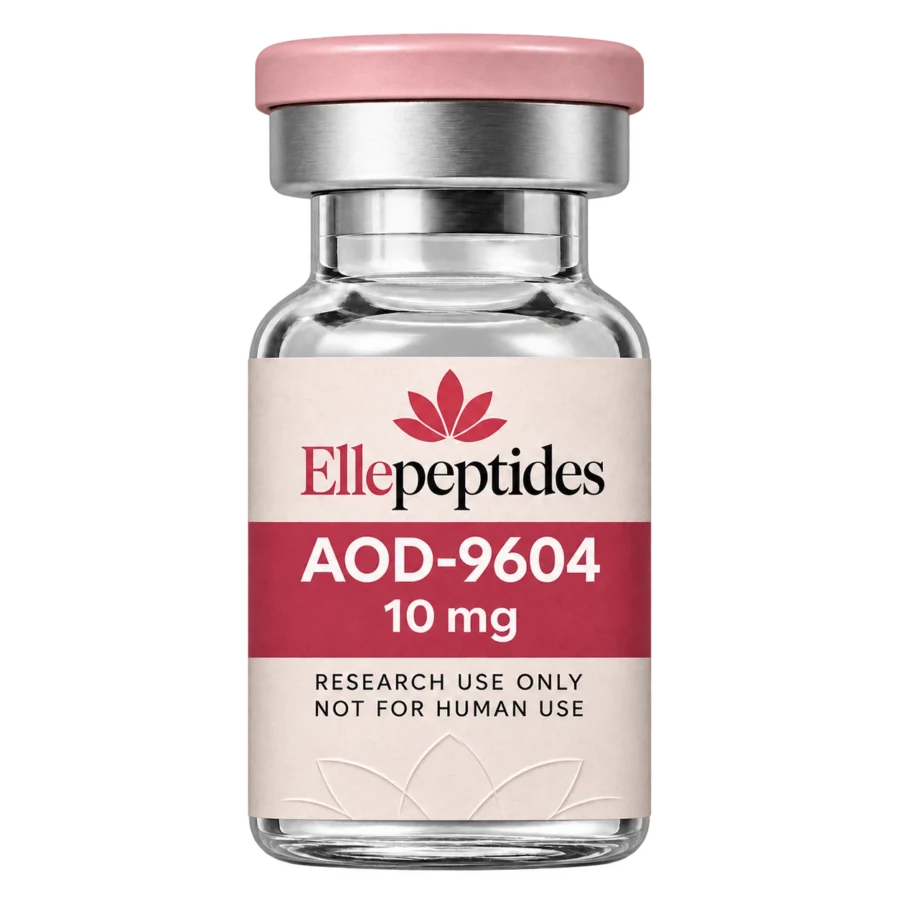
Description
AOD-9604 at a glance
AOD-9604 (also written AOD 9604 or AOD9604) is a 16-residue synthetic peptide modeled on the tail end of human growth hormone, residues 177–191 with an added tyrosine. Developed as a fat-metabolism compound, it failed its larger human weight-loss trial. Ellepeptides supplies AOD-9604 as freeze-dried research material in a 10 mg vial, listed in our weight management research collection.
- Molecule type: modified growth-hormone fragment, 16 amino acids
- Vial size: 10 mg
- Listed price: $110.00 USD
- Form: freeze-dried (lyophilized) powder
- Ships within the United States; free shipping when the merchandise subtotal is over $200
- For laboratory research only
AOD-9604 vial sizes and price per mg
| Vial size | Listed price (USD) | Price per mg |
|---|---|---|
| 10 mg | $110.00 | $11.00 |
Prices are listed in USD at the time of writing; the size selector above shows the current price. Bulk or combination savings through the cart or coupons are not promised.
AOD-9604 compound profile
| Research name | AOD-9604 (AOD9604, AOD 9604) |
|---|---|
| Reference identity | Tyr-hGH(177–191) |
| Peptide length | 16 amino-acid residues |
| Reference sequence and structure | YLRIVQCRSVEGSCGF; Cys7–Cys14 disulfide |
| Molecular reference form | Disulfide-linked parent peptide; counterion excluded |
| Reference molecular formula | C78H123N23O23S2 |
| Reference molar mass | 1815.1 g/mol |
| CAS number | 221231-10-3 |
| PubChem record | CID 71300630 |
These values describe the named reference structure, not the salt form or analytical make-up of any lot. Compare the vial label and any documentation supplied against the identity your method requires.
How AOD-9604 works in research
AOD-9604 was designed to isolate the fat-metabolism activity attributed to one end of the growth-hormone molecule. Its sequence covers growth-hormone residues 177–191 plus an N-terminal tyrosine, and a fragment can behave very differently from its parent. Stier et al. (2013)
In obese Zucker rats, 19 days of oral AOD9604 reduced body-weight gain by more than 50%, raised lipolytic activity in fat tissue and showed no adverse effect on insulin sensitivity. Ng et al. (2000) In obese mice, it reduced weight gain and increased fat oxidation without the growth-hormone receptor binding seen with intact hormone. Heffernan et al. (2001a)
A knockout-mouse experiment linked the longer-term response to expression of the beta-3-adrenergic receptor, while concluding that AOD-9604 did not act by directly stimulating that receptor. Heffernan et al. (2001b) In people, pooled trials found no effect on serum IGF-1, the growth-factor marker that intact growth hormone raises. These are pathway findings, not proof of human weight loss.
Key AOD-9604 studies
| Year | Study & model | What was measured | Main finding | Source |
|---|---|---|---|---|
| 2000 | Obese Zucker rats; oral, 19 days | Weight gain, fat-tissue lipolysis, insulin sensitivity | Weight gain cut by over 50%; more lipolysis; insulin sensitivity unaffected | Ng et al. |
| 2001 | Obese mice | Weight gain, fat oxidation, GH-receptor binding | Less weight gain, more fat oxidation; no GH-receptor binding | Heffernan et al. |
| 2001 | Beta-3-adrenergic receptor knockout mice | Longer-term response by receptor status | Response linked to receptor expression, not direct stimulation | Heffernan et al. |
| 2007 | OPTIONS trial, sponsor announcement; oral formulation; 12 and 24 weeks | Weight loss vs placebo | Less than 1 kg extra vs placebo, not significant; obesity program stopped | Metabolic Pharmaceuticals |
| 2013 | Pooled safety; six trials, 893 adults | Adverse events, IGF-1, glucose tolerance, antibodies | Tolerability indistinguishable from placebo; no IGF-1 effect; no antibodies detected | Stier et al. |
| 2015 | 32 rabbits with induced knee osteoarthritis | Cartilage-damage scores | Lower damage than saline; combination with hyaluronic acid scored best | Kwon and Park |
The efficacy result was negative. In its 2007 OPTIONS announcement, the developer reported less than 1 kg of additional weight loss versus placebo at 12 or 24 weeks, without statistical significance. Subgroup observations did not change that, and the obesity program was stopped. This is a sponsor report on an oral formulation, not a peer-reviewed paper. Sponsor announcement
The safety paper is manufacturer-linked. Stier and colleagues pooled six trials with 893 adults: two used intravenous preparations and four used oral capsules or tablets. They reported no withdrawals or serious adverse events attributed to AOD9604, no antibodies and no negative effect on carbohydrate metabolism, with more gastrointestinal events in the highest-strength oral arm. The developer funded all six trials, and the authors had ties to it. Stier et al. (2013)
The joint study was in rabbits. Kwon and Park’s rabbit model found lower cartilage-damage scores than saline, with the hyaluronic-acid combination performing best. It says nothing about human cartilage. Kwon and Park (2015) Our research page explains how we weigh animal against human evidence.
AOD-9604 research involving women
Women were well represented in the largest human study. The 24-week METAOD006 trial randomized 502 adults, 56% of them women and 44% men, and used oral tablets. Its outcomes are pooled; the paper presents no women-only analysis of weight, IGF-1 or safety. Stier et al. (2013)
None of the sources on this page examines menstrual cycles, menopause, pregnancy or female hormones, so no women-specific claim follows from them. Browse our peptides for women hub for compounds with more women-focused study notes.
AOD-9604 vs tesamorelin, 5-Amino-1MQ and tirzepatide
| Compound | Type | Main research focus | Sizes on Ellepeptides |
|---|---|---|---|
| AOD-9604 (this page) | Modified growth-hormone fragment, 16 residues | Fat metabolism without growth-hormone receptor binding | 10 mg |
| Tesamorelin | Synthetic GHRH analogue | Stimulating the body’s own growth-hormone release | 5 mg, 10 mg, 20 mg |
| 5-Amino-1MQ | Small molecule, not a peptide | Inhibition of the NNMT enzyme | 10 mg, 50 mg |
| Tirzepatide | GIP and GLP-1 receptor agonist | Glucose control and body weight | 10 mg, 15 mg, 20 mg, 30 mg, 60 mg |
AOD-9604 and tesamorelin both trace back to growth-hormone biology but in opposite ways: one is a fragment of the hormone, the other prompts the pituitary to release intact hormone. 5-Amino-1MQ is not a peptide at all, and tirzepatide works through incretin receptors. Findings do not transfer between them.
AOD-9604 handling, storage and reconstitution math
AOD-9604 arrives as a lyophilized solid. Its reference structure includes a disulfide bond between the two cysteines; verify the label’s identity statement against your method. Storage conditions belong to the label; keep the vial sealed until needed and record the lot number with each experiment.
To find concentration, divide the vial mass by the solvent volume. A 10 mg vial taken up in 2 mL gives 5 mg/mL; in 5 mL it gives 2 mg/mL. The peptide calculator handles the conversions, and bacteriostatic water is a common choice when a vial is sampled more than once. Your protocol sets the solvent.
Ordering AOD-9604 in the US
AOD-9604 orders ship to addresses within the United States. Shipping is free when your merchandise subtotal is over $200 after coupon discounts (before taxes and shipping); below that, standard shipping is $15.99 per order. The available payment methods and delivery options are shown at checkout, so check the shipping policy for current details.
AOD-9604 FAQ
What is AOD-9604?
AOD-9604 is a synthetic 16-residue peptide matching human growth-hormone residues 177–191 with an added N-terminal tyrosine. It was developed by an Australian company as a fat-metabolism compound. Ellepeptides sells AOD-9604 as freeze-dried research material in a 10 mg vial, for laboratory research only.
How much does AOD-9604 cost in the US?
At the time of writing, Ellepeptides lists AOD-9604 at $110.00 USD for a 10 mg vial, which works out to $11.00 per mg. The product page always shows the current price. Shipping is free when the merchandise subtotal is over $200 after coupons; otherwise standard shipping is $15.99.
Where can I buy AOD 9604 in the US?
Ellepeptides lists AOD 9604 research vials and ships them to addresses across the United States, with prices in U.S. dollars and payment methods shown at checkout, for laboratory research only. Current rates and the free-shipping threshold are in the shipping policy.
What did AOD-9604 clinical trials find?
The efficacy result was negative. The developer’s 2007 OPTIONS announcement reported less than 1 kg of extra weight loss versus placebo at 12 or 24 weeks, without statistical significance, and the obesity program was stopped. A separate pooled analysis focused on safety rather than proving weight loss.
What side effects of AOD-9604 were reported in studies?
A pooled analysis of six manufacturer-funded trials with 893 adults described tolerability indistinguishable from placebo, no serious adverse events attributed to AOD9604 and no antibodies detected. Gastrointestinal events were more frequent in the highest-strength oral arm. These findings concern the clinical preparations tested, not research vials.
Does AOD-9604 raise IGF-1 like growth hormone?
Not in the human trials. The pooled safety analysis reported that AOD9604 had no effect on serum IGF-1, and in the 24-week trial no significant differences appeared between groups. In obese mice, it also lacked the growth-hormone receptor binding seen with the intact hormone.
Is AOD-9604 the same as HGH fragment 176-191?
The names overlap and are used loosely. AOD-9604’s reference identity is Tyr-hGH(177–191), a 16-residue sequence: YLRIVQCRSVEGSCGF. Products labeled as other growth-hormone fragments may or may not share that sequence, so compare the stated sequence and structure rather than relying on a name.
AOD-9604 vs 5-Amino-1MQ: what is the difference?
AOD-9604 is a peptide fragment of growth hormone studied for fat metabolism. 5-Amino-1MQ is a small molecule, not a peptide, studied as an inhibitor of the NNMT enzyme. They belong to different chemical classes and act on different targets, so findings for one cannot be applied to the other.
Is AOD-9604 available as a capsule, cream or nasal spray?
Ellepeptides sells AOD-9604 only as freeze-dried powder in a sealed vial. Four of the six human trials used the developer’s oral capsules or tablets and two used intravenous preparations; those clinical formulations are not what this listing supplies. No cream or nasal spray study is cited here.
How should AOD-9604 be stored?
Use the storage conditions on the vial label and any documentation supplied with the order; published trials do not set storage rules for research material. If a detail you need is missing from the label, email [email protected] before starting your work.
AOD-9604 references
- Stier H, et al. (2013). Safety and tolerability of AOD9604 in humans. J Endocrinol Metab, doi 10.4021/jem157w.
- Ng FM, et al. (2000). Metabolic studies of a synthetic lipolytic domain (AOD9604). PubMed 11146367.
- Heffernan M, et al. (2001a). Fat oxidation in obese mice. PubMed 11673763.
- Heffernan M, et al. (2001b). Beta-3-adrenergic receptor knockout experiment. PubMed 11713213.
- Kwon DR, Park GY (2015). Rabbit knee osteoarthritis model. PubMed 26275694.
- Metabolic Pharmaceuticals (2007). OPTIONS phase 2b results announcement. ASX announcement.
- National Library of Medicine, PubChem. AOD-9604, CID 71300630.
Related research materials: Weight Management, all research peptides, 5-Amino-1MQ, Tesamorelin, Retatrutide and Tirzepatide. For laboratory research only. Not for human or veterinary use.

Reviews
There are no reviews yet.