
Description
PT-141 (bremelanotide) at a glance
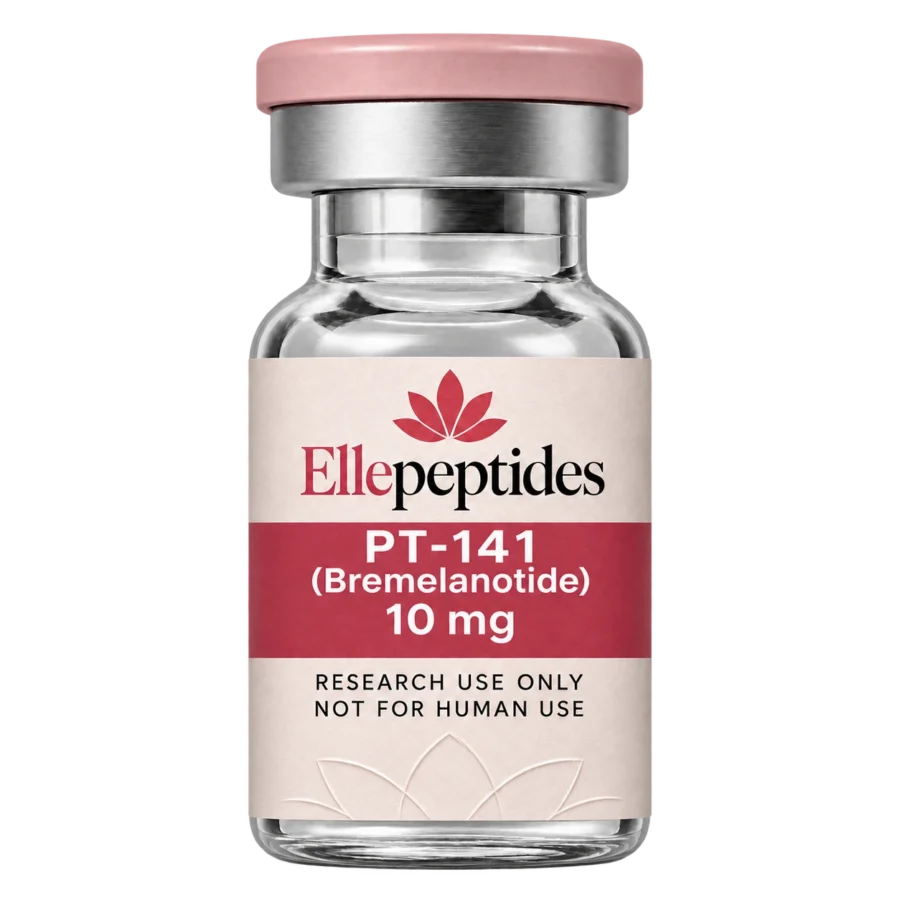
PT-141, also written PT 141 and known by its generic name bremelanotide, is a synthetic cyclic seven-residue analogue of alpha-melanocyte-stimulating hormone (alpha-MSH) that acts on brain melanocortin receptors (Molinoff et al., 2003). Most of its evidence comes from placebo-controlled trials in premenopausal women with hypoactive sexual desire disorder (HSDD), plus earlier studies in men (Kingsberg et al., 2019). Ellepeptides lists a single 10 mg research vial in our Tanning & Libido research category and the Peptides for Women hub.
- Molecule type: cyclic heptapeptide; alpha-MSH analogue and melanocortin receptor agonist
- Vial size: 10 mg (single size)
- Listed price: from $60.00 USD
- Form: freeze-dried (lyophilized) powder
- Ships within the US; free shipping when the merchandise subtotal exceeds $200
- For laboratory research only — not for human or veterinary use
PT-141 vial sizes and price per mg
| Vial size | Listed price (USD) | Price per mg |
|---|---|---|
| 10 mg | $60.00 | $6.00 |
That figure reflects the listed USD price when this page was written; the price shown beside Add to cart is always the current one. No bulk or combination discount is promised here — any coupon savings appear only in the cart.
PT-141 compound profile
| Catalog names | PT-141; bremelanotide |
|---|---|
| Amount per vial | 10 mg |
| Reference class | Cyclic heptapeptide; alpha-MSH analogue |
| Research pathways | Melanocortin receptors, including MC3R and MC4R |
| Molecular reference form | Parent peptide; counterion excluded |
| Reference CAS number | 189691-06-3 |
| Reference molecular formula | C50H68N14O10 |
| Reference molar mass | 1025.2 g/mol |
These rows restate the published bremelanotide structure cataloged by PubChem (CID 9941379). They are textbook chemistry for the named molecule — not a measurement of the salt form, counterion or contents of any individual vial.
How PT-141 works in research
Bremelanotide is a melanocortin receptor agonist that activates several receptor subtypes non-selectively, according to its US prescribing information, which also states plainly that the mechanism behind its effect on HSDD in women is unknown (Vyleesi label). Development work focused on MC3R and MC4R, receptors expressed mainly in the central nervous system, and recorded activation of hypothalamic neurons in rats — evidence for a brain-level signaling model rather than a reproductive-hormone one (Molinoff et al.).
PT-141 grew out of the Melanotan program: Hadley and Dorr describe it as a newer analogue of Melanotan II (Hadley & Dorr, 2006). Their study histories differ, so results should not be swapped between them.
The label reports a median time to peak plasma concentration of about one hour, a mean terminal half-life of about 2.7 hours (range 1.9–4.0) and metabolism mainly by amide-bond hydrolysis. Melanocortin activity also explains focal darkening of skin and gums in about 1% of trial participants (label, section 5.2).
Key PT-141 studies
| Year | Study & model | What was measured | Main finding | Source |
|---|---|---|---|---|
| 2003 | Molinoff et al.; receptor assays and rats | Melanocortin receptor activity; hypothalamic neuron activation | Agonist at MC3R and MC4R; central neuronal activation in rats | PubMed |
| 2004 | Diamond et al.; placebo-controlled study in men (nasal preparation) | Erectile response | Response versus placebo; nausea and flushing common | PubMed |
| 2006 | Diamond et al.; crossover in 18 premenopausal women | Subjective desire; vaginal vasocongestion | Desire favored bremelanotide; vasocongestion did not differ significantly | PubMed |
| 2016 | Clayton et al.; phase 2, 397 premenopausal women randomized, four arms | Change in satisfying sexual events | Mean change 0.8 (highest arm) vs 0.2 (placebo) | ClinicalTrials.gov |
| 2019 | Kingsberg et al.; RECONNECT 301 and 302, 1,267 premenopausal women with HSDD, 24 weeks | FSFI desire domain; FSDS-DAO item 13 distress | Desire +0.35, distress −0.33 vs placebo (P<.001); satisfying events not different | PMC |
| 2019 | US FDA trial snapshot; safety population of 1,247 women | Adverse events | Nausea 40.0% vs 1.3%; flushing 20.3% vs 0.3%; headache 11.3% vs 1.9% | FDA |
RECONNECT consisted of two identical phase 3 studies with 1:1 randomization. Mean age was 39, and 96.6% of women were enrolled at US sites. Both coprimary endpoints — desire and desire-related distress — favored bremelanotide in each study and in the pooled analysis, while the key secondary count of satisfying sexual events did not differ (Kingsberg et al.). Effect sizes were modest: about 25% of women given bremelanotide versus about 17% given placebo gained 1.2 points or more on the desire score (FDA announcement, 2019).
Before phase 3, Clayton and colleagues ran a placebo-controlled phase 2 study: of 397 randomized women, 394 received study treatment, and mean changes in satisfying events over the final four weeks were 0.2 (placebo), 0.6, 0.7 and 0.8 across the rising study arms, with statistical significance listed only for the highest arm (NCT01382719; Clayton et al., 2016).
PT-141 research involving women
Most controlled human data on PT-141 come from women: 18 premenopausal women in the 2006 crossover (Diamond et al.), 397 premenopausal women with female sexual arousal disorder and/or HSDD in phase 2, and 1,267 premenopausal women with HSDD in RECONNECT. The FDA snapshot describes the phase 3 participants as aged 19 to 56 (mean 38.7), 85.6% White and 11.5% Black (FDA Drug Trials Snapshot).
Nausea affected 40.0% of women versus 1.3% with placebo, and about 13% needed anti-nausea medication (FDA). Focal hyperpigmentation occurred in 4% of Black and 1% of White participants and persisted in about half of affected women after stopping. Blood pressure rose transiently by up to 6 mmHg systolic and 3 mmHg diastolic (label).
The gaps matter too. These trials enrolled premenopausal women with a diagnosed condition and used a formulated clinical product; they say nothing about postmenopausal women, women without HSDD or research powder. In 2006, self-reported desire and a physiological measure also moved differently.
PT-141 vs Melanotan 2, Kisspeptin-10 and Oxytocin
| Compound | Type | Main research focus | Sizes on Ellepeptides |
|---|---|---|---|
| PT-141 (bremelanotide) | Cyclic heptapeptide; melanocortin agonist | Desire and distress in premenopausal women with HSDD | 10 mg |
| Melanotan II | Cyclic heptapeptide with lactam bridge; alpha-MSH analogue | Pigmentation, small male studies, dermatology case reports | 10 mg |
| Kisspeptin-10 | Ten-residue amidated peptide; KISS1R agonist | LH and FSH responses in reproductive endocrinology | 5 mg, 50 mg |
| Oxytocin | Cyclic nonapeptide; oxytocin-receptor agonist | Obstetric physiology, social cognition, sexual function | 10 mg |
The most common comparison is PT 141 vs Melanotan 2. Both are alpha-MSH analogues and PT-141 was derived from the Melanotan II line (Hadley & Dorr), but PT-141’s controlled evidence is in women, while Melanotan II has tiny male studies and dermatology case reports. Kisspeptin-10 and Oxytocin act through unrelated receptors.
PT-141 handling, storage and reconstitution math
PT-141 arrives as a lyophilized solid, and the storage conditions on the vial label are the ones that apply. Routine practice is to keep freeze-dried peptide dry and away from light and heat, and to let a chilled vial warm to room temperature before opening so condensation does not form. Concentration is plain arithmetic, vial mass divided by solvent volume: as a maths example only, 10 mg in 2 mL gives 5 mg/mL (5,000 µg/mL). The peptide calculator handles unit conversions; Bacteriostatic Water 30 mL is listed separately for labs whose protocol specifies it.
Ordering PT-141 in the US
PT-141 ships to addresses within the United States. When the merchandise subtotal exceeds $200 after coupon discounts (before taxes and shipping), shipping is free; otherwise standard shipping is $15.99 per order. Delivery options and the available payment methods are shown at checkout, so please check the shipping policy for current details. Questions can go to [email protected].
PT-141 FAQ
What is PT-141?
PT-141 is the development code for bremelanotide, a synthetic cyclic peptide that mimics alpha-MSH at melanocortin receptors. First described under that code in 2003, it was later studied in premenopausal women with HSDD. Ellepeptides supplies it only as a 10 mg lyophilized vial for laboratory research.
How much does PT-141 cost in the US?
The 10 mg vial is listed at $60.00 USD at the time of writing, about $6.00 per mg. The price shown beside Add to cart is the current one. Shipping is free when the merchandise subtotal exceeds $200 after coupon discounts.
Where can I buy PT 141 in the US?
Ellepeptides lists PT-141 (bremelanotide) as a 10 mg research vial that ships to US addresses, with the available payment methods shown at checkout. It is sold strictly as laboratory research material, not as a medicine. Current delivery options are on the shipping policy page.
What did PT-141 trials in women find?
In RECONNECT, 1,267 premenopausal women with HSDD were randomized for 24 weeks. Desire rose and distress fell more than with placebo, but satisfying sexual events did not differ. Responder differences were modest — roughly 25% versus 17% for a meaningful desire-score gain.
What side effects were reported in PT-141 studies?
In the phase 3 safety population, nausea was the most common event (40.0% versus 1.3% with placebo), followed by flushing (20.3%), administration-site reactions (13.2%), headache (11.3%) and vomiting (4.8%). The label also describes transient blood-pressure rises and focal hyperpigmentation in about 1% of participants.
What is the half-life of PT-141?
The US prescribing information reports a mean terminal half-life of about 2.7 hours, with a range of 1.9 to 4.0 hours, and a median time to peak plasma concentration of about one hour. These describe a clinical formulation in people, not the stability of a research vial.
Is PT-141 the same as Melanotan 2?
No. PT-141 was derived from the Melanotan II line and both are cyclic alpha-MSH analogues, but they are distinct molecules with different CAS numbers and study histories. PT-141’s controlled data come from women; Melanotan II has small early studies in men and dermatology case reports.
What is the difference between PT-141 nasal spray and a vial?
The 2004 study in men used a nasal preparation, while the phase 3 program in women used a subcutaneous formulation. Those were formulated clinical products tested in specific trials. Ellepeptides sells PT-141 only as lyophilized powder in a 10 mg vial — no nasal sprays, creams or capsules.
How should a PT-141 vial be stored?
Follow the storage conditions on the vial label; they take priority over general guidance. Freeze-dried peptides are generally kept dry and away from light and heat, and a prepared solution needs stability limits from your own validated method. The peptide calculator helps with concentration arithmetic.
How long does PT-141 shipping take?
Delivery options are shown at checkout. Standard shipping is $15.99 per order, and shipping is free when the merchandise subtotal exceeds $200 after coupon discounts.
PT-141 references
- Molinoff PB et al. (2003). Melanocortin agonist PT-141: receptor and rat data. PubMed 12851303
- Diamond LE et al. (2004). Placebo-controlled study in men. PubMed 14963471
- Diamond LE et al. (2006). Crossover study in premenopausal women. PubMed 16839319
- Clayton AH et al. (2016). Phase 2 trial in premenopausal women. PubMed 27181790; registry record NCT01382719
- Kingsberg SA et al. (2019). RECONNECT phase 3 trials. Obstet Gynecol. PMC6819021
- US Food and Drug Administration (2019). Drug Trials Snapshots: Vyleesi. fda.gov
- US Food and Drug Administration (2019). Bremelanotide announcement (republished). BioSpace
- Vyleesi (bremelanotide) US prescribing information. FDA label via NDC List
- Hadley ME, Dorr RT (2006). Melanocortin peptide therapeutics review. Peptides. PubMed 16412534
- PubChem. Bremelanotide (CID 9941379). pubchem.ncbi.nlm.nih.gov
Related research materials: Tanning & Libido peptides, Peptides for Women, Melanotan II, Kisspeptin-10, Oxytocin and our research standards page. For laboratory research only. Not for human or veterinary use.

Reviews
There are no reviews yet.