
Description
Pinealon at a glance
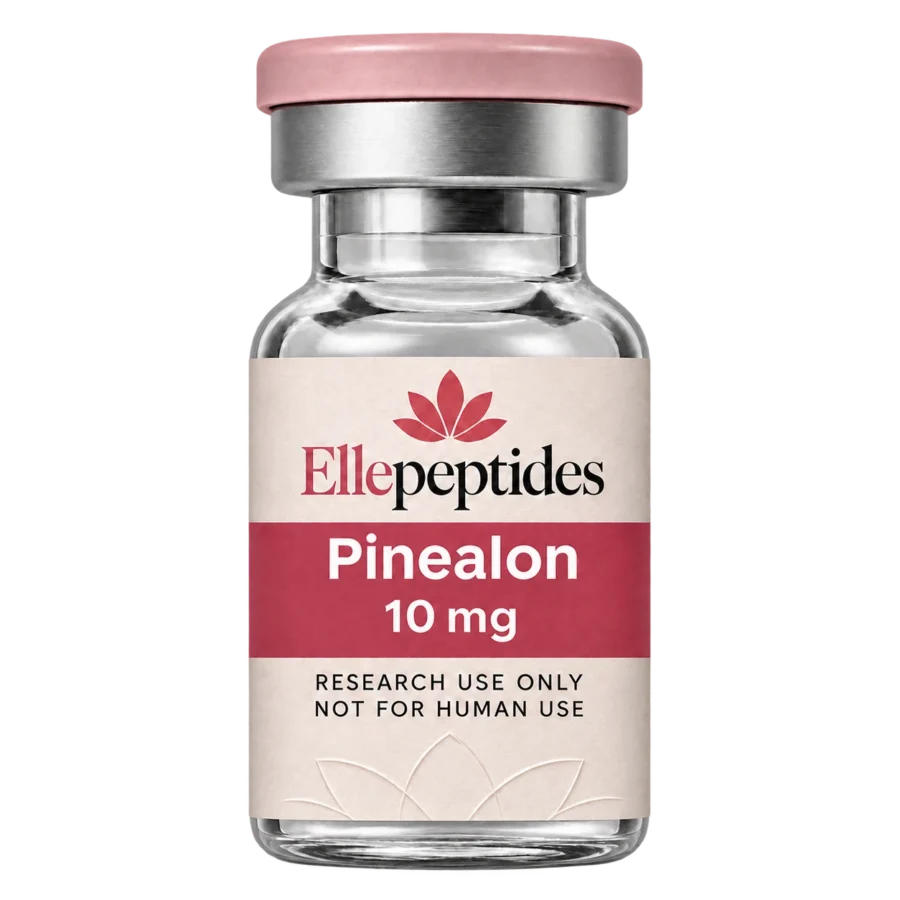
Pinealon is a synthetic three-amino-acid peptide, Glu-Asp-Arg (EDR), studied mainly for oxidative stress and survival in nerve-cell models. The evidence is thin: a handful of cell, rat and small clinical reports, almost all from one research group. Ellepeptides supplies Pinealon as freeze-dried research material in a 10 mg vial, listed in our focus, mood and sleep research collection.
- Molecule type: synthetic tripeptide (EDR)
- Vial size: 10 mg
- Listed price: $53.12 USD
- Form: freeze-dried (lyophilized) powder
- Ships within the US; free shipping when the merchandise subtotal is over $200
- For laboratory research only
Pinealon vial sizes and price per mg
| Vial size | Listed price (USD) | Price per mg |
|---|---|---|
| 10 mg | $53.12 | $5.31 |
Prices are listed in USD at the time of writing; the size selector above shows the current price. Bulk or combination savings through the cart or coupons are not promised.
Pinealon compound profile
| Research name | Pinealon |
|---|---|
| Reference sequence | H-Glu-Asp-Arg-OH (EDR) |
| Compound class | Synthetic tripeptide |
| Reference molecular formula | C15H26N6O8 |
| Reference molar mass | 418.40 g/mol |
| CAS number | 175175-23-2 |
| PubChem record | CID 10273502 |
These rows describe the reference EDR structure, not the analytical make-up of a given lot. Counterions and water content can differ between materials; the vial label and any documentation supplied are the place to confirm what you received.
How Pinealon works in research
Most Pinealon work asks one question: does the peptide help cells survive oxidative stress? In a 2011 study, cerebellar granule cells, neutrophils and PC12 cells exposed to stressors accumulated less reactive oxygen species and showed less cell death with Pinealon, along with changes in signaling and cell-cycle measures. Khavinson et al. (2011)
The same group has proposed a more ambitious idea: that a peptide this small can enter cells and bind histone proteins or DNA, nudging the expression of genes tied to antioxidant defense, apoptosis and serotonin synthesis. Their 2021 review gathers cell, rat and molecular-modeling data behind that hypothesis, including restored dendritic spines in neuron cultures from Alzheimer’s-model mice. It also concedes that several proposed targets have not been tested directly with EDR. Khavinson et al. (2021)
That makes the mechanism a working hypothesis from one laboratory network, not an established pathway in any species.
Key Pinealon studies
| Year | Study & model | What was measured | Main finding | Source |
|---|---|---|---|---|
| 2011 | Rat cerebellar granule cells, neutrophils and PC12 cells under oxidative stress | Reactive oxygen species, cell death, signaling | Less ROS accumulation and cell death | Khavinson et al. |
| 2012 | Offspring of rats with diet-induced prenatal hyperhomocysteinemia | Cognitive function in offspring | Treated offspring showed better cognitive measures | Arutjunyan et al. |
| 2015 | Small clinical report, Pinealon with Vesugen; included women with chronic conditions | Outcomes summarized in the abstract | Inconsistent participant totals; no women-specific results | Meshchaninov et al. |
| 2021 | Review of cell, rat and molecular-modeling data | Proposed gene-expression mechanism | EDR proposed to act on gene expression; several targets untested | Khavinson et al. |
The rat study. Pregnant rats were fed extra methionine to raise homocysteine, a model of prenatal hyperhomocysteinemia. Offspring that then received Pinealon showed better cognitive function than untreated offspring. It is a single animal model from the same research network. Arutjunyan et al. (2012)
The human report. The 2015 report combined Pinealon with a second peptide, Vesugen, so its results cannot be assigned to Pinealon alone. Its abstract gives inconsistent participant totals and too little design detail to isolate an effect. Meshchaninov et al. (2015) Our research page explains why we flag reports like this rather than build claims on them.
Pinealon research involving women
The only human source on this page that mentions women is the 2015 combination report, which included women with multiple chronic conditions. It does not provide women-specific outcomes, and because Vesugen was given alongside Pinealon, no effect can be attributed to Pinealon. Meshchaninov et al. (2015)
The rat study modeled pregnancy-related homocysteine exposure, but its outcomes were measured in offspring, not in mothers. The honest summary is an evidence gap: there is no controlled study of Pinealon in women. Our peptides for women hub lists compounds with stronger women-specific study notes.
Pinealon vs Epitalon, DSIP and Semax
| Compound | Type | Main research focus | Sizes on Ellepeptides |
|---|---|---|---|
| Pinealon (this page) | Synthetic tripeptide (EDR) | Oxidative stress in nerve-cell models | 10 mg |
| Epitalon | Synthetic tetrapeptide (AEDG) | Telomerase and aging biomarkers | 10 mg |
| DSIP | Nine-residue neuropeptide | Sleep physiology, with mixed human results | 15 mg |
| Semax | Synthetic heptapeptide | Neuroprotection and cognition research | 5 mg, 10 mg |
Pinealon and Epitalon share an origin in the same research group but differ in sequence and research question. DSIP and Semax are larger peptides with separate literatures. A result for one is not evidence for another.
Pinealon handling, storage and reconstitution math
Pinealon is a lyophilized solid. Rely on the vial label for the stated amount and storage conditions, keep the vial closed until your protocol needs it, and record the lot with your results.
Mass concentration is vial mass over solvent volume, so 10 mg in 2 mL is 5 mg/mL. For molar work, 10 mg of a 418.40 g/mol tripeptide is about 23.9 µmol, which in 2 mL comes to roughly 12 mmol/L. The peptide calculator covers the mass arithmetic, and bacteriostatic water is often chosen when one vial is sampled several times. Use the solvent your method names.
Ordering Pinealon in the US
Pinealon orders ship to addresses within the United States. Shipping is free when your merchandise subtotal is over $200 after coupon discounts (before taxes and shipping); below that, standard shipping is $15.99 per order. Delivery options and the available payment methods are shown at checkout, so check the shipping policy for current details.
Pinealon FAQ
What is Pinealon?
Pinealon is a synthetic tripeptide with the sequence Glu-Asp-Arg (EDR) and a molar mass of 418.40 g/mol. It is studied mainly in cell and rat models of oxidative stress in nerve cells. Ellepeptides sells Pinealon as freeze-dried research material in a 10 mg vial, for laboratory research only.
What does EDR mean for Pinealon?
EDR is the one-letter amino-acid code for Pinealon’s sequence: E for glutamic acid, D for aspartic acid and R for arginine. Papers sometimes call the compound “EDR peptide” rather than Pinealon. Both names refer to the same three-residue structure listed in PubChem.
How much does Pinealon cost in the US?
At the time of writing, Ellepeptides lists Pinealon at $53.12 USD for a 10 mg vial, or $5.31 per mg. The product page shows the current price. Shipping is free when the merchandise subtotal is over $200 after coupons; otherwise standard shipping is $15.99.
Where can I buy Pinealon in the US?
Ellepeptides lists Pinealon research vials and ships them to US addresses, with prices in USD and the available payment methods shown at checkout. The material is sold for laboratory research only. Current rates and the free-shipping threshold are in the shipping policy.
What benefits of Pinealon have studies reported?
Cell studies reported less reactive-oxygen-species accumulation and cell death under stress, and a rat study reported better cognitive measures in offspring exposed to high homocysteine before birth. These results come mostly from one research group and have not been confirmed in controlled human trials.
What side effects of Pinealon have been reported?
No controlled human safety data for Pinealon appear in the sources reviewed here, so no side-effect profile can be given. The one human report on this page combined Pinealon with another peptide and gave inconsistent participant totals, which makes it unsuitable as a safety reference.
Is Pinealon a pineal-gland extract?
No. Despite the name, the cited research describes Pinealon as a synthetic tripeptide with a defined sequence, not an extract of the pineal gland. A peptide’s name should not be read as evidence of its source; the structure is what identifies it.
Pinealon vs Epitalon: what is the difference?
Both come from the same St. Petersburg research tradition, but they are different molecules. Pinealon is the tripeptide EDR, studied for oxidative stress in nerve cells; Epitalon is the tetrapeptide AEDG, studied for telomerase and aging biomarkers. Findings for one cannot be applied to the other.
Pinealon vs DSIP: are they both sleep peptides?
No. DSIP is a nine-residue peptide named after early sleep experiments, with mixed human results. Pinealon has no comparable sleep literature in the sources cited here; its research centers on oxidative stress and nerve-cell survival. The two are listed in the same collection but answer different questions.
Is Pinealon available as capsules or a nasal spray?
Ellepeptides sells Pinealon only as freeze-dried powder in a sealed vial. The cell and animal studies summarized on this page used laboratory preparations, not consumer capsules or nasal sprays, so their findings cannot be assumed to describe another product form.
Pinealon references
- National Library of Medicine, PubChem. Pinealon (EDR), CID 10273502.
- Khavinson V, et al. (2011). Pinealon and cell viability under oxidative stress. PubMed 21978084.
- Arutjunyan A, et al. (2012). Pinealon in rat offspring after prenatal hyperhomocysteinemia. PubMed 22567179.
- Meshchaninov VN, et al. (2015). Small clinical report on Pinealon and Vesugen. PubMed 26390612.
- Khavinson V, et al. (2021). EDR peptide and gene expression in Alzheimer’s disease models (review). Molecules 26(1):159. MDPI article.
Related research materials: Focus, Mood & Sleep, all research peptides, Epitalon, DSIP, Semax and Selank. For laboratory research only. Not for human or veterinary use.

Reviews
There are no reviews yet.