
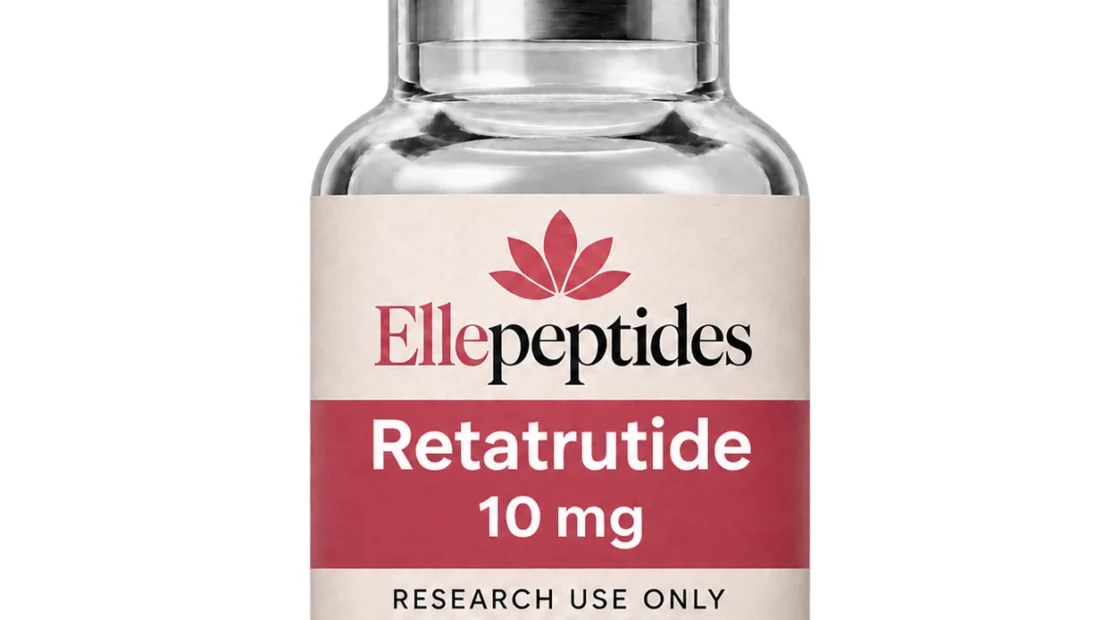
GLP-3 is not a real hormone. It is an informal nickname for retatrutide (LY3437943), an investigational peptide that switches on three hormone receptors at once: GIP, GLP-1 and glucagon. The body makes GLP-1 and GLP-2, but nothing called GLP-3, so the “3” is best read as a count of targets rather than the name of a hormone.
At a glance
- “GLP-3” is internet shorthand for retatrutide, not a hormone or a receptor.
- Retatrutide is one 39-amino-acid peptide that activates GIP, GLP-1 and glucagon receptors.
- Semaglutide targets one of these receptors, tirzepatide two and retatrutide three.
- In TRIUMPH-1, adults without diabetes saw body weight change by 17.6% to 25.0% at 80 weeks, versus 3.9% on an inactive treatment (placebo).
- Digestive effects, led by nausea, were the most common side effects in every trial.
Featured research vials
- Retatrutide (the “GLP-3”): 5, 10, 30, 50 and 60 mg. View research vials
- Tirzepatide (dual agonist): 10, 15, 20, 30 and 60 mg. View research vials
- Semaglutide (GLP-1 agonist): 5, 10, 20 and 30 mg. View research vials
- Cagrilintide (amylin analogue): 5 and 10 mg. View research vials
Table of contents
- Is GLP-3 a real hormone?
- What do the three receptors do?
- How does one molecule activate three receptors?
- What did the retatrutide trials find?
- How does retatrutide compare with GLP-1 and dual agonists?
- What side effects have the trials reported?
- What does retatrutide research show in women?
- How is retatrutide supplied for research?
- Frequently Asked Questions
- References
Is GLP-3 a real hormone?
No. The gene behind glucagon (the proglucagon gene) produces glucagon, glucagon-like peptide-1 (GLP-1) and glucagon-like peptide-2 (GLP-2), along with related fragments such as oxyntomodulin and glicentin (Sandoval and D’Alessio, 2015: proglucagon peptides; Flatt et al., 2021: proglucagon-derived peptides). The family stops at GLP-2.
Researchers describe retatrutide by what it does. The phase 2 obesity paper calls it a “triple-hormone-receptor agonist” (Jastreboff et al., 2023: phase 2 obesity trial). An agonist is a molecule that switches a receptor on, the way a key turns a lock.
The nickname lines up with a simple count: semaglutide acts on one receptor, tirzepatide on two and retatrutide on three. If you search the scientific literature or ClinicalTrials.gov, use “retatrutide” or “LY3437943”, since that is how studies are indexed.
What do the three receptors do?
All three natural hormones help the body handle food and fuel, but they come from different places and pull in somewhat different directions.
| Receptor | Where the natural hormone comes from | Main roles studied | Source |
|---|---|---|---|
| GIP (glucose-dependent insulinotropic polypeptide) | K cells in the upper gut | Boosts insulin release after a meal (an incretin) | Nauck and Meier, 2018: incretin hormones |
| GLP-1 (glucagon-like peptide-1) | L cells in the lower gut | Boosts insulin release, lowers glucagon, reduces appetite and food intake | Nauck and Meier, 2018 |
| Glucagon | Alpha cells of the pancreas | Counters falling blood sugar; possible role in energy expenditure | Sandoval and D’Alessio, 2015 |
GIP and GLP-1 are called incretins: gut hormones behind the two- to three-fold larger insulin response to glucose taken by mouth compared with glucose given through a vein (Nauck and Meier, 2018). Glucagon has long been known as a counter-regulatory hormone, the one that pushes blood sugar back up, and pharmacology studies point to a role in energy expenditure (Sandoval and D’Alessio, 2015).
That energy role is why drug designers added glucagon activity. In obese mice, the glucagon component of retatrutide raised energy expenditure on top of the lower food intake linked to GIP and GLP-1 activity (Coskun et al., 2022: retatrutide discovery).
How does one molecule activate three receptors?
Retatrutide is a single modified peptide of 39 amino acids, not three drugs mixed together. The discovery paper reported activity at all three human receptors, strongest at the GIP receptor (Coskun et al., 2022).
A fatty-acid side chain keeps the molecule circulating longer, the same design approach described for semaglutide (Lau et al., 2015: semaglutide design). A phase 1b study measured a half-life of about six days (Urva et al., 2022: phase 1b study), in line with the weekly schedules used in trials. For comparison, the tirzepatide label lists about 5 to 6 days (Zepbound prescribing information) and semaglutide’s discovery paper cites about 165 hours, roughly one week.
Tirzepatide, the dual GIP and GLP-1 agonist that came before it, is also a 39-amino-acid lipidated peptide (Coskun et al., 2018: tirzepatide discovery). Retatrutide is a separate molecule, not tirzepatide with a piece added.
What did the retatrutide trials find?
Retatrutide has been tested in obesity, type 2 diabetes, knee osteoarthritis and cardiovascular disease. These are the main results reported so far.
| Trial | Who took part | Length | Main result | Source |
|---|---|---|---|---|
| Phase 2 obesity | 338 adults with obesity | 48 weeks | Weight −8.7% to −24.2% vs −2.1% placebo | Jastreboff et al., 2023 |
| Phase 2 type 2 diabetes | 281 adults with type 2 diabetes | 36 weeks | Weight −3.19% to −16.94% vs −3.00% placebo and −2.02% dulaglutide; HbA1c down by up to 2.02 points at 24 weeks | Rosenstock et al., 2023 |
| TRIUMPH-1 | 2,339 adults with obesity, no diabetes | 80 weeks | Weight −17.6%, −23.7% and −25.0% vs −3.9% placebo | Jastreboff et al., 2026 |
| TRIUMPH-2 | 1,152 adults with type 2 diabetes | 80 weeks | Weight −11.9% to −18.8% vs −5.1% placebo | TRIUMPH-2 investigators, 2026 |
| TRIUMPH-3 | 1,949 adults with severe obesity and cardiovascular disease | 80 weeks | Weight −21.6% and −22.6% vs −3.2% placebo (efficacy estimand) | Eli Lilly, 2026 |
| TRIUMPH-4 | 445 adults with knee osteoarthritis and obesity or overweight | 68 weeks | Weight −20.0% and −23.7% vs −4.6%; knee pain scores down 62.6% to 67.2% vs 35.1% | Eli Lilly, 2025 |
| TRANSCEND-T2D-1 | 537 adults with type 2 diabetes | 40 weeks | HbA1c −1.69 to −1.94 vs −0.81 points; weight −11.5% to −15.3% vs −2.6% | Bajaj et al., 2026 |
| TRANSCEND-T2D-2 | 1,298 adults with type 2 diabetes, open-label vs semaglutide | 80 weeks | HbA1c −2.2 vs −1.8 points; weight −19.5% to −20.9% vs −9.4% (efficacy estimand) | Eli Lilly, 2026 |
Most phase 3 numbers above use the treatment-regimen estimand, which counts everyone randomized, including people who stopped. Rows marked “efficacy estimand” assume people stayed on treatment, which gives larger numbers. HbA1c is a standard blood marker of longer-term blood sugar.
How does retatrutide compare with GLP-1 and dual agonists?
Here is how the “GLP-3” sits beside the single-receptor GLP-1 agonist and the dual agonist, using each compound’s flagship obesity trial in adults without diabetes.
| Feature | Semaglutide (GLP-1 agonist) | Tirzepatide (dual agonist) | Retatrutide (“GLP-3”, triple agonist) |
|---|---|---|---|
| Receptors activated | GLP-1 | GIP and GLP-1 | GIP, GLP-1 and glucagon |
| Peptide length | 31 amino acids | 39 amino acids | 39 amino acids |
| Developer | Novo Nordisk | Eli Lilly | Eli Lilly |
| Half-life | About 165 hours (one week) | About 5 to 6 days | About 6 days |
| Flagship obesity trial | STEP 1: −14.9% vs −2.4% at 68 weeks (Wilding et al., 2021) | SURMOUNT-1: −15.0% to −20.9% vs −3.1% at 72 weeks (Jastreboff et al., 2022) | TRIUMPH-1: −17.6% to −25.0% vs −3.9% at 80 weeks (Jastreboff et al., 2026) |
| Nausea in that trial | 44.2% vs 17.4% placebo | 24.6% to 33.3% vs 9.5% (Eli Lilly, 2022) | 28.6% to 42.4% vs 14.8% (Eli Lilly, 2026) |
| Direct comparisons | Comparator in SURMOUNT-5 and TRANSCEND-T2D-2 | SURMOUNT-5: −20.2% vs −13.7% with semaglutide (Aronne et al., 2025) | TRANSCEND-T2D-2 vs semaglutide; TRIUMPH-5 vs tirzepatide ongoing |
| Sizes on Ellepeptides | 5, 10, 20, 30 mg | 10, 15, 20, 30, 60 mg | 5, 10, 30, 50, 60 mg |
The ladder is tidy, but cross-trial comparisons are rough because the trials ran for different lengths in different groups of people. The direct evidence so far comes from trials against semaglutide, and in both, the newer molecule produced the larger weight change. Lilly lists TRIUMPH-5, against tirzepatide, as ongoing (Eli Lilly, 2026: TRANSCEND-T2D-2). A fourth route sits outside this ladder: cagrilintide works through amylin receptors instead (Kruse et al., 2021: cagrilintide).
What side effects have the trials reported?
Digestive events led every trial: nausea, diarrhea, vomiting and constipation, mostly mild to moderate. Phase 3 trials also reported dysesthesia, an altered skin sensation, in 4.5% to 20.9% of retatrutide study groups versus 0.7% to 1.3% on placebo (Eli Lilly, 2026: TRIUMPH-2 and -3; Eli Lilly, 2025: TRIUMPH-4). In phase 2, heart rate rose, peaked at 24 weeks and then declined (Jastreboff et al., 2023).
Our full breakdown, with stopping rates and side-by-side tables against tirzepatide and semaglutide, is in Retatrutide side effects: what the clinical trials reported.
What does retatrutide research show in women?
Women are well represented in retatrutide research. The phase 2 obesity trial enrolled 163 women among 338 participants, and its prespecified subgroup analysis found greater percentage weight reduction in women than in men (Jastreboff et al., 2023: NEJM full report). TRIUMPH-2 included 554 women, 48% of 1,152 participants (TRIUMPH-2 investigators, 2026), and TRANSCEND-T2D-1 randomized 296 women among 537 adults (Bajaj et al., 2026).
None of these trials was built around menopause, polycystic ovary syndrome (PCOS), fertility or pregnancy outcomes, and the sources cited here do not report side effects separately by sex. For tirzepatide, the label describes lower exposure to an oral contraceptive linked to slower stomach emptying (Zepbound prescribing information); whether retatrutide does the same is not established. Related compounds are grouped in our peptides for women collection.
How is retatrutide supplied for research?
Ellepeptides lists retatrutide under its real name, as freeze-dried (lyophilized) powder in sealed 5, 10, 30, 50 and 60 mg vials, from $33.50. Reconstitution math is one division, vial mass divided by solvent volume, which our peptide calculator handles; the reconstitution guide explains the steps, and bacteriostatic water is a common preserved diluent where a method calls for one.
Storage conditions belong to the label on the vial you receive. For a wider view of the category, see our peptides for weight loss research guide and the explainer Are peptides steroids?
Frequently Asked Questions
Is GLP-3 a real hormone?
No. The proglucagon gene produces glucagon, GLP-1 and GLP-2, and the family stops there. “GLP-3” is an online nickname for retatrutide, a 39-amino-acid peptide that activates three receptors. Use the real name when you look up studies.
Why do people call retatrutide GLP-3?
The label tracks a simple count of receptors. Semaglutide activates one (GLP-1), tirzepatide two (GIP and GLP-1) and retatrutide three (GIP, GLP-1 and glucagon). Published papers call it a triple-hormone-receptor agonist or LY3437943.
What is the difference between GLP-1, GLP-2 and GLP-3?
Your body does make GLP-1 and GLP-2, both cut from the same precursor protein (proglucagon). Nobody has ever found a hormone called GLP-3; the name is only a nickname. GLP-1, released by L cells in the lower gut, is one of the two incretins behind the two- to three-fold larger insulin response to glucose taken by mouth. GLP-3 refers to retatrutide, which acts on GLP-1 receptors plus GIP and glucagon receptors.
Which receptors does retatrutide activate?
Three: the GIP, GLP-1 and glucagon receptors. The 2022 discovery paper found its strongest activity at the GIP receptor. In obese mice, the glucagon part raised energy expenditure on top of the lower food intake from the other two.
What weight change did the retatrutide trials report?
In TRIUMPH-1, adults with obesity and without diabetes saw weight change by 17.6%, 23.7% and 25.0% across study groups at 80 weeks, versus 3.9% on placebo. The earlier phase 2 trial reported 8.7% to 24.2% at 48 weeks versus 2.1%. In type 2 diabetes, TRIUMPH-2 reported 11.9% to 18.8% versus 5.1%.
Has retatrutide been compared directly with tirzepatide?
Not yet in a reported trial. Lilly lists TRIUMPH-5, a phase 3 head-to-head study against tirzepatide, as ongoing. Across separate trials, TRIUMPH-1 reported 17.6% to 25.0% weight change at 80 weeks and SURMOUNT-1 reported 15.0% to 20.9% at 72 weeks, but different designs limit that comparison.
How did retatrutide do against semaglutide?
It produced larger changes in the one direct trial. In TRANSCEND-T2D-2, 1,298 adults with type 2 diabetes saw HbA1c fall 2.2 points with retatrutide versus 1.8 with semaglutide, and weight change of 19.5% to 20.9% versus 9.4% at 80 weeks. The trial was open-label and reported by the sponsor.
What side effects were reported with GLP-3?
Mostly digestive ones. In TRIUMPH-1, nausea affected 28.6% to 42.4% of retatrutide study groups versus 14.8% on placebo, and phase 3 trials also reported dysesthesia, a tingling or burning skin sensation. Our retatrutide side effects article lists every trial’s numbers.
How long does retatrutide stay in the body?
A phase 1b study measured a half-life of about six days. That is close to tirzepatide at about 5 to 6 days and a little shorter than semaglutide at about 165 hours. Half-life describes clearance from the body, not how long powder keeps in a vial.
Were women included in the GLP-3 trials?
Yes, in large numbers. Women made up 163 of 338 phase 2 participants, 48% of TRIUMPH-2 and 296 of 537 people in TRANSCEND-T2D-1. No trial cited here studied menopause, PCOS, fertility or pregnancy outcomes.
Does Ellepeptides sell GLP-3 in the US?
Ellepeptides sells it under its real name, retatrutide, as freeze-dried powder in 5, 10, 30, 50 and 60 mg vials for laboratory research. Orders ship to addresses within the United States, with free shipping when the merchandise subtotal exceeds $200 after coupons. Search for “retatrutide” rather than “GLP-3” when comparing listings.
How does Ellepeptides shipping work within the US?
Delivery options are shown at checkout. Standard shipping is $15.99 per order, and shipping is free when the merchandise subtotal exceeds $200 after coupon discounts. Check the shipping policy for current details.
References
- Sandoval DA, D’Alessio DA. 2015. Physiology of proglucagon peptides. Physiol Rev. PubMed 25834231
- Flatt PR, Knop FK, Tarasov AI. 2021. Editorial: proglucagon-derived peptides. Front Endocrinol. Frontiers
- Nauck MA, Meier JJ. 2018. Incretin hormones: their role in health and disease. PubMed 29364588
- Coskun T, et al. 2022. Discovery of LY3437943, a triple receptor agonist. PubMed 35985340
- Coskun T, et al. 2018. Tirzepatide (LY3298176) discovery. PubMed 30473097
- Urva S, et al. 2022. Retatrutide phase 1b study. PubMed 36354040
- Lau J, et al. 2015. Discovery of semaglutide. PubMed 26308095
- Jastreboff AM, et al. 2023. Retatrutide phase 2 obesity trial. PubMed 37366315; NEJM full text
- Rosenstock J, et al. 2023. Retatrutide phase 2 type 2 diabetes trial. Lancet. PubMed 37385280
- Jastreboff AM, et al. 2026. TRIUMPH-1. NEJM; Eli Lilly topline release, May 21, 2026. Lilly
- TRIUMPH-2 investigators. 2026. TRIUMPH-2. PubMed 42810372
- Eli Lilly and Company. July 23, 2026. TRIUMPH-2 and TRIUMPH-3 results. Lilly investor release
- Eli Lilly and Company. December 11, 2025. TRIUMPH-4 results. Lilly investor release
- Bajaj M, et al. 2026. TRANSCEND-T2D-1. PubMed 42250575
- Eli Lilly and Company. October 28, 2026. TRANSCEND-T2D-2 results. Lilly announcement (PDF)
- Wilding JPH, et al. 2021. STEP 1. PubMed 33567185
- Jastreboff AM, et al. 2022. SURMOUNT-1. PubMed 35658024; Eli Lilly topline release, April 28, 2022. Lilly
- Aronne LJ, et al. 2025. SURMOUNT-5. PubMed 40353578
- Kruse T, et al. 2021. Cagrilintide development. PubMed 34288673
- US National Library of Medicine. Zepbound (tirzepatide) prescribing information. DailyMed
Explore the research catalog: see all weight management research peptides and the wider research peptide range, including retatrutide, tirzepatide, semaglutide, cagrilintide and AOD-9604, or read how we cite research. For laboratory research only. Not for human or veterinary use.