
Description
Kisspeptin-10 at a glance
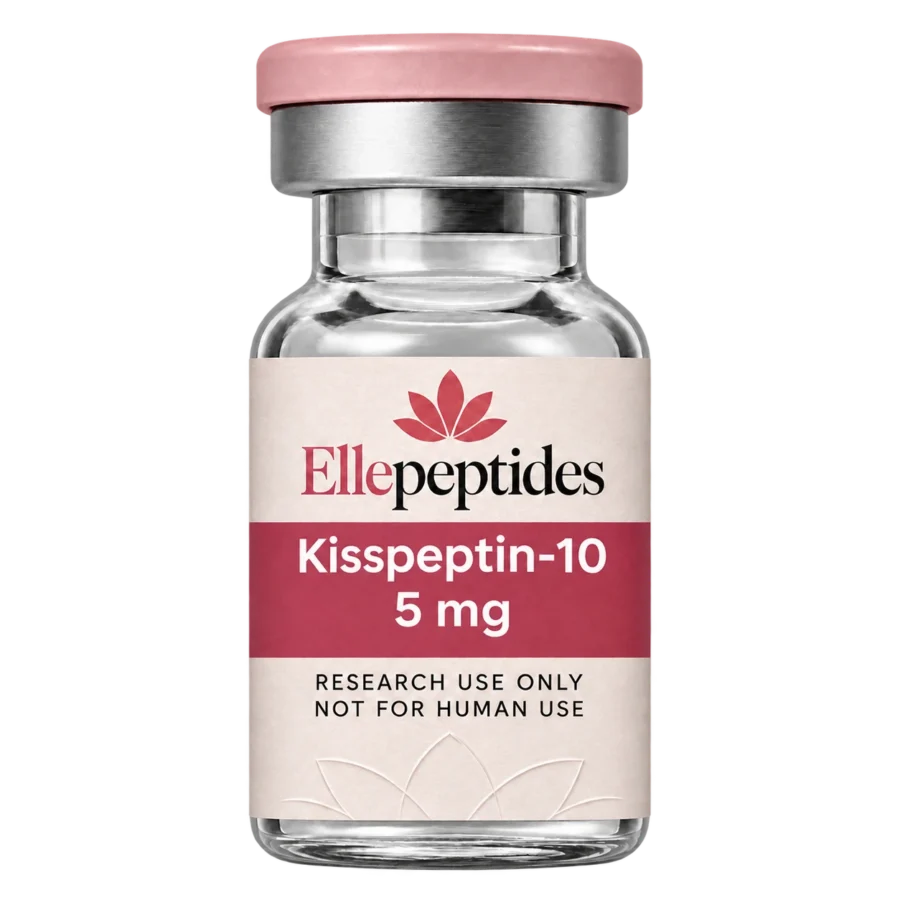
Kisspeptin-10 is the shortest active member of the kisspeptin family: a ten-residue amidated peptide (YNWNSFGLRF-NH2) that activates the KISS1R receptor, also called GPR54, upstream of gonadotropin-releasing hormone (George et al., 2011). Kisspeptin research spans puberty genetics, menstrual-cycle hormone studies in women and IVF trials, the latter mostly with the longer kisspeptin-54. Ellepeptides lists 5 mg and 50 mg vials in the Tanning & Libido category and the Peptides for Women hub.
- Molecule type: linear ten-residue peptide amide; KISS1R (GPR54) agonist
- Vial sizes: 5 mg and 50 mg
- Listed price: from $39.99 USD
- Form: freeze-dried (lyophilized) powder
- Ships within the US; free shipping once the merchandise subtotal passes $200
- For laboratory research only — not for human or veterinary use
Kisspeptin-10 vial sizes and price per mg
| Vial size | Listed price (USD) | Price per mg |
|---|---|---|
| 5 mg | $39.99 | $8.00 |
| 50 mg | $199.99 | $4.00 |
Both rows are USD list prices at the time of writing; selecting a size shows the live price beside Add to cart. Beyond the per-mg difference shown, no bulk or combination saving is promised; any coupon applies in the cart.
Kisspeptin-10 compound profile
| Catalog compound | Kisspeptin-10 |
|---|---|
| Vial options | 5 mg or 50 mg |
| Reference length | 10 amino-acid residues |
| Research receptor | KISS1R, also called GPR54 |
| Molecular reference form | Human reference peptide, amidated; counterion excluded |
| Reference CAS number | 374675-21-5 |
| Reference molecular formula | C63H83N17O14 |
| Reference molar mass | 1302.4 g/mol |
| Reference sequence and structure | YNWNSFGLRF-NH2 |
The values follow PubChem’s human Kisspeptin-10 entry (CID 25240297) and identify the intended sequence. Sequence identity on paper is not the same thing as an analysis of what a specific lot contains.
How Kisspeptin-10 works in research
The kisspeptin story began in cancer biology. In 1996, Lee and colleagues identified KiSS-1 as a gene whose expression suppressed metastasis in human melanoma cells; among normal tissues tested it was most strongly expressed in placenta (Lee et al., 1996). Its reproductive role emerged in 2003, when Seminara and colleagues showed that loss-of-function mutations in GPR54 cause autosomal recessive idiopathic hypogonadotropic hypogonadism in people and mice, with failed or delayed puberty (Seminara et al., 2003).
Kisspeptins share a C-terminal sequence that binds KISS1R. Activation of this receptor sits upstream of GnRH, which in turn drives pituitary release of luteinizing hormone (LH) and follicle-stimulating hormone (FSH) — the reason most kisspeptin studies measure gonadotropins rather than clinical outcomes (George et al.).
Length changes behavior. In male mice, kisspeptin-10 had a blood half-life of about 4 minutes against about 32 minutes for kisspeptin-54, and repeated kisspeptin-10 every 10 minutes still failed to match the sustained LH rise after one kisspeptin-54 administration; only the longer peptide activated GnRH neurons lying behind the blood–brain barrier (d’Anglemont de Tassigny et al., 2017).
Key Kisspeptin-10 studies
| Year | Study & model | What was measured | Main finding | Source |
|---|---|---|---|---|
| 1996 | Lee et al.; human melanoma cell lines | Metastasis; KiSS-1 expression | KiSS-1 suppressed metastasis; highest normal expression in placenta | JNCI |
| 2003 | Seminara et al.; affected family and knockout mice | GPR54 mutations; puberty | Mutations cause idiopathic hypogonadotropic hypogonadism | PubMed |
| 2011 | George et al.; healthy men | LH secretion and pulse frequency | Kisspeptin-10 stimulated LH and increased pulse frequency | PubMed |
| 2011 | Jayasena et al.; 35 women, 11 men | Gonadotropins by sex and cycle phase | Responses in men and preovulatory women; none in follicular-phase women under tested conditions | PMC |
| 2012 | Chan et al.; 31 women, ten-residue fragment | LH pulses across the cycle | Immediate pulse in all preovulatory and midluteal women; 5 of 10 early follicular | PubMed |
| 2014 | Jayasena et al.; 53 women in IVF (kisspeptin-54) | Egg maturation | Maturation in every study arm; clinical pregnancy 23% | JCI |
| 2015 | Abbara et al.; 60 women at high OHSS risk (kisspeptin-54) | Oocyte maturation; OHSS | Maturation in 95%; no moderate or severe OHSS | PMC |
| 2017 | d’Anglemont de Tassigny et al.; male mice | Half-life; LH | Kisspeptin-10 about 4 min vs kisspeptin-54 about 32 min | PMC |
George’s experiments in healthy men are the core kisspeptin-10 pharmacology: the peptide stimulated LH and increased LH pulse frequency under the tested conditions (George et al.). This was a hormone-release study, not evidence of fertility, sexual-function or wellbeing effects.
Kisspeptin-10 research involving women
In women, cycle phase shapes the response. Jayasena’s 2011 study recruited 35 women and 11 men; kisspeptin-10 stimulated gonadotropins in men and in women in the preovulatory phase, but not in follicular-phase women under the tested conditions (Jayasena et al., 2011). Chan’s 2012 study of 31 women, using the same ten-residue fragment, found an immediate LH pulse in all 3 preovulatory and all 14 midluteal women, but only 5 of 10 in the early follicular phase (Chan et al., 2012). Follicular-phase results therefore differed between protocols.
The best-known IVF evidence used kisspeptin-54, not kisspeptin-10. In 53 women undergoing IVF, a single administration triggered egg maturation in every study arm; embryos were transferred in 92%, clinical pregnancy occurred in 23%, and ten women gave birth (Jayasena et al., 2014). In 60 women at high risk of ovarian hyperstimulation syndrome, maturation occurred in 95%, with no moderate, severe or critical OHSS (Abbara et al., 2015).
The gaps: no kisspeptin-10 IVF trial was identified in the sources reviewed, studies are small and hormone-focused, and adverse-event reporting is limited.
Kisspeptin-10 vs PT-141, Oxytocin and Sermorelin
| Compound | Type | Main research focus | Sizes on Ellepeptides |
|---|---|---|---|
| Kisspeptin-10 | Ten-residue amidated peptide; KISS1R agonist | LH and FSH release; puberty and cycle physiology | 5 mg, 50 mg |
| PT-141 (bremelanotide) | Cyclic heptapeptide; melanocortin agonist | Desire and distress in premenopausal women with HSDD | 10 mg |
| Oxytocin | Cyclic nonapeptide; oxytocin-receptor agonist | Obstetric physiology, social cognition, sexual function | 10 mg |
| Sermorelin | GHRH(1–29)-NH2 fragment (Soule 1994) | Pituitary growth-hormone release | 5 mg, 10 mg |
All four act through hypothalamic or pituitary signaling, but on different axes. Kisspeptin-10 sits at the top of the reproductive axis; Sermorelin is its closest analogue on the growth-hormone axis; PT-141 works through brain melanocortin receptors; and Oxytocin acts on its own receptor.
Kisspeptin-10 handling, storage and reconstitution math
Storage instructions belong to the label on each vial, whichever size you choose. As general practice, unopened lyophilized vials are kept dry and away from heat and light, and a cold vial is allowed to equilibrate before opening. Concentration equals mass divided by solvent volume, so the two sizes differ sharply: as a worked example only, 5 mg in 2.5 mL is 2 mg/mL, while 50 mg in 5 mL is 10 mg/mL. The peptide calculator runs these numbers, and Bacteriostatic Water 30 mL is listed for protocols that use it.
Ordering Kisspeptin-10 in the US
Kisspeptin-10 ships to addresses within the United States. When the merchandise subtotal exceeds $200 after coupon discounts (before taxes and shipping), shipping is free; otherwise standard shipping is $15.99 per order. Delivery options and the available payment methods are shown at checkout, so please check the shipping policy for current details. Questions can go to [email protected].
Kisspeptin-10 FAQ
What is kisspeptin?
Kisspeptin is a family of peptides encoded by the KISS1 gene that activate the KISS1R (GPR54) receptor upstream of GnRH. First identified in 1996 as a melanoma metastasis-suppressor gene, it was linked to puberty in 2003. Kisspeptin-10 is the shortest active form, with ten residues.
What is the difference between kisspeptin-10 and kisspeptin-54?
They share the receptor-binding C-terminal sequence but differ in length. In male mice, kisspeptin-10 cleared from blood in about 4 minutes versus about 32 for kisspeptin-54, and produced a shorter LH response. Most IVF trials used kisspeptin-54, so their results do not transfer to kisspeptin-10.
How much does kisspeptin-10 cost in the US?
At the time of writing, the 5 mg vial is listed at $39.99 USD ($8.00 per mg) and the 50 mg vial at $199.99 USD ($4.00 per mg). The size selector shows the current price. The 50 mg vial on its own falls just under the $200 free-shipping threshold.
Where can I buy kisspeptin in the US?
Ellepeptides lists Kisspeptin-10 in 5 mg and 50 mg research vials that ship to US addresses, with the available payment methods shown at checkout. It is supplied for laboratory research only, not as a fertility or wellness product. See the shipping policy for delivery options.
What has kisspeptin research found in women?
Hormone responses depend on cycle phase. Kisspeptin-10 produced LH pulses in all preovulatory and midluteal women tested in one study, but less consistently in the early follicular phase. Separate IVF trials with kisspeptin-54 reported egg maturation in women undergoing fertility treatment. These are measured outcomes, not general benefits.
Has kisspeptin been studied in IVF?
Yes, mainly as kisspeptin-54. In 53 women undergoing IVF, a single administration triggered egg maturation, with a 23% clinical pregnancy rate. In 60 women at high risk of OHSS, maturation occurred in 95% with no moderate or severe OHSS. No kisspeptin-10 IVF trial was found in the sources reviewed.
What side effects of kisspeptin have been reported?
Adverse-event reporting in the small hormone studies cited here is limited. In the 2015 kisspeptin-54 trial of 60 women at high risk of OHSS, three had mild early OHSS and one mild late OHSS, and none had moderate or severe forms. Those figures concern kisspeptin-54 in IVF, not kisspeptin-10.
What is the half-life of kisspeptin-10?
A 2017 study in male mice measured a blood half-life of about 4 minutes for kisspeptin-10, compared with about 32 minutes for kisspeptin-54. That short half-life helps explain why its LH responses are brief. Animal pharmacokinetics say nothing about vial stability.
Does the 10 in kisspeptin-10 mean 10 mg?
No. The number refers to the peptide’s length — ten amino-acid residues. Kisspeptin-54 likewise has 54 residues. The amount of material is a separate figure: Ellepeptides lists Kisspeptin-10 in 5 mg and 50 mg vials, and the label states the nominal mass of each.
What is the difference between kisspeptin and oxytocin?
Kisspeptin acts on KISS1R at the top of the reproductive-hormone axis, so studies measure LH and FSH. Oxytocin is a nine-residue cyclic peptide acting on its own receptor, studied in labor physiology, social cognition and sexual function. Their evidence bases do not overlap.
How should kisspeptin-10 vials be stored?
Follow the storage conditions on the label of the vial you receive; they take precedence over general advice. Lyophilized peptides are usually kept dry, closed and protected from heat and light, and a prepared solution needs stability limits from your own validated method. The peptide calculator helps with concentrations.
Kisspeptin-10 references
- Lee JH et al. (1996). KiSS-1, a melanoma metastasis-suppressor gene. JNCI. DOI
- Seminara SB et al. (2003). GPR54 and puberty. NEJM. PubMed 14573733
- George JT et al. (2011). Kisspeptin-10 and LH in men. PubMed 21632807
- Jayasena CN et al. (2011). Responses by sex and cycle phase. PMC3232613
- Chan YM et al. (2012). Kisspeptin in women across the cycle. JCEM. PubMed 22577171
- Jayasena CN et al. (2014). Kisspeptin-54 and egg maturation in IVF. JCI
- Abbara A et al. (2015). Kisspeptin-54 in women at high OHSS risk. JCEM. PMC4570165
- d’Anglemont de Tassigny X et al. (2017). KP-54 versus KP-10 in vivo. PMC5413024
- Soule S et al. (1994). GHRH fragment comparison. PubMed 7962295
- PubChem. Kisspeptin-10, human (CID 25240297). pubchem.ncbi.nlm.nih.gov
Related research materials: Peptides for Women, Tanning & Libido peptides, PT-141, Oxytocin, Sermorelin and our research standards page. For laboratory research only. Not for human or veterinary use.

Reviews
There are no reviews yet.