Description
Bacteriostatic Water at a glance
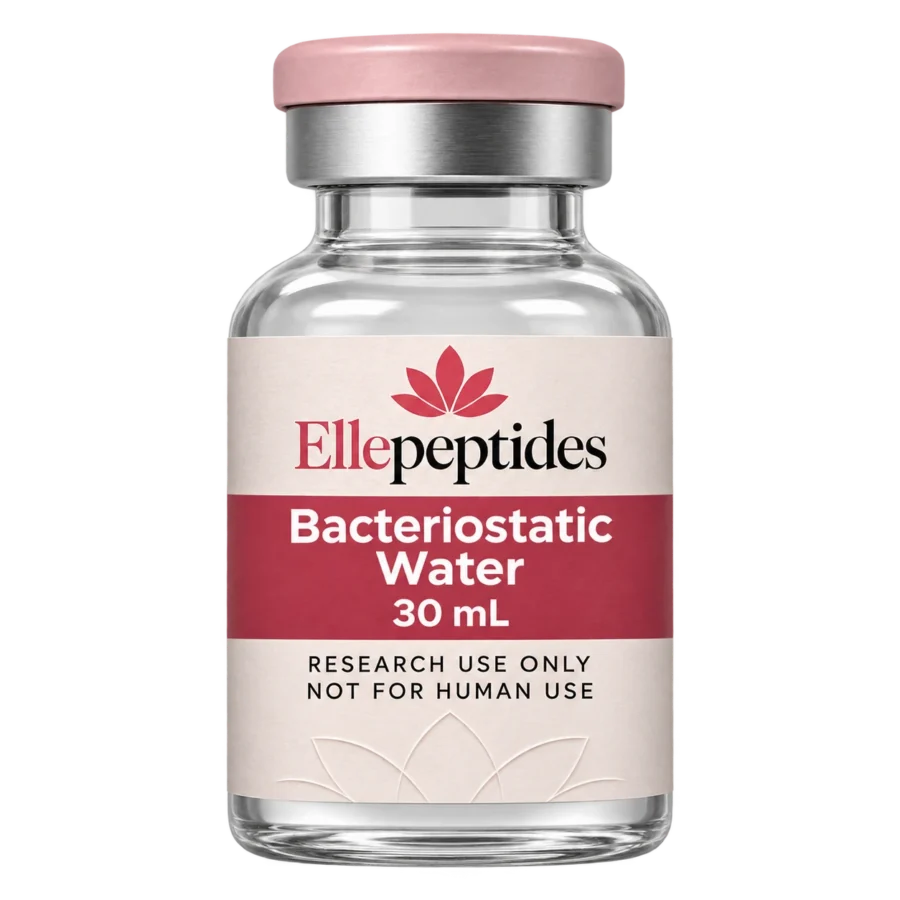
Bacteriostatic water is sterilized water of pharmacopeial quality that contains an added antimicrobial preservative, so a container can be entered more than once; in widely sold products that preservative is 0.9% benzyl alcohol. Ellepeptides lists bacteriostatic water in a 30 mL container as a laboratory supply for dissolving freeze-dried research materials. The water Ellepeptides ships is Bacteriostatic Water for Injection, USP, labeled by Pfizer or Hospira: one 30 mL multidose vial with 0.9% benzyl alcohol. Which of the two labels you receive depends on stock.
- What it is: water with one or more added antimicrobial agents (USP definition)
- Usual preservative: benzyl alcohol, 0.9% (9 mg/mL), per the Pfizer/Hospira label
- Size: one 30 mL container
- Listed price: $40.00 USD
- Shipping: ships within the United States; free shipping on merchandise subtotals over $200
- Scope: for laboratory research only; no peptide included
Bacteriostatic Water size and price per mL
| Container size | Listed price (USD) | Price per mL |
|---|---|---|
| 30 mL | $40.00 | $1.333 |
Prices are listed in USD at the time of writing, and the price shown beside Add to cart is current. Bulk or combination savings via cart or coupon are not promised. The 30 mL figure is the liquid volume in the container; it is not a concentration and says nothing about how much a protocol will use.
Bacteriostatic Water product facts
| Product | Bacteriostatic water |
|---|---|
| Listed volume | 30 mL |
| Category | Laboratory supply |
| Reference preservative | Benzyl alcohol, C7H8O, CAS 100-51-6, 108.14 g/mol |
| Preservative concentration in this container | 0.9% benzyl alcohol (9 mg/mL), as labeled by the manufacturer |
| Manufacturer | Pfizer or Hospira, depending on stock |
| Lot and expiry | Printed on the supplied vial |
| Sterility status | Per the manufacturer’s label; not claimed by Ellepeptides |
| Peptide included | No |
| Dispatch | Within the United States |
The benzyl alcohol row describes the reference chemical from the NIST Chemistry WebBook, not a measurement of this container. The 0.9% figure is the manufacturer’s labeled value for the Pfizer and Hospira vials. If your method needs the full current label, email [email protected] for the current label before ordering.
What Bacteriostatic Water is: benzyl alcohol explained
The USP monograph defines bacteriostatic water as sterilized, suitably packaged pharmacopeial water “containing one or more suitable antimicrobial agents.” It does not fix a single preservative or strength. Instead, the label must state the name and proportion of each added agent and carry the statement “not for use in newborns” in bold capitals. The same monograph limits glass containers to 30 mL or smaller.
Benzyl alcohol is the usual agent. One widely distributed Hospira product label lists 0.9% (9 mg/mL) benzyl alcohol “added as a bacteriostatic preservative,” a pH of 5.7 (range 4.5 to 7.0) and 30 mL plastic flip-top vials intended for repeated withdrawals; the same label also describes a 1.1% version. “Bacteriostatic” means the preservative inhibits microbial growth in the container between entries. It does not sterilize a contaminated vial and does not replace aseptic technique.
The newborn warning has a documented history. In 1982, CDC’s MMWR reported 16 deaths in preterm infants at two centers linked to benzyl alcohol in flush solutions and diluents, usually preserved at 0.9%, and the FDA recommended against those products for newborns. For laboratory work, the lesson is practical: benzyl alcohol is an active chemical, not an inert carrier, and it can matter to an experiment.
Key Bacteriostatic Water reference documents
| Year | Document | What it covers | Key point | Source |
|---|---|---|---|---|
| 1982 | CDC MMWR 31(22) | Benzyl alcohol and newborns | 16 preterm-infant deaths reported; FDA advised against benzyl-alcohol-preserved flushes for newborns | CDC |
| 2012 | USP 35–NF 30 monograph, bacteriostatic water | Definition, packaging, labeling | One or more suitable antimicrobial agents; glass containers of 30 mL or less; label names each agent and its proportion | USP text |
| 2012 | USP 35–NF 30 monograph, sterile water | Definition, packaging | No antimicrobial agent or other added substance; single-use containers up to 1 L | USP text |
| 2019 | Hospira (Pfizer) product label | One manufacturer’s composition and storage | 0.9% benzyl alcohol; pH 5.7; store at 20 to 25 °C; consult the solute maker for vehicle choice | Label |
| 2020 | Public Health Ontario guidance | Opened multi-use vials | Discard per manufacturer or within 28 days, whichever is shorter; date the vial; scrub the diaphragm with 70% alcohol | PHO |
| 2023 | CDC disinfection guideline | Alcohol as a disinfectant | Effective at 60–90%; alcohol towelettes used on rubber vial stoppers | CDC |
Two points from these documents are easy to miss. First, the pharmacopeial definition is broad: “bacteriostatic water” on a label does not by itself tell you which preservative is present or at what strength, which is why the label must state it. Second, guidance on how long an opened container stays in use comes from the manufacturer and from clinical infection-control bodies, not from the word “bacteriostatic.”
Because Ellepeptides ships Pfizer- or Hospira-labeled vials, the Hospira label above is the most relevant reference for this listing. Lot numbers and expiry dates still differ from vial to vial, so read the label on the container you receive.
How Bacteriostatic Water is used in research labs
In peptide research, bacteriostatic water is a common choice for redissolving freeze-dried material when a protocol calls for a preserved aqueous solvent that will be drawn from more than once. It is not universal. The Hospira label advises consulting the solute maker’s instructions for the choice of vehicle and warns that some materials are incompatible with a given vehicle or with benzyl alcohol, so the documentation for your research compound decides the solvent.
Typical bench steps drawn from these sources: use aseptic technique for every entry; do not use the liquid unless it is clear and the seal is intact; scrub the stopper with 70% alcohol, using friction, and let it dry first (an alcohol prep pad suits this); and mark the date of first entry on the container. Recording the lot number alongside your prepared solutions makes troubleshooting easier.
Bacteriostatic Water vs sterile water
| Liquid | Added preservative | USP container rule | Repeated entry | On Ellepeptides |
|---|---|---|---|---|
| Bacteriostatic water | One or more antimicrobial agents; commonly 0.9% benzyl alcohol | Single- or multiple-use; glass 30 mL or less | Designed for it | 30 mL listing (this page) |
| Sterile water | None: “no antimicrobial agent or other added substance” | Single-use only; up to 1 L | Not intended | Not listed |
| Bacteriostatic sodium chloride | Salt solution with a preservative (0.9% benzyl alcohol in the products MMWR described) | Separate monograph | Designed for it | Not listed |
The practical difference is the preservative. Sterile water has nothing added, so once opened it is treated as single-use. Bacteriostatic water tolerates repeated entry because benzyl alcohol suppresses microbial growth, but that same additive can be a problem for materials that are incompatible with it. Bacteriostatic saline adds sodium chloride as well, which changes the chemistry again. Choose the liquid your method specifies; Ellepeptides currently lists only bacteriostatic water in its lab supplies.
Bacteriostatic Water handling, storage and reconstitution math
Storage belongs to the label. The Hospira label, for example, states 20 to 25 °C, but your container’s label governs, so do not assume refrigeration or room temperature without reading it. Once a research compound is dissolved, how long that solution keeps depends on the compound’s documentation, not on the water: the same label says not to store reconstituted solutions unless the solute maker directs otherwise.
For opened containers, Public Health Ontario advises discarding per the manufacturer’s instructions or within 28 days, whichever is shorter. That is clinical guidance, but many labs adopt a similar dated-discard rule in their own procedures.
The arithmetic is mass ÷ volume. A 10 mg vial of BPC-157 dissolved in 2.0 mL gives 5 mg/mL; the same 10 mg in 1.0 mL gives 10 mg/mL. A 50 mg vial of GHK-Cu in 5.0 mL gives 10 mg/mL, and a 10 mg vial of retatrutide in 2.0 mL gives 5 mg/mL. The 30 mL in this container is simply the supply on hand. Use the peptide calculator to check your figures against the volume your protocol specifies.
Ordering Bacteriostatic Water in the US
Orders ship to addresses within the United States, with prices in USD. Shipping is free when your merchandise subtotal exceeds $200 after coupon discounts (before taxes and shipping). Otherwise, standard shipping is $15.99 per order. The available payment methods and delivery options are shown at checkout; see our shipping policy for current terms.
Bacteriostatic Water FAQ
What is bacteriostatic water?
Bacteriostatic water is sterilized pharmacopeial water containing one or more added antimicrobial agents, most often 0.9% benzyl alcohol. The preservative inhibits microbial growth so the container can be entered more than once. Labs use it to dissolve freeze-dried materials when a protocol calls for a preserved aqueous solvent. Ellepeptides lists it in a 30 mL container.
Which brand of bacteriostatic water does Ellepeptides ship?
Ellepeptides ships Bacteriostatic Water for Injection, USP labeled by Pfizer or Hospira. Each item is one 30 mL multidose vial preserved with 0.9% benzyl alcohol. The two labels are used interchangeably depending on stock, so a specific label cannot be chosen at checkout.
What is the difference between bacteriostatic water and sterile water?
Sterile water contains no antimicrobial agent or other added substance and comes in single-use containers. Bacteriostatic water adds a preservative, commonly benzyl alcohol, so it can be drawn from repeatedly. That additive is useful for multi-entry use but can be incompatible with some materials, so your protocol should decide which liquid to use.
What is 0.9% benzyl alcohol for in bacteriostatic water?
It is the preservative. At 0.9%, or 9 mg per mL, benzyl alcohol inhibits bacterial growth inside the container between entries. It does not sterilize a contaminated container and does not replace aseptic technique. Because the USP monograph allows other suitable agents, read the label on your container to confirm the preservative and its strength.
How long does bacteriostatic water last once opened?
Follow the manufacturer’s label first. Public Health Ontario’s guidance for opened multi-use vials is to discard them per the manufacturer’s instructions or within 28 days, whichever is shorter, and to mark the date of first use. Unopened, the expiry date printed on the container applies. Neither rule comes from the word “bacteriostatic” itself.
Can bacteriostatic water be used for all peptides?
No. Some materials are incompatible with benzyl alcohol or need a different solvent, and the Hospira label tells users to consult the solute maker’s instructions for the choice of vehicle. Check the documentation for each research compound before choosing a solvent, and record which liquid and lot you used with each prepared solution.
Where can I buy bacteriostatic water in the US?
Ellepeptides lists 30 mL bacteriostatic water as a laboratory supply on this page and ships it to addresses within the United States. Retail pharmacy stock varies by store and product, so ask a pharmacy directly if you want to buy locally. Wherever you buy, read the label before use.
How much bacteriostatic water should be added to a peptide vial?
That depends on the concentration your protocol specifies; this page does not suggest volumes. The relationship is fixed, though: concentration equals vial mass divided by solvent volume. A 10 mg vial in 2.0 mL gives 5 mg/mL. The peptide calculator does this arithmetic and checks it against your target concentration.
How should bacteriostatic water be stored?
Store it as its label directs. The Hospira label specifies storage at 20 to 25 °C; the label on the vial you receive governs. Keep it sealed until first use, date it once opened, and do not use it unless the liquid is clear and the seal intact.
Is bacteriostatic water the same as saline?
No. Bacteriostatic water contains water and a preservative, with no salt. Bacteriostatic sodium chloride, sometimes called bacteriostatic saline, is a separate product that contains sodium chloride as well as a preservative such as benzyl alcohol. The two are not interchangeable in a protocol. Ellepeptides lists bacteriostatic water only.
Why does bacteriostatic water say “not for use in newborns”?
The USP monograph requires that statement on the label because of benzyl alcohol. In 1982, CDC’s MMWR reported 16 deaths in preterm infants linked to benzyl-alcohol-preserved flush solutions and diluents, and the FDA recommended against those products for newborns. The warning shows that the preservative is chemically active, not an inert ingredient.
Does the 30 mL bacteriostatic water come with a peptide?
No. This listing is the water supply alone. Research compounds such as BPC-157 or GHK-Cu are separate catalog items, and you can add them to the same order. Browse the research peptides collection to find them, then check each compound’s documentation for a compatible solvent.
How much does bacteriostatic water cost?
Ellepeptides lists the 30 mL container at $40.00 USD at the time of writing, or about $1.333 per mL. The price beside Add to cart is current. If your order, after coupon discounts, brings the merchandise subtotal above $200, shipping is free; otherwise standard shipping at $15.99 applies.
Bacteriostatic Water references
- CDC. 1982. Neonatal deaths associated with use of benzyl alcohol, United States. MMWR 31(22):290. cdc.gov
- United States Pharmacopeia. USP 35–NF 30 (2012). Monograph: bacteriostatic water. Reproduced text
- United States Pharmacopeia. USP 35–NF 30 (2012). Monograph: sterile water. Reproduced text
- Hospira, Inc. (Pfizer). 2019. Bacteriostatic Water, USP: product label. labeling.pfizer.com
- Public Health Ontario. 2020. Updated guidance on the use of multi-use vials. publichealthontario.ca
- CDC. 2023 (last reviewed). Guideline for disinfection and sterilization: chemical disinfectants. cdc.gov
- NIST Chemistry WebBook. Benzyl alcohol, CAS 100-51-6. webbook.nist.gov
Related research materials: Lab Supplies, Alcohol Prep Pads (200 pack), BPC-157, Retatrutide, GHK-Cu and the peptide calculator. Browse everything in the shop or read about our approach on the research page. For laboratory research only. Not for human or veterinary use.

Reviews
There are no reviews yet.